Concerning Life as It Is Supposed to Be

Month: May 2018

Preparing for Silence

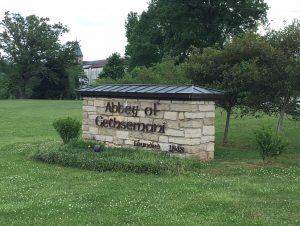
A week ago Monday I pulled into the grounds of the Abbey of Gethsemani, a Trappist monastery set in the beautiful rolling hills of Western Kentucky. Gethsemani is home to brothers of the Cistercian Order of the Strict Observance. At Gethsemani the monks (including author Thomas Merton until his death in 1968) continue the monastic disciplines of prayer, silence and labor as it has been practiced there for the past 170 years and around the world for nearly a millennium. For ordinary people like me the Abbey provides a place where one might sample a period of silence and reflection, and so I had come.
I was directed to a modest third floor room that would be my home for five days. It had once housed a monk for life. On the desk were a schedule of meals and times of prayer and the ubiquitous FAQ answers. Were I in charge, I’d add a page to that stack to adequately prepare new ‘retreatants’. It would say something like this:

  1. Be prepared to be silent. There are specified places for talking, but signage nearly everywhere reminds one of the rule of silence. Shocking as this may be to us used to constant noise, it IS a balm to one’s inner introvert.
  2. Be prepared to be silent. I know. I already said that. But your hosts mean it. You will find yourself wondering whether to say things like ‘excuse me’ and ‘thank you’ (you may). You will need to suppress the urge to ask others for their names and hometowns and stories. They will remain strangers. But they are there to hear from God, not you. So, as much as this is a challenge to your inner extrovert, be silent.
  3. Be prepared to be well fed with three precisely timed (7:00, 12:30, and 6:00) meals of simple and wholesome food.
  4. Be prepared to not find beer. These are not the Trappists who brew. These ones make fruitcake and fudge. Sorry.
  5. Be prepared to look at these men as if they are some kind of zoo animal. (“O, look! There goes one!”) Monks are rare, after all.
  6. Be prepared to climb. There is an elevator that serves the newer portion of the retreat house, but it is so slow that I fear if I entered with a green banana on the ground floor it would be rotten by the third. To get a cup of tea from my room required 140 stairs. I counted. Of course I did.
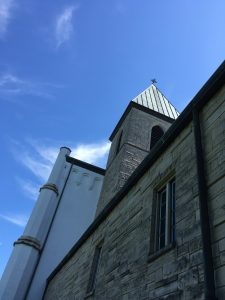
  7. Be prepared to be awakened at 3AM by the bell in the bell tower. (Your
    The Bell

    window is open because there is no AC in these rooms. The bell therefore sounds like it is hovering, oh, three feet above your bed.) Vigils are at 3:15 (followed through the day by lauds, terce, sext, none, vespers, and, before bed, compline). These monks are serious about prayer and think you might want to join them. Even at 3:00AM. (I did. Once.)

  8. Be prepared to be drawn into these rhythms of prayer and psalm. I found myself at times checking my watch so that I might sit in the back of the church and bring my own heart and its concerns to their scheduled times of prayer.
  9. Be prepared to be different – to not like it. Some of us don’t like silence. Some of us reflect better in a library surrounded by books or in a coffee shop with a laptop than we do sitting in a garden or in a church. That’s okay.
  10. Be prepared to sleep. It’s not being lazy. It’s called rest.

I left my ‘cell’ early Friday, summoned by the 3AM bell, trudging down 70 stairs and out into the darkness and back to the ‘real’ world. I left having grown fond of the place in spite of its oddities.

And I left sent on my way by prayer, by men devoting their lives to that “useless” endeavor.

Theodicy and the Cross

Tuesday morning my wife and I read together these words:

How long, O LORD? Will you forget me forever?
How long will you hide your face from me?
How long must I take counsel in my soul
and have sorrow in my heart all the day?
How long shall my enemy be exalted over me? (Psalm 13:1, 2)

In my experience, “How long” questions generally morph into “why” questions and when those who ask them don’t hear an answer from God they often ask their pastor. When asked I would love to answer with words that make the pain disappear. I listen and empathize as a fellow struggler.

That day that began with these questions ended with the terrible news of a friend’s tragic and sudden death.

Kevin Collins was a faithful minister of the Gospel, a servant who had given his life (that part not irretrievably captured by his love for the University of Tennessee!) to Christ and his church. As such he had loved and ministered to me and served and strengthened the church I pastor. His kindness was legendary and his pastoral heart irrepressible. I was shaken by this and was reminded how often death steals from us the things, the people, we love.
Why, God? How long shall our enemy be exalted over us?

Our souls cry out for explanations that satisfy our hearts. We want what theologians call a theodicy, a justification of the ways of God, an explanation of how evil can seem to still exert sway in a world purportedly governed by a loving God. We want a word to satisfy the ache in the heart caused by death.

God, however much we might plead, chooses not to answer all our questions. The scriptures do not exist to assuage our curiosity but to ensure our salvation. What we are told is that in the light of the cross, no matter how great the inexplicable evil around us, there are no grounds for questioning the love of God for us nor his devotion to our welfare. The God whose ways we so often question leaves us no question of his love for us.

By this we know love, that he laid down his life for us…. (1 John 3:16)

In this is love, not that we have loved God but that he loved us and sent his Son to be the propitiation for our sins. (1 John 4:10)

No matter what we face, we need to be once again stunned by the depth of the love of God in the cross.

“We learn from John [1John 3:16, 4:10], then, that although in this world our attention is constantly arrested by the problems of evil and pain, which seem to contradict God’s love, we will be wise not to allow it to be deflected from the cross, where God’s love has been publicly and visibly made manifest.” (John Stott, The Cross of Christ)

God’s love has been revealed to us in a dazzling and objective display of sacrifice. Will he who died for us not care for us in every other way?

We will still not understand the evil we experience. Life will continue to confuse us. Hard things will come. Questions will be asked. We will not get the answers we want. It is then we must look to the cross and know the unwavering love of God for us.

Senator Rubio’s Instructions on Prayer

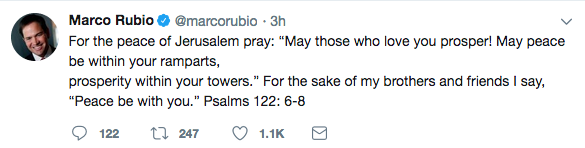
On Monday Florida Senator Marco Rubio tweeted

For the senator this was a good political move. It will stir his base and none can argue a prayer for peace. Points all around.

And yet this vexes because it plays into a common misreading of the psalm to which it refers, a misreading which often poisons evangelical political thinking.

The Psalms of Ascent, of which Psalm 122 is one, were hymns of hope sung by Jewish pilgrims traveling to Jerusalem for one of Israel’s annual feasts. Jerusalem was their focus because it was where God’s house was.

I was glad when they said to me, “Let us go to the house of the LORD!” Our feet have been standing within your gates, O Jerusalem! (1, 2)

Jerusalem fills the psalmist’s heart not as a piece of real estate or civic entity but as the place where God is. It was a place of worship and a place of justice. It was held in his heart as the place where things are as they are supposed to be.

Jerusalem— built as a city that is bound firmly together, to which the tribes go up, the tribes of the LORD, as was decreed for Israel, to give thanks to the name of the LORD. There thrones for judgment were set, the thrones of the house of David. (3-5)

This is the psalmist’s vision, but it is an idealized vision. He is aware of the city’s inability to effect all he longs for and so his hope is seated in Jerusalem as a symbol of what God will and can do when he dwells among his people, not in the city itself.

The failure of the physical Jerusalem moved Jesus to tears.

“O Jerusalem, Jerusalem, the city that kills the prophets and stones those who are sent to it! How often would I have gathered your children together as a hen gathers her brood under her wings, and you were not willing!” (Matthew 23:37)

Jesus did not weep for the city per se (cities don’t throw stones) but for the people the city represented. The city stood as the symbol of the people among whom God was determined to dwell, the people who bore his covenant promises. And so Jesus spoke of the destruction of the city (which came) and the consequent re-centering of those covenant promises in his church.

The psalmist is making a pilgrimage to a city which would fall under judgment and eventually be destroyed. But the hope his pilgrimage represented would not be touched. It would be relocated.

We all ache to be in that place where God is. The Jerusalem the psalmist longs for and is heading for and longs to be a part of is a society in which worship is unfettered, where judgment is rich with justice and mercy, and where God’s people are one. We long for the garden, for that deep impulse to be in naked fellowship with our God and with one another, and it is a longing that will be fulfilled. But it will be fulfilled by a city God brings from above, not one that is built on earth.

In the meantime, the hope and the prayers encouraged by this psalm are not for the protection of the residents and political stability of a city in Israel, appropriate though such prayers might be. The prayer this psalm encourages is for the peace of that people and that place where God’s worship is now centered, and where now God’s purposes of justice and unity are now worked out. To pray for the peace of Jerusalem is to pray for the stability, purity, and prosperity of the church.

I’m going to go out on a limb here and suggest that this is not what Sen. Rubio had in mind.

The Exact Book

A popular eatery in town has fun asking customers to identify their orders by  answers to questions and not by name. One’s order may be identified by The Beatles if the month’s question is “What is your favorite band” or by “Main Street” if the question is “On what street did you grow up?” This month’s question is, “With whom would you most like to have lunch?” Being there with my wife, I knew the correct answer on that occasion. I have a hunch, though, that most people populated their answers with the names of famous people. Fame and celebrity dictate our interests.

And our reading choices. And that can be a shame.

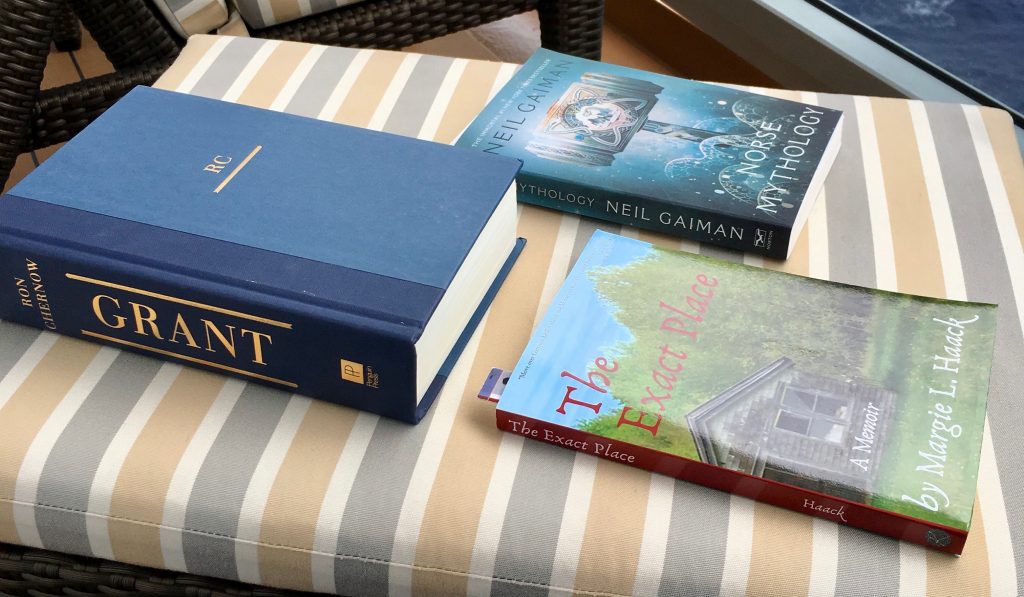
Faced with a choice of what to read recently, my choices narrowed to three: Ron Chernow’s biography, Grant, Neil Gaiman’s retelling of Norse mythology titled, not surprisingly, Norse Mythology, and Margie Haack’s memoir, The Exact Place. Chernow wrote the biography that inspired Lin Manuel Miranda to create the Broadway hit Hamilton. Gaiman is the masterful storyteller both dark and delightful behind movies as diverse as Coraline and Stardust. And if we ask “Who is Margie Haack,” Wikipedia has no idea. Some know her as one of the key persons, with her husband Denis, behind a ministry called Ransom Fellowship. If fame was the deciding factor in my choice, Haack would not be in the race.

To help my choice, I read the first ten pages of each.

Fame be damned.

The Exact Place winsomely tells Haack’s story of being raised by her mother and stepfather on a farm in a piece of rural northern Minnesota that should be Canada. The family’s house gave up no floor space for bathroom facilities (those being conveniently located in a separate building) but it was still small for a family of eight. The neighbors were memorable, some for their primness, some for their libertine tendencies, some for the terror they would bring. All the delights and hardship of such a life are lovingly told. Life, death, love, and bringing the horse into the house. Lack was normal, family ties were tight, and life was mostly okay.

Mostly.

There is an ache in these pages as she reveals her deep longing for the love of a father. She carefully unfolds this longing and weaves it through the story of her spiritual awakening, finding in God the love her heart was unable to find elsewhere. She lets her stories reveal this longing, its frustration and its satisfaction, without any tone of preachiness. Content with gentle nudges she helps us see the longing to be known and loved we all possess. I felt befriended and confided in, not lectured. There is power in that.

At times, fame is deserved. I’m now reading Grant and it is worth the praise it brings for Chernow. But lack of fame is not necessarily a reflection on quality. The Exact Place is s a wonderful book that was agented and rejected by thirty-five publishing houses before being given life by Kalos Press, a small independent publisher. I get that larger publishers must base their decisions on what will sell. They know that a book such as this by a relatively unknown, though profoundly gifted, author would not sell in the numbers they needed. And so they passed on giving it the kind of visibility they could give.

But this is our fault and not theirs. As readers we flock to the well known often over the well written. We prefer the Chernows and Gaimans and neglect the Haacks. And we are all the poorer for it.

🕰 Books Worthy of Your Time 🕰

I had occasion the other day to resurrect all the book reviews I’ve written and posted on this site. For ease of access I’m posting them all here and taking the opportunity to categorize them.

The first groups the books I have read or would be likely to read more than once. Being worth such time, I’ve awarded them four “clocks.” 🕰🕰🕰🕰

The second grouping, receiving three “clocks,” 🕰🕰🕰, is for those that I genuinely liked. They are quite worthy, but did not have the same impact on me as those in the first.

The third lists books for which I did not much care. 🕰🕰,

And the fourth are books which I would not encourage any to invest their time. 🕰

I don’t start to read books I’m not likely to like. So, for books to end up in the bottom two categories means that these were books that I entered hopefully and was subsequently greatly disappointed.

These are only the books I’ve taken the time to write about. I could populate each category with many more selections, as could you.

I’m interested in hearing from you, especially if you disagree with my rankings.

🕰🕰🕰🕰
Cry, the Beloved Country

Knocking on Heaven’s Door

Moby Dick

Gilead and here

The Brothers K

Summerland

The Miraculous Journey of Edward Tulane

At Large and at Small

Matterhorn: A Novel of the Vietnam War

The Jesus Storybook Bible

How Starbucks Saved My Life

The Elegance of the Hedgehog


🕰🕰🕰
Between the World and Me

Hillbilly Elegy

Strange Glory

Surviving Ministry

Being Mortal

The Name of the Wind

The Wright Brothers

George Whitefield: America’s Spiritual Founding Father

In the Garden of Beasts

Amazing Grace: A Vocabulary of Faith

Just Do Something

1776

The Bullpen Gospels

New Bible Commentary

Physics for Future Presidents

The History of the Ancient World

Tinkers

Mornings on Horseback

The Man Who Loved Books Too Much

Crazy Love

Counterfeit Gods

The Color of Water


🕰🕰
Prayer: Experiencing Awe and Intimacy with God

The Pastor

The Silence of Adam


🕰
Bonhoeffer: Pastor, Martyr, Prophet, Spy and here.

With Reverence and Awe

A Resilient Life

A Reader/Pastor/Preacher/(Writer?) Attends the FF&W

[For a spell I was away from my computer and easy access to the internet. Five thousand miles away, in fact. Hence, this post is a bit dated but I hope not wholly disposable.]

* * * * *

Off and on I ponder what God might want to do with my impulse to write.

That’s a lie, of course. I think about it all the time.

Writing is a large part of what I do as a pastor. But there are those who encourage me to push my writing to a larger platform. Such urgings stir something inside of me which I sometimes ignore. Other times, I feed them, as I did in April by attending the Festival of Faith and Writing, a biennial writers’ conference hosted by the Calvin College Center for Faith and Writing.

The attractiveness of this event is conveyed in this summary of the event’s history:

“Since our first gathering in 1990, we have been privileged to host hundreds of writers, including Maya Angelou, John Updike, Elie Wiesel, Marilynne Robinson, Zadie Smith, Miroslav Volf, Salman Rushdie, Chimamanda Ngozi Adichie, George Saunders, Christian Wiman, Jonathan Safran Foer, Tobias Wolff, Nadia Bolz-Weber, Mary Karr, Joyce Carol Oates, Philip Yancey, Anne Lamott, Ann Voskamp, and Michael Chabon.”

One need not have writerly aspirations to be drawn by such a lineup. My wife (who cannot understand why anyone would want to write) thoroughly enjoyed attending with me. She was moved by the presentations of Walter Wangerin, Jr. and Kate Bowler touching upon suffering and joy, and she was challenged by a number of panel discussions on racism and diversity in contemporary publishing and church life. Books create community among readers. To meet and interact with their authors enriches that experience of community.

We both were particularly engaged by Kate Bowler, a young professor of church history whose cancer diagnosis two years ago spawned her wonderful book Everything Happens for a Reason (and Other Lies I’ve Loved). She has not yet escaped this diagnosis. She is still on a journey that may result in her early death. Her affirmation of life, that it is both beautiful and awful, is necessary for us all to hear. “I am not special,” she pointed out, meaning that sadly many, many others are on her path. This was confirmed during the question and answer period as one person after another stood up to ask questions preceded by statements of context, “My brother/mother/wife/friend has cancer/is bedridden/is suffering….” Her voice is a hopeful one in this broken world, and her voice draws people into a community of hope.

As a pastor with a conservative bent, I found myself sailing an unfamiliar ocean of theological diversity. I suspect that some of the nearly 2000 people in attendance are moored in the same theological harbor as I. Others, though, clearly sail from different ports and some struck me as genuinely adrift. I am grateful for my rootedness in historic Christianity. I find security in the sound doctrine and clear definition given by the creeds of the church and I find no need to jettison any of that (even if I had the right or desire to do so). When people differ it is easy from a distance to pass judgment and to condemn. When, however, I meet these people, when I have coffee with them or engage them in conversation, they become people with real questions and concerns. I may still disagree with them, but I am moved to treat them with greater charity and to ponder how my well moored theology might bring answers to the questions and struggles that they raise. Though uncomfortable this is good.

All the while, the preacher in me was moved to preach. And this came from a surprising source. The church in which I serve does not ordain women to ministry and does not permit them to preach. Consequently I did not expect to have my flickering belief in the power of preaching so magnificently fanned into flame by a woman preacher. Fleming Rutledge, one of the first women ordained as a priest in the Episcopal church, is renowned as a preacher in many circles. (She has recently been widely praised for her book, The Crucifixion.) She spoke passionately on the power of the word of God preached. Her words challenged me to remember what I often forget. There is power in the word preached. The Holy Spirit of God carries that word forward to the hearts of His people. It is a great privilege as a preacher to stand in the pulpit every Sunday and participate, not in a show or display of oratorical or rhetorical prowess but in the work of God among his people. She moved me to want to preach fourteen weeks before I will be able to do so again.

As a reader, as a pastor, and as a preacher I benefited. But as a writer? Did attending confirm my impulse to write? One session, wonderfully titled “Publish or Parish?” featured a panel of men and women (including Lauren Winner) all who have found ways to balance pastoring a church with their writing . To this panel I posed the question, “Is writing a hobby or a calling?” Their unwavering answer was that if it were a hobby, they would have abandoned it long ago.

I’m not so sure. I’m still processing whether this is a part of my calling or just a notion that needs to be put to bed. If it is calling, the question becomes what will or should I do to serve that calling? The jury is still out on that.

Powered by WordPress & Theme by Anders Norén