Randy Greenwald

Concerning Life as It Is Supposed to Be

Calvin the Poet?

John Calvin was known for his theology and not for poetry. However, this snippet from the introductory sections on the Christian life if not poetic is at least lyrical, and shows just how readable Calvin really is.

This is worth sharing. And pondering.

We are not our own:
let not our reason nor our will therefore sway our plans and deeds.
We are not our own:
let us therefore not set it as our goal to seek what is expedient for us according to the flesh.
We are not our own:
in so far as we can, let us therefore forget ourselves and all that is ours.

We are God’s:
let us therefore live for him and die for him.
We are God’s:
let his wisdom and will therefore rule all our actions.
We are God’s:
let all the parts of our life accordingly strive toward him as our only lawful goal.

from John Calvin, Institutes of the Christian Religion, 3.7.1

The History Channel Bible

I heard about the History Channel’s broadcast of a Bible mini-series through predictable channels – the buzz through evangelical church culture that we should all watch this so that major media outlets would produce more like it.

I’m not moved by such marketing ploys. I did feel some sense that I SHOULD watch the first installment so as to be able to responsibly review what I believed others would be watching. But I didn’t even do that.

However, my friend Bill is a much more fair and honest critic of culture and of the contemporary religious scene than I. He has done us a favor and issued a generally favorable review of the first segment of this series. Bill has the background and grace to do this well. His wisest point was his reminder that we live in a biblically illiterate age, so that ANYTHING that in a reasonably accurate way tells the bible’s stories is going to be a helpful thing.

Much more critical was a review published in the NY Times. Interesting to me was that this review did not, as we might expect, take shots at the series’ attempt to be biblically faithful. Rather, the reviewer felt that the series falls short of really capturing the grand flow and passion of the whole bible. The series gives snapshots of biblically reported events but fails to root them in an overall narrative. That seems like a fair critique, as Bill as well compares the series to the bible story books of our collective youth.

The NY Times reviewer notes that

By taking on the entire Bible, even at 10 hours in length, Mr. Burnett and Ms. Downey force themselves into a clumsy “Bible’s greatest hits” approach. This doesn’t serve the source material — so rich in interconnections across time — very well, and it doesn’t make for very involving television.

and then suggests

Those looking for something that makes them feel the power of the Bible would do better to find a good production of “Godspell” or “Jesus Christ Superstar.”

Well, in my mind, perhaps not. Rather those looking for something that makes them feel the power of the bible arising from is marvelous interconnections across time would do better to find a good church and a faithful pastor/preacher whose goal it is to do just that.

Lenten Fast

Predictably this time of year debates ramp up over the propriety of the observance of Lent in the Church. I’m not interested enough in those debates to enter into them now. What I can affirm is that properly framed, fasting is good and commended by Jesus. And I can also testify that fasting from anything is anathema to me because the stuff I love, I love. I don’t let go easily.

But I’m fasting this Lent, and am loving it.

I’m a naturally introspective person. And generally, when I turn my thoughts inward, I don’t like what I see. My sin, my weakness, my personality defects, my lack of faith, often overwhelm me. And I can’t seem to help it.

Consequently, when I read the scriptures, I don’t see the kindness and compassion of God. I see more readily my inability to hold on to God’s promises, I see my weak commitment to holiness, I see commands that I’ve been unable to keep.

THAT is what I’ve decided to give up for Lent.

My focus this season – and one hopes there is a lasting effect – is to read Scripture with the goal of simply seeing my Savior. I read and reflect upon the attributes of God. I’m not allowed to ponder long my defects along the way.

I’m not expecting this to give me a whole new personality. I’ll still be far too quick to note my faults and highlight my failures. But perhaps incremental progress will matter in the long run.

A guy who cares too much about his appearance will look in the mirror and see only the mole on his nose or the hair out of place. Such a focus will wear him down to the place he can see nothing good. The remedy is to take his eyes off himself and look at the beauty of the One who loves him without concern for his appearance.

I’ve put away the mirror for Lent. Care to join me?

Djesus Uncrossed?

I’m sincerely interested in what those who read this blog think of the recent SNL production based upon the revenge movies of Quentin Tarantino and starring Tarantino’s favorite Christopher Waltz. Is it good humor or blasphemy? I want to hear others’ opinions before I share my own.

I have been for some reason unsuccessful in embedding the clip here. So here is the link to the video on the NBC site.

That link was not working on Chrome or Safari for me (Firefox seems to work fine), and so if you are having trouble, you can view the clip here.

Warning: if you have NOT seen this and are bothered by Tarantino-style blood and gore you should not watch this!

Let me know what you think.

Book Notes

As has been noticed, I don’t have much chance to blog these days. The schedule simply does not allow it. I’m sad about that and hope someday to pick the pace up again.

I did, however, want to take a moment to post a couple of notes about books read and being read.

Over twenty-five years ago I read William Manchester’s first two volumes in his biography of Winston Churchill. I reported earlier that I had recently been able to purchase both volumes and was going to reread them.

Then for Christmas I was given the third volume. I was about to skip the first two and read the third, but a friend on Sunday reported that he was re-reading the first two, and so that is what I’ve begun. I’m only 30 pages in, but I am reminded of the depth and interest of Manchester’s writing and of the fascinating subject that Churchill is. When I read some biographies, I get information. When I read Manchester, I get an education.

I’m glad I’m starting over. Reading all three, of course, may be a year-long endeavor!

The other note I wanted to share was one additional bit from Michael Chabon’s Summerland which I mentioned on Monday. His writing in this book at times sparkles. For reasons I can’t fathom, I loved his account of a giant’s temper tantrum. The account runs three pages, which I can’t excerpt here. But a taste:

“He sputtered and raged; he snorted and choked on his own saliva. He threatened punishments and uttered oaths so heinous and foul that even to summarize them here in mildest of terms would curl the very pages of the book you are holding and make your hands and fingertips hum as if they were swarming with bees.”

Summerland

For a while I’ve been urged to read something by Michael Chabon, a Pulitzer prize winning contemporary novelist. When I picked up his 2002 novel Summerland and scanned the blurb on the back, I knew I had my point of entry. A fantasy novel with baseball at its core – it begged to be read.
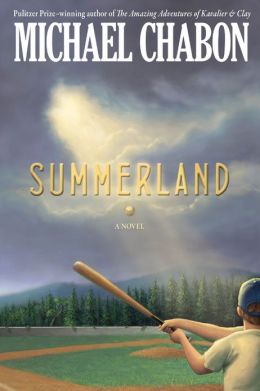
SummerlandI’m not qualified or able to give a proper review of the book. Reviewers tend to suggest that the book fell short of its potential. As a ‘young adult’ fantasy, it is measured by a certain Hogwartian Wizard. The book was sometimes hard to grasp because so many of the creatures and characters had to be explained. Much new had to be learned before the pieces began to make sense. The pace picked up, however and I found myself well immersed in the last third and intrigued to see the end.

Perhaps this was not Chabon’s, or the genre’s, best. I’m not qualified to tell. But there were gems buried here that made the book a delight for THIS reader.

I know little of Chabon, but he has to be a lover of baseball. He has to be one who understands and appreciates the game.

“A baseball game is nothing but a great slow contraption for getting you to pay attention to the cadence of a summer day.”

He writes with such delight in his subject and in the game:

“The truth was that Sasquatches have never been passionate about baseball.”

And he sees how baseball can be the context for explaining so much else:

“Can you see love? Can you touch it?”
“Well,” Ethan said, hoping it was not a trick question. “No, love is invisible and untouchable, too.”
“And when your pap puts on that big Roosters jersey of his, and sits there watching you in the bleachers with the smile never leaving his face? And slaps palms with you after a game even though you struck out four times looking?”
“Huh?” Ethan said.
“Some things that are invisible and untouchable can nevertheless be seen and felt.”

Most fascinating, though, are the themes in the book which, if not Christian in origin, are able to be read in a Christian way. The villain is a creature named Coyote who, in our world, is known as Satan, who says:

“I would like to put an end to existence as we know it.”

His ultimate aim is to poison the universe at its root, but along the way, he ruins what makes life enjoyable. Any traditional baseball fan will appreciate that Coyote entered one world and began to whisper to the inhabitants that the game was boring:

“Is there anything duller in the game of baseball than watching the pitcher hit? Pitcher goes up there, if she even gets the bat off her shoulder it’s to give it a few weak waves like she’s shooing a little moth away. And then, big surprise, three or four pitches later, she’s out. Well,…why does the pitcher have to hit?…Let somebody else hit for the pitcher. One of the old-timers, somebody whose legs, maybe they’re not what they were….

Now we know the origin of the designated hitter rule. It IS the end of the world as we know it.

Coyote’s goal is to undo the creation. Whether he is able to do so or not, I suppose, should be left unsaid here. But the last section perhaps is reflective of what I have heard elsewhere, that Chabon is a fan of Tolkien and Lewis. Reading it made me wonder if he might also be a fan of N. T. Wright, or of the Bible itself.

Cracker Jacks and baseball are forever linked. One may not like everything that is in the box of Cracker Jacks, but there is always a prize that makes eating them worthwhile. So, too, is this book full of prizes worth seeking.

Oh, Starbucks

Starbucks, you’ve done it again.

As much as I try to fault you when thinkgs are not quite up to my hopes, you have a way of reclaiming my affection.

Today I was working in my Willasprings Starbucks corner office waiting for the line to shrink to a stage which would allow a quick trip to the bar.

I ended up in the line behind the store manager, Helen. That she was in line like the rest of us said something in itself. We spoke a bit about her plans for the day and about the busy-ness of the store. When her turn came to order, I joked to the clerk behind the register, “I’m with her.”

I was joking, Helen. We were supposed to laugh and go about our business.

She wouldn’t leave it there. She turned to the clerk and said, “He’s with me” and then to me said, “What do you want?” I protested, but the clerk already knew that I order the same thing every time, and so she rang it up, and that was that.

Small acts of kindness, to be sure. But it’s the small things that keep us coming back. To Starbucks, yes. But also to the church.

UPDATE: Of course, just because you’ve been kind does not mean that we can’t still have some fun at your expense. Here is SNL’s take on your new Verismo machine. Classic.

Chapter 37 and Holding

Community groups at the church I pastor are looking this year at the stories of various biblical characters, thinking through them in the light of our own stories. It is a dual purposed vision of engaging scripture as well as coming to know one another better. It has generally worked very well.

This past Sunday, the group of which I’m a part considered Genesis 37. Genesis 37 introduces us to Abraham’s great-grandson Joseph and his relationships with his father and siblings. Dysfunction does not seem to be a strong enough word to describe this family. Eventually things fall apart so terribly that his brothers decide not to kill Joseph, which was their first impulse, but to sell him into slavery.

I’m not sure too many families are dealing with their dysfunction that way, but I think we all can identify with family life falling short of what we might imagine as an ideal.

We were asked then to consider what we learn about God from the passage. Our general answer was either “nothing” or “he’s absent”. But then it was argued that he was not absent, though he is not mentioned in the chapter. It was pointed out that in Genesis 50, when all was resolved, that Joseph is able to see God’s hand in the whole mess as moving purposefully through his life and the lives of his brothers.

But Joseph said to them, “Do not fear, for am I in the place of God? As for you, you meant evil against me, but God meant it for good, to bring it about that many people should be kept alive, as they are today. (Genesis 50:19, 20)

This was true, others of us argued, but we are not being asked what we learn about God from chapter 50, but what we learn about him in chapter 37. We found it terribly frustrating to try to make sense of chapter 37 without being given recourse to the later chapters.

And then it struck me that this is the very thing that works frustration into our own lives.

We see the dysfunction in our families or churches or work environments. We see the miserable state of our lives. And we can make sense of none of it. We want to see purpose, but we see only sorrow. But that is because we are by our human limitations constrained to see only the present. We are stuck in Chapter 37 where God seems absent. But perhaps one day we will be able to peruse our own “Chapter 50” which will give meaning to our Chapter 37 life.

And if we take Biblical teaching to heart, we can be encouraged to wait with patience. We can be assured that God is at work, purposefully, even when his work is not seen. We can know that we rest in the palm of his hands. We can know that he who began a good work in us, will not leave us unfinished on the potters wheel. We can know that he who raised his Son from the dead is intent on restoring all things and removing all sorrow. We can know that it will make sense one day.

We are simply (!) encouraged to wait. Waiting is hard. Our lives often feel Genesis 37-ish. But waiting is softened by the promise of Genesis 50. And for that we should be grateful.

Wide Right

I tend to leave the sports analogies to my good and wise friend Geoff at Be Thou My Vision. One should leave stuff like that to the pros. He does a great job. But today I can’t help myself.

I happened Sunday afternoon to catch the wild finish of the Seattle-Atlanta football game. With something like 18 seconds left in the game, Atlanta’s Matt Bryant was preparing to kick a 50+ yard field goal for the win. Just before the snap, but not in time to stop the snap, Seattle called a time-out. Teams do this ostensibly to mess with the kicker’s head. This time it backfired.

As the whistles blew, the center snapped, and Bryant kicked. The ball sailed wide right. But it did not matter. It did not matter, except that this gave Bryant a practice shot and enabled him to make adjustments for the actual kick, which he nailed, and with which Atlanta won the game.

Most of us don’t get to make such adjustments in the work we do. I know I don’t. I preach a sermon and on Monday can detail to any who will listen (and generally no one really wants to hear me whine) all that was wrong with it. I can see exactly how I went wrong, wide right or left, and what could be done to fix it. But the chance to make adjustments never comes.

A preacher (or teacher, or worship leader, or whomever) has to realize that the power of his work does not alone reside in his ability to split the uprights. I told our music team on Sunday that they work really hard at their craft and I work really hard at mine. And we work so hard, that we might easily begin to think that the power in what we do lies in our hard work. We so easily forget what we regularly confess in the Apostles’ Creed: “I believe in the Holy Spirit”.

I won’t always nail the field goal. Sometimes I won’t even reach the end zone. But when it comes to worship, we are really waiting to see what God will do with what we offer.

Sanctification: Fixed. I think.

A few years ago, I wrote a series of posts in which I puzzled through the question of how change might really be seen and gained in a Christian’s life. And over those years, people have asked me questions which seemed best answered by in some measure referring them to that series of posts. So, I compiled a single post with links to the others in the series, and have directed people there.

However, also, in the course of those years, I switched from posting on Blogger to posting on WordPress. And, silly me, I did not realized that in making such a transition, all the links in those posts would be broken. So, any I’ve sent to read through those have found a spaghetti nest mess.

I think I have now cleaned up the mess. I have, oh arrogant claims, fixed sanctification. Well, at least my posts on them.

For those curious what all the fuss is about, you can see the whole series here. All joking aside, I find this topic so terribly important. The thoughts expressed in these posts have been ones which have been particularly helpful to me. I offer them here in the hopes that they remain helpful to others.

Needless to say, if you find any more broken links, do let me know via the comments here.

Page 33 of 142

Powered by WordPress & Theme by Anders Norén