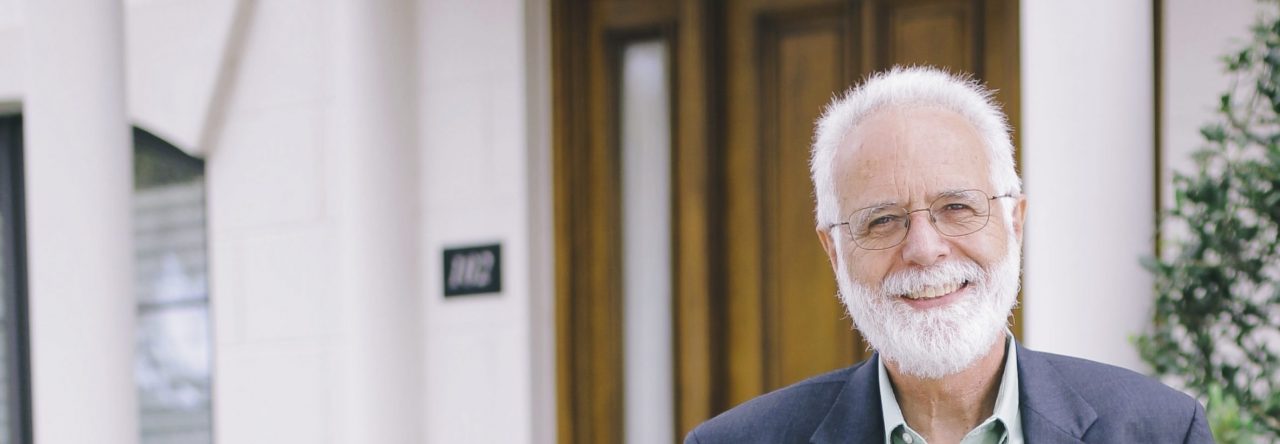
Randy Greenwald

Concerning Life as It Is Supposed to Be

Don’t Blame Autism

As we all are, I am saddened deeply by the tragic shooting at the elementary school in Newtown, CT. But I am also saddened for the millions of children and adults who will have an extra burden added to the stigma they already bear because of careless associations between this violent act and suggestions of autism or Aspergers Syndrome.

I hope that all would read this article by Priscilla Gillman, published the New York Times, and reprinted below. Very helpful.

Don’t Blame Autism for Newtown

LAST Wednesday night I listened to Andrew Solomon, the author of the extraordinary new book “Far From the Tree,” talk about the frequency of filicide in families affected by autism. Two days later, I watched the news media attempt to explain a matricide and a horrific mass murder in terms of the killer’s supposed autism.

It began as insinuation, but quickly flowered into outright declaration. Words used to describe the killer, Adam Lanza, began with “odd,” “aloof” and “a loner,” shaded into “lacked empathy,” and finally slipped into “on the autism spectrum” and suffering from “a mental illness like Asperger’s.” By Sunday, it had snowballed into a veritable storm of accusation and stigmatization.

Whether reporters were directly attributing Mr. Lanza’s shooting rampage to his autism or merely shoddily lumping together very different conditions, the false and harmful messages were abundant.

Let me clear up a few misconceptions. For one thing, Asperger’s and autism are not forms of mental illness; they are neurodevelopmental disorders or disabilities. Autism is a lifelong condition that manifests before the age of 3; most mental illnesses do not appear until the teen or young adult years. Medications rarely work to curb the symptoms of autism, but they can be indispensable in treating mental illness like obsessive-compulsive disorder, schizophrenia and bipolar disorder.

Underlying much of this misreporting is the pernicious and outdated stereotype that people with autism lack empathy. Children with autism may have trouble understanding the motivations and nonverbal cues of others, be socially naïve and have difficulty expressing their emotions in words, but they are typically more truthful and less manipulative than neurotypical children and are often people of great integrity. They can also have a strong desire to connect with others and they can be intensely empathetic — they just attempt those connections and express that empathy in unconventional ways. My child with autism, in fact, is the most empathetic and honorable of my three wonderful children.

Additionally, a psychopathic, sociopathic or homicidal tendency must be separated out from both autism and from mental illness more generally. While autistic children can sometimes be aggressive, this is usually because of their frustration at being unable to express themselves verbally, or their extreme sensory sensitivities. Moreover, the form their aggression takes is typically harmful only to themselves. In the very rare cases where their aggression is externally directed, it does not take the form of systematic, meticulously planned, intentional acts of violence against a community.

And if study after study has definitively established that a person with autism is no more likely to be violent or engage in criminal behavior than a neurotypical person, it is just as clear that autistic people are far more likely to be the victims of bullying and emotional and physical abuse by parents and caregivers than other children. So there is a sad irony in making autism the agent or the cause rather than regarding it as the target of violence.

In the wake of coverage like this, I worry, in line with concerns raised by the author Susan Cain in her groundbreaking book on introverts, “Quiet”: will shy, socially inhibited students be looked at with increasing suspicion as potentially dangerous? Will a quiet, reserved, thoughtful child be pegged as having antisocial personality disorder? Will children with autism or mental illness be shunned even more than they already are?

This country needs to develop a better understanding of the complexities of various conditions and respect for the profound individuality of its children. We need to emphasize that being introverted doesn’t mean one has a developmental disorder, that a developmental disorder is not the same thing as a mental illness, and that most mental illnesses do not increase a person’s tendency toward outward-directed violence.

We should encourage greater compassion for all parents facing an extreme challenge, whether they have children with autism or mental illness or have lost their children to acts of horrific violence (and that includes the parents of killers).

Consider this, posted on Facebook yesterday by a friend of mine from high school who has an 8-year-old, nonverbal child with severe autism:

“Today Timmy was having a first class melt down in Barnes and Nobles and he rarely melts down like this. He was throwing his boots, rolling on the floor, screaming and sobbing. Everyone was staring as I tried to pick him up and [his brother Xander] scrambled to pick up his boots. I was worried people were looking at him and wondering if he would be a killer when he grows up because people on the news keep saying this Adam Lanza might have some spectrum diagnosis … My son is the kindest soul you could ever meet. Yesterday, a stranger looked at Timmy and said he could see in my son’s eyes and smile that he was a kind soul; I am thankful that he saw that.”

Rather than averting his eyes or staring, this stranger took the time to look, to notice and to share his appreciation of a child’s soul with his mother. The quality of that attention is what needs to be cultivated more generally in this country.

It could take the form of our taking the time to look at, learn about and celebrate each of the tiny victims of this terrible shooting. It could manifest itself in attempts to dismantle harmful, obfuscating stereotypes or to clarify and hone our understanding of each distinct condition, while remembering that no category can ever explain an individual. Let’s try to look in the eyes of every child we encounter, treat, teach or parent, whatever their diagnosis or label, and recognize each child’s uniqueness, each child’s inimitable soul.
My Precious-es

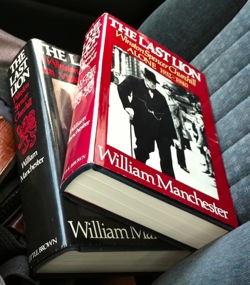
In the late 80s I borrowed from a friend the first volume of a biography of Winston Churchill by William Manchester entitled The Last Lion. When I had devoured that, I rushed off to the library to borrow and read the next volume. But this volume, which I presumed to be the final volume, ended in 1939. A third volume, I heard, was in the works.

Last LionAnd so I waited. And waited. And waited.

Eventually, I wrote a letter to Mr. Manchester through his publisher Little, Brown, and Company to ask when I could expect the third volume to be published. After a time, I received a personal, hand written reply (rare, even in those pre-email days) from Mr. Manchester’s personal assistant. Mr. Manchester, he regretted to inform me, had had a stroke, and would be unable to complete his work on the third volume. I was saddened by the news both of his disability and of the loss of the capstone to this tremendously written life.

Recently, however, I learned that the third volume had been published, completed by Mr. Manchester’s personal friend, journalist Paul Reid. Whether it measures up to Manchester’s original hardly matters. It completes that which was left undone, and for that I am glad.

The first two volumes were books I read but never owned. Books that mean something to me I like to own and to see and to hold. But to buy them new now would cost over $60 (from Amazon) and over $30 used.

But today. Today I walked into Brightlight Books, Orlando’s gem of a used bookstore to see if, on a lark, they had the books. Remarkably, they did. Top shelf, dusty, and labeled as having been there over a year, which means in Brightlight’s pricing policy, steep discounts. Both volumes are first edition, first printing, with dust covers and only minor wear. And I bought both for $8.00.

I’m giddy over my new “precious-es”, which I must now re-read. Can’t wait.

All the Least of These

I just finished reading Mike Beates’ helpful book Disability and the Gospel: How God Uses Our Brokenness to Display His Grace. The book is important and necessary, and is disarming in its direct honesty. It is a disturbing challenge to consider how the Christian church has successfully excluded the ‘different’ and the ‘imperfect’ from her community.
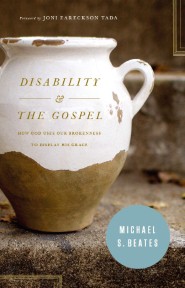
Disability and the gospel how god uses our brokenness to display his graceThe book stimulated two tangential thoughts which I think call for some more long term thinking.


Once again I’m struck with how God has used the non-Christian to shame the church. If any should be the champions of the weak and powerless, it should be Christians who have a deep appreciation for the gospel of grace. And yet the most forceful, effective and prophetic voices in fighting for accessibility in the broader culture have come not from Christians, but from those outside the church. Our blind spots have been legion (see slavery, civil rights, poverty). When will we have eyes to see the causes worth championing and the courage to champion them?

One cause that we have championed has been a concern for the unborn. But labor in this field, while producing local and individual victories, has not produced much in the way of a fundamental shift in public concern. After 40 years, abortion is still legal and prevalent.

And so I wonder if there is a connection between our embrace of the ’cause’ of life for the unborn and our lack of embrace of the actually disabled all around us. Causes are always easy to embrace, but broken people are not. Letter writing, petition signing and sign carrying are all fairly easy and antiseptic. But actually engaging our lives with those whose brokenness makes us uncomfortable is all so much more difficult.

Perhaps what this exposes is hypocrisy in our camp. We OUGHT to care passionately about the unborn and the women who carry them. But the reality of our caring is tested and measured by our lack of concern for the born, but different. Perhaps God withholds his blessing until we learn to love in deed all the least of these.

No Snow

Once a couple weeks ago I was nosing around the settings on my blog, and saw this odd option:

Snow no

So, I clicked it.

Snow yeah

And forgot about it. You see, I never go to my blog. (Like most of the world, actually.)

Today it was pointed out to me that snowflakes on a white background is, um, ‘ineffective’. Very tactfully said. And accurate.

So, goodbye snowflakes!

The Trilogized Hobbit

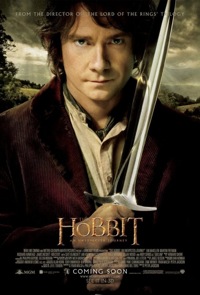
Hobbit Movie Poster BilboWe were glad when The Hobbit was rescued from the hands of Guillermo del Toro and returned safely to the trustworthy Peter Jackson.

We were glad when we learned that our favorites from The Lord of the Rings movies would be returning to play Gandalf and Gollum and even Frodo.

And we were delighted to make the acquaintance of Martin Freeman as Dr. Watson… I mean Bilbo Baggins. A perfect hobbit he seems to be.

But we were stunned to hear that the story would be spread over three films, and further surprised to see that the first, no doubt foretelling the whole, was to be nearly three hours long.

Nevertheless, we dutifully bought our tickets and watched the movie, and indeed we were entertained. Freeman’s Bilbo is perfect. The fairy-tale and comic opening scenes delightful. The dark brooding and therefore foreshadowing of Thorin’s passion proper. I sat through a three hour movie and only a time or two wondered how much time was left. And I’ll most likely suck it up (and cave into Jackson’s money grab) and pay to see the remaining two films.

But I am begrudgingly saying that the movie was good. Much of it was very good. And yet I often thought during the movie of the advice to writers (which I first read from Stephen King): “kill your darlings”. Just because you have a great idea or a great line or a great turn of phrase, or in this case, a great scene or a great visual effect, does not mean you should use it. However, in King’s case, and now in Jackson’s, they are both so big and their resumes so overwhelming that no editor has the courage to make them kill their darlings. So everything goes in and it is not all good.

In the case of The Hobbit, all the essential encounters of the first three books – oops, I mean book – are there. But they are too much there. The scenes of peril are so contrived that even our fantasy-softened reality expectations are shattered. That a group of 14 could battle their way through a goblin infested mountain, falling multiple times many stories, and all of them emerge unscathed makes a Mission Impossible movie look believable.

A wee bit of restraint would have made the movie far better. We hope for better. As Bilbo says at the end of this installment, “Well, I think the worst is behind us.” Yes, Bilbo, I hope you are right.

An Idealized Child

Our sorrow is often a measure of the distance between our idealized vision of reality and its actual form. So it was that in the days of the Old Testament prophet Haggai, when the foundation was laid for the new temple, that as some rejoiced, others wept. They wept when the awareness dawned that their idealized vision for the temple was not going to be matched by reality.

This is the cause of so much sorrow in marriages. A husband or wife brings an idealized vision of their spouse and of marital bliss into a relationship that cannot be matched by reality. When the distance between the reality and the dream becomes unavoidable, sorrow sets in.

So, could it be that many of our children feel an almost telepathic sense of disappointment from us, their parents, because our idealized vision of what we think they should be is unattainable for them?

So many parents are certain that everyone else has children who are more compliant/intelligent/athletic/cooperative/accomplished than their own. And the more pervasive this idea, the greater the gap between this idealized vision of their children and the reality of who those children really are. By so doing, many of us can miss the beauty that is our children.

Those who have children with Aspergers Syndrome, or know those who do, will especially appreciate the honesty and insight of this article, written by journalist Ron Fournier. His conclusion which is valid for every parent is this:

I learned that while Tyler was not my idealized son, he was the ideal one.

For our children to know such acceptance from us, their parents, should be our deep, compelling desire. When we can love the children God has given us, and not the idealized image which they can never attain, we will give them the greatest gift we could bestow.

Rainbows for Caitlin

I know that some of you were moved to pray for Caitlin and her family by my previous post. Now I would ask you to pray for her family, and if it seems appropriate, to weep for them and for the brokenness of this world and the pain of death. Caitlin passed away this past Sunday. I would encourage you to read her mom’s testimony here. But I know that many of you won’t click through, and so, to make it easy, I will copy and paste it here. And as I type, it is raining.

It is Florida’s dry season

There is a joke about Florida’s seasons. Florida has 2: a wet season and a dry season. The wet season runs from April-October, and the dry season runs from November-March. They are just that. It rains every day during the wet season and not at all during the dry season.

So imagine our surprise when God winked and threw us a couple rainbows and some rain in the last several days.

Sunday morning, as I woke next to Caitlin, on the make-shift bed we had relocated downstairs, I knew the day was going to be different. Although she begged for me to take her to church, I knew we would not get there and that she was failing us.

I will not weigh this post down with details and specifics, because death is not beautiful or glamorous as some have described it. I will tell you the beautiful part of this story however.

We held Caitlin in our arms, while family gathered around, and at 3:24 on Sunday afternoon Caitlin took one last breath and died.

We cried some more, and said goodbye. And then, as if God rolled out the carpet for her to travel to heaven, a rainbow appeared. That means, moments after each of her family members said goodbye it rained (for only a few minutes) AND produced a rainbow….in my heart I want to believe Caitlin took the hand of loved ones, and unafraid, she skipped up that rainbow and right into heaven with only one look back to wave and say, “It’s ok mama! I promise I’m not scared! I can skip again!”

Again, without details of the day, I will fast forward to several hours later. We let go of the shell that had once contained Caitlin’s incredible spirit. We kissed those uncharacteristeric chubby cheeks, and the no-longer crooked and droopy mouth, and we placed her body into the care of the funeral home.

As they drove away I started thru the house and out the back door to retrieve the other children from a friend’s house. As I got half way thru the backyard, the sky opened up, and it rained. I stood in the rain with a friend who was walking with me. Honestly, I think we were both paralyzed with shock. Turning our heads toward the sky in stunned silence, we put up our hands and shrugged our shoulders because words weren’t necessary. As our feet hit the back porch of our other friend’s house just a few yards away, the rain stopped.

We gathered children and sent them running thru the backyard for some dinner. Again as we reached the halfway mark in the joined backyards, it rained. It rained harder and harder until we reached the door of my back porch. It rained for 3 minutes and was done. Another wink? How can it be anything but a wink.

Then, finally, after a day of being surrounded by family and friends, and Jeff and I dealt with the tasks of funeral home and church service arrangements, we arrived home yesterday afternoon. We were greeted with a dozen excited and shouting adults and children. Apparently, while we were out “arranging”, at exactly 3:24, a rainbow, ever so faint and light, appeared in the backyard of our home.

God let Caitlin throw her own rainbow. She loved them so much. She thought they were beautiful. And in the last year, when everyone joined in and made it “hers” to own as a symbol of things so much bigger than she could ever know, she was thrilled.

So I’m going to believe, that God picked her up, and said, “Let’s send a message to mommy, daddy, and everyone left down on Earth crying for you. How could we let them know that you’re ok?” It wouldn’t take Caitlin long to reply, “Mama loves rainbows!” And with that, God held her hand, and together they threw a rainbow; a tiny, fading, almost invisible rainbow.

Rainbows and rain, during the “dry” season…..best.wink.yet.

with love from our broken hearts, d

Notes about Jobs

I don’t know if I will ever get to post anything substantive regarding the Walter Isaacson bio of Steve Jobs. A superb read, and stimulating for those who lead organizations striving for impact and beauty. Like a church.

Steve jobs book coverOf course, not all the lessons are positive. Some are sober reminders of perspective. Jobs changed our world – about few can that be said – in ways I deeply appreciate. And yet, though he changed the world, I have to wonder: did he ever shoot hoops in the driveway with his son? Makes me reflect on my priorities.
My normal bio and history diet includes dates like 1705 or 1905. I confess it is odd to read a bio that has sentences beginning with “By 2005…” with characters still alive and still functioning in the roles identified in the book. Very odd.

I look forward to discussing this book with others who have read it. (Among others, I’m looking at you JT, the one who insisted I read it.)

Something More

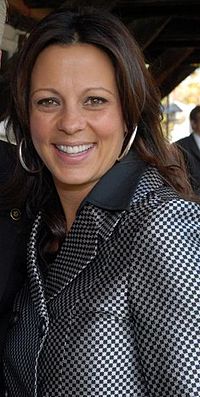
Country star Sara Evans sings:

I keep looking, I keep looking forSara Evans
I keep looking for something more
I always wonder what’s on the other side
Of the number two door
I keep looking
Looking for something more

So true.

In Walter Isaacson’s fascinating biography of Steve Jobs, he recounts the purchase of the one-billionth purchase from the iTunes store. It was made by a sixteen year old from West Bloomfield, Michigan. For his purchase of Coldplay’s “Speed of Sound” he received a personal phone call from Jobs, ten iPods, an iMac, and a $10,000 music gift certificate.

And all I could think is, “I never win anything like that.”

I keep looking, I keep looking for
I keep looking for something more

The reality is I had a great childhood, I have a wonderful wife, amazing kids, and a good job. I have a hope for life granted by a God whose love has been proven to me and a place to rest my fears, anxieties, and guilt.

Borrowing once again from Ms. Evans:

I’ve found all I’ve waited for
And I could not ask for more

Cheering for Caitlin

Our church, Covenant Presbyterian Church in Oviedo, Florida, meets in Partin Elementary School. A student there has a sister, five year old Caitlin Downing, suffering from a fatal cancer. We’ve joined the school in ‘cheering for Caitlin’ by praying for her. This morning’s Orlando Sentinel published an article about Caitlin’s condition which gives us a greater understanding of the seriousness of her situation. I invite others to join us in prayer for this little girl.

Can FDA help Caitlin Downing battle brain tumor?

By Marni Jameson, Orlando Sentinel

Medical science moves too slowly for some, in part because the Food and Drug Administration’s job is to carefully, methodically regulate the pace.

But once in a while, even the FDA makes an exception to its own rules. Sometimes it takes just one little girl.

Caitlin“The FDA is all about science, not emotion,” said Dr. Jeff Downing, a family-practice physician from Oviedo. “I get that. The government doesn’t want wild procedures going on without science behind them. But waiting is tough because we don’t know how quickly this will grow.”

The “this” he refers to is his 5-year-old daughter’s deadlybrain tumor.

Diagnosed in January with diffuse intrinsic pontine glioma(DIPG), Caitlin Downing is one of about 200 children in the United States each year who gets this type of cancerous brain tumor. Because these growths wind around the brainstem, they cannot be surgically removed.

They are 100 percent fatal; 98 percent of children die within two years of their diagnosis.

Dr. Mark Souweidane, a pediatric neurosurgeon atMemorial Sloan-Kettering Cancer Center in New York, has devoted much of his 17-year career to finding a cure for DIPG.

On May 1, Caitlin became the first person to take part in a phase one clinical trial for which he had just received FDA approval.

The experimental treatment involved opening the skull to create a window onto the tumor site, then delivering a cone of enhanced radiation directly to the area. This “cone of death” emits radiation laced with small molecules that seek out the tumor tissue, attach to it and kill it.

“We get a high concentration where we want it,” Souweidane said.

Initial results were encouraging. A follow-up MRI of Caitlin’s brain showed that the tumor tissue in the treatment area was dead.

“But the cone of death didn’t get the whole tumor,” said Downing, whose family practice is in Casselberry.

By September, medical scans showed the tumor was growing back.

Because Caitlin did so well with the first round of treatment, her parents wanted the procedure repeated. That, however, would require special FDA approval.

“The physicians we worked with all said, ‘We’ll submit the paperwork, but don’t expect this is something we’ll get,’” said Denise Downing, Caitlin’s mother.

So, they put in their plea to the FDA, knowing that the words “government” and “fast” don’t usually occur together.

Yet in a move that stunned everyone, the FDA responded quickly with a go-ahead, a one-time, “off-study” approval that fell under the murky heading of “compassionate use.”

Those who qualify must submit proof that they have life-threatening conditions, no other treatment options and a good argument that they might benefit, said Stephanie Yao, FDA spokeswoman.

“If the doctors thought it was a good idea, and the parents wanted the treatment, they said we could go ahead,” said Denise Downing. “It was really a David and Goliath moment, and we won. They came through.”

There was just one catch: Caitlin had to get the same dose she received during her first treatment. Since Souweidane treated Caitlin, he has doubled the dose in subsequent study patients, who have tolerated it well, and he plans to quadruple it.

However, as with all phase one trials, the goal of this study is to prove the safety of a new treatment and to figure out dosing. Subsequent trials aim for effectiveness. A double dose of this radiation treatment on a human brain has never been done. Giving Caitlin a larger second dose would be “unconscionable,” said Souweidane.

But Caitlin’s tumor has grown beyond the reach of the approved dose. So after conferring with their cancer experts, the Downings decided to try one more cancer weapon. Chemotherapycan get where the immuno-radiation therapy can’t. The Downings hoped chemo would shrink the tumor and create a smaller target.

Caitlin has gone through two rounds. However, both Souweidane and the Downings believe that shrinking the tumor to the point where the second, FDA-approved surgery would be advisable is unlikely.

“We are so grateful that the FDA came back with an approval,” said Denise Downing. “I just wish her tumor wasn’t so big. We either need a bigger dose or a smaller target.”

Meanwhile, Caitlin’s symptoms are worsening. Her face is puffy on one side, and she’s having more problems walking and seeing, her mom says.

“She knows her body’s not doing what it used to,” said Denise Downing. “She apologizes to me all day long, saying she’s sorry she needs my help, sorry she’s not getting better.”

When Souweidane saw Caitlin and her mom in New York two weeks ago, he saw the same spirit that had won him over from the start. “She was still her spunky self, challenging us in thought-provoking ways,” he said.

In fact, she had a question for him: “Can you get rid of the bump on my brain before I go to heaven?” she asked.

Denise Downing says she has no doubt that Souweidane and his team are on the right track. “I believe in everything this man is doing,” she said. “He probably has a cure. I had hoped that our daughter could live long enough to get that cure. But that’s not going to happen.”

Regardless, “Caitlin is a pioneer,” Souweidane said. “She has advanced science in important ways. She has not gone through this for nothing.

That said, he added, “If I could save one child’s life, it would be hers.”

mjameson@tribune.com or 407-420-5158

Copyright © 2012, Orlando Sentinel

[The Orlando Sentinel keeps articles behind a paywall. I am a subscriber, and so I am making the decision to share this article with my friends who are not.]

Page 34 of 142

Powered by WordPress & Theme by Anders Norén