Randy Greenwald

Concerning Life as It Is Supposed to Be

Asking for Stuff

Someone asked me about prayer the other day, making the common and necessary observation that we who pray forget that prayer is something more than asking for stuff.

Making such an observation tells me that this person has been reading all the right books. She is well informed of all the right cautions, cautions I’ve heard and tried to heed.

And yet, my prayer life is still heavily tilted toward asking for stuff. I can’t get away from that. And maybe I shouldn’t.

There is no question my prayer life, and perhaps yours, needs a greater measure of praise, of confession, of gratitude. But at the same time we have a God who tells us that to put our anxieties at ease, we need to let our requests be known. We have a God who tells us to lay our cares before him, because he cares for us. And though that which we know as “The Lord’s Prayer” has prayers of praise and confession, it is largely about asking for stuff.

I think God is honored and blessed the MORE stuff we ask him, for in asking, we acknowledge Him to be the only source of the good things we seek.

When I begin to think of the tremendous needs that are in the lives of the people I know and love, much less those of the missionaries we support, the leaders who rule over us, and the world in which tragedy (e.g. Haiti) strikes, I can’t deemphasize supplication. No, such realizations only make my prayer list burst its seams.

I think we need to be spending more and more time asking for things from the only One who is not hopeless and helpless in the face of such things. Not less. Somehow I don’t think God minds.

Of Books, Stolen and Otherwise

As I’ve mentioned before, my daughter-in-law works at a used book store in Mentor, Ohio. It’s a good thing that that is so far away. The last time there we walked out with something like three-feet of books. If we lived closer, we’d have to buy a bigger house.

One day, she was explaining to me how to interpret the printing history from the bibliographic info inside a book. She told me that she has fantasized about buying, for example, the first printing of the first Harry Potter book before it, and its author, had become famous.

I now know that if she had picked up such a book, one of only 500 printed, it would be worth more than $30,000 today.

I learned this, of course, in a book.

Journalist Alison Hoover Bartlett has written a fascinating little book called The Man Who Loved Books Too Much.Tidbits such as this are found throughout the book.

It’s probably safe to say that a guy who walks into a used book store and comes out with 36-inches of books may love books too much. But I buy them with at least the intention of reading them. Bartlett’s book is about people who collect, not read, them.

In particular, it is about one collector, John Gilkey, who, since he can’t particularly afford the books he wants, finds, er, more creative ways to acquire them. The book’s subtitle is “The True Story of a Thief, a Detective, and a World of Literary Obsession”.

Barb and I first heard about this book, and the strange world, people, and events it chronicles, from an NPR interview with the author. If you have a spare seven or eight minutes, I’d encourage you to listen.

Though the book is a story of thievery and detective work, the question that animates it is this: What drives people to collect? Whether it is rare books, stamps, coins, or Beanie Babies, what fuels this desire? Is it a desire for order? Does it fill up emptiness in our lives? Or is it, as Freud suggested, driven by an obsession with conquest?

That idea of conquest links this book with another I’ve been reading.

A refrain that Bartlett would hear often among rare book dealers was this: that all rare books are stolen books. Books of great antiquity all have histories, and for many of them, these histories include military conquest, plunder, pillage, and other kinds of thievery.

Susan Wise Bauer points out in her surprisingly entertaining book The History of the Ancient World that Assyrian king Ashurbanipal, whose kingdom centered in Ninevah was eviscerated by the Old Testament prophet Nahum, was the first person in history known to amass a library, 22,000 volumes at his death.

Was he a literary man? Was he concerned for the preservation of culture? Or was he, like John Gilkey, 2700 years later, simply obsessed with possession? For what Ashurbanipal could acquire with armies and swords, John Gilkey had to use stolen credit card numbers. They were both men who loved books too much.

—–

UPDATE: The NPR story above is not the one we heard first. Here is a longer and more in-depth interview with the author of the book:

/**/

UPDATE 2: And here is the actual interview that Barb and I first heard, with one of my favorite interviewers.

Good Look

I think this has a good look about it:


Of course, at this point being only about 2 minutes into his trumpet career, technique could use some work. But still…

Perspective

My day started by my spilling coffee all over some papers I was carrying, followed by finding out that I had scheduled a meeting of a committee I chair for next Monday but had failed to inform any of the members of that committee. All that is a problem to me, and represented two messes that I’ve needed to work on cleaning up this morning.

And yet, where is my perspective on ‘mess’ and ‘suffering’?

Last night I received an email update from a man who is serving in Haiti with his wife and family. He is a man I met a number of years ago. He is a gentle, soft-spoken Haitian man with a heart deeply committed to serving Christ.

When I first met him, he was in seminary, adding Greek and Hebrew to his complement of languages which already included French, Creole, and English. He persevered and was eventually ordained to the gospel ministry in our presbytery, our association of churches.

He pastored for a time a church of Haitian families. He loved them and faithfully served them. I met there his lovely wife and their four delightful boys, all of whom remind me of my own son who is, himself, of Haitian ethnic descent.

But he was not settled there. His heart yearned for his native land. Though he could live comfortably pastoring in Florida, he chose to move with his wife and family to the depravation of life in Haiti. He chose this. This is Crazy Love personified.

Our last personal contact with him came last year some time when he was gathering material to replace the personal belongings he and others had lost as a result of the hurricane triggered floods in Haiti. He received what we could give with joy and gratitude, though he had lost nearly everything. He still went back to Haiti.

So, when the earthquake hit, we all immediately thought of him and his family. We were happy to hear that they had survived. We were saddened to hear that they could not reenter their house. Though it had not collapsed, it has been seriously weakened and is now unusable.

Last night, I tried to read to my family an email update from our friend, whose name I’m purposely not using since I am going to copy from that email, and don’t have any way of securing his permission to do so. So he remains here anonymous. But I tried to read the letter, but couldn’t without weeping, overwhelmed with his suffering, with the sense of helplessness, and with the realization that this is what he has chosen. This is where love for Jesus has led him.

Dear Partners in Christ,

There is a new update in our situation here in Port-au-prince. Today at about 1:00PM the principal of the Christian School came to me and my wife and said, “I have made connection to Missionary Flight international for your wife and the boys to leave the country and you have five minutes to be ready.” They had no time to even change and go get some clothes at home. As I am writing this email they are in the air going to Florida to my mother-in-law.

As for me, I am here at the school trying to minister to the people that have lost children, parents, siblings. People whose houses have collapsed. The scene is horrible. The air is polluted with the smells of dead bodies laying everywhere. My kids have seen dead bodies and they are so afraid that they could not even sleep.

Please pray for us for this open opportunity to share the wondrous love of our God. People are dying here because the relief effort of the international community and the government is very slow. There are cities like Leogane that is destroyed at about 80%.

This is a huge thing.I am overwhelmed by the magnitude of devastation and the amount of people that died. Every body, including ourselves, have been sleeping on the streets under the stars.

Please Pray!

Yes, indeed, please pray.

Applied Piper (or Sproul, Packer, Keller, Tozer, et. al.)


———-

Crazy Love: Overwhelmed by a Relentless God by Francis Chan (2008, David C. Cook Publishing)

———-

I really tried to dislike this book. I really did.

First, the young man who mentioned it to me had not cared a whole lot for it. I felt that if a hip young guy couldn’t wrap his heart around Francis Chan’s hip style, then there was no way that an older Christian like myself could.

Secondly, the style issue center’s on Chan’s desire to write like he speaks. This should not surprise me, as he has gained his reputation as a passionate and engaging preacher. But I expect books to have a certain style and flavor, and speech another. I find their combination unsettling.

Thirdly, he seems to forget that this is, indeed, a BOOK. His frequent suggestions that I check out this or that on various web sites irritated me no end. If he was speaking, he could put what he wants on slides and let everyone see. But don’t expect me to stop reading to watch an online video. I’m not programmed that way.

And fourthly, he expresses his examples of faithful Christianity disproportionately through stories of missionaries, when I want to know how a radical Christian artist or teacher or business professional might live. I don’t believe it is God’s will for all of us to respond to Christ by moving to Africa (or in with our parents, for that matter, which is what one of his examples does).

Please believe me when I say that I tried very hard to dislike this book.

But I find myself wanting to buy it and pass it around which, if you’ve read the book yourself, you will know is not quite the response that Chan has in mind. Rather, he writes the book to challenge Christians to examine whether they are really living their own lives out of love for Christ.

He assumes that most of us are not, and he spends 175 pages calling our bluff when we try to claim that we are. And that is hard to take.

A few pages in, Chan reflects on what he sees in the church and says this:

“The core problem… is that we’re lukewarm, halfhearted, or stagnant Christians…because we have an inaccurate view of God.” (22)

Where have we heard that before?

In varying ways, J. I. Packer has made this case in Knowing God. A. W. Tozer points in this direction in his book The Knowledge of the Holy. And John Piper is forthright about it in Desiring God.

What Chan does is to urge Christians to climb aboard the roller coaster of Christian obedience guided and directed by the God whom these men revealed. He is pushing the application which should naturally follow upon coming to know the Savior revealed in these books.

His pushing can be disconcerting. His chapter exposing ‘lukewarm’ Christian living is painfully searching. His chapter on obsession with God is rightfully challenging.

He forces us to examine our lives in light of the question, “What would our lives look like if we truly and really loved Jesus?” What really matters to us? What are our true heart affections? Tough questions, to be sure, but questions which must be asked.

I am a bit fearful that there may not be enough grace in the book. The book is not devoid of grace, so I do not fault him. But do I read it one way as one familiar with (and humbled by) grace and another read it with more fear and guilt?

My sense is that this is a book needed by Christians who understand grace. My failings are laid bare in his bold pronouncements. Because I am weak and because I change slowly, without an understanding of grace, Chan’s challenges might lead me to despair, or to a guilt induced ‘obedience’ that misses somehow the love for Christ which is the proper motivation for all things. A knowledge of grace does not blunt the sharpness of Chan’s challenge, but it perhaps gives us ears to hear.

Tim Keller reminds us of how great the father’s love for us is in his marvelous little book The Prodigal God. It is a great reminder of the depth of God’s love and grace.

Chan’s book is the book to challenge the one who knows that his father has welcomed him home. Am I really living my life as one who knows he is THIS loved by God?

To be honest, as a BOOK I don’t really like Crazy Love. I’d rather read Packer or Piper or Tozer or Keller. Those are much better books, much more reflective, better written, and well worth multiple readings.

But I know that I NEED this book, one which has taken their message, distilled it, applied it, and thrust it in my face as an inescapable challenge.


Imagine

Imagine a room where 100 people are talking at once.

And all of these people expect you to hear everything they say.

And you expect everyone to hear all that you say.

If you blink for a moment, if your mind fades, if you focus elsewhere for the smallest amount of time, you miss what others expect you to have heard, because they said it.

So, imagine such a place. Then know that what you have imagined already exists. They call it Facebook.

City of Ember

The family/sci-fi/fantasy adventure City of Ember is set in a civilization which had existed underground for over 200 years, founded when life on the surface of the earth could no longer be sustained. The builders had designed the city to last no more than 200 years, assuming that to be sufficient time for the surface to restore viability. But after the lapse of 200 years, through negligence, corruption, and mistaken ideology, life on the surface had been forgotten, and it was assumed that there was no way out of Ember. At the same time, the planned obsolescence built into Ember was beginning to take its toll.

Ember is a deteriorating society in a seemingly closed universe longing for rescue. The metaphoric possibilities in such a scenario are colossal. Who will rescue the trapped and doomed residents of Ember? Who will rescue us?


Don’t think that I sit watching a movie ruminating the whole time about it’s world view implications. I really can and do enjoy a good story well told, and enjoyed this one last Sunday night.

To whom can we turn for rescue? Two institutions are shown to be impotent in the hour of Ember’s need. Government is corrupt and religion is irrelevant. The burden of deliverance rests then upon the individual, individuals with vision and confidence.

This is the typical American myth, isn’t it? That if something needs doing, we need to do it ourselves.

I think there is a great deal of truth underlying this myth. Deliverance often comes down to a person or a group of people with vision sufficient to see beyond a crisis and courage to take the right steps to move toward a solution. Governmental and religious institutions are often ill suited to do what needs doing.

An example: On Monday, America acknowledges the leadership and courage that Dr. Martin Luther King brought to the struggle of Black American’s to achieve some modicum of freedom long promised. He is one example and one need not look hard to see others.

One cannot know fully what was in the mind of the makers of this film. Typically the exploration of such a myth places all the glory upon the human instrument of deliverance. My vision is broader. I believe that like Esther God raises up men and women for times such as these. And at times these whom God raises up step to the fore self-consciously in the service of the one who has raised them up.

Even in Ember, two courageous teens, who pioneer a way out of destruction, cannot do so without a challenge, encouragement, and word of instruction from those who built the city. Someone from outside reaches in to guide them in their deliverance. Their universe is not so closed after all.

Neither is ours.

Chess Clocks and Coffee

Before breakfast Monday morning, I drank three cups of coffee in honor of my daughter. In fact, every cup of coffee I drink is in her honor. That, though, is a story for another day.

The connection between my daughter and coffee centers around the bi-weekly games of chess we play at local coffee shops, a tradition at least five years old.

This Monday afternoon we took our game to a new level of fun-ness.

My daughter, brilliant girl that she is, has a clever strategy. She takes so much time between moves that if I ever have a coherent plan, it is, by the time my next move comes around, long forgotten. So, just before Christmas I decided that ‘we’ needed the discipline of the chess clock.

A chess clock consists of two timers connected by a switch that switches one off when the other is switched on. Thus, when black, for example, is contemplating his move, his timer is counting down. At the end of his move, he pushes a button which stops his timer and starts white’s timer. A player can take all the time he needs for any particular move, but if his time runs out before the end of the game, he loses.

When I last used a chess clock, the Beatles were still a band, Richard Nixon was still an honest president, and Americans were still dying in Vietnam. I had, no surprise, forgotten how the thing was supposed to work.

My daughter gave me an Amazon.com gift certificate for Christmas. I transformed this into a chess clock, and we were therefore armed and ready to go.

Monday was the first opportunity to use it. It used to be, my imagination tells me, that people would go home from a coffee shop and tell their families that they saw this strange sight: an old white guy and a young black girl playing chess. Now they will go home shaking their heads and reporting a yet stranger sight: an old white guy and a young black girl playing chess using a chess clock.

For our first game, we set the timer for 25 minutes. That is, each of us would have 25 minutes to make all our moves. Such a game would, you see, last no longer than 50 minutes. Ours probably lasted forty or forty-five. But the thing is, we finished it. With time to spare. We actually finished a game. A miracle.

With some of the consequent ‘time to spare’, we decided to try our hands at a ‘blitz’ game. This is the chess one sees being playing in Washington Park in the highly recommended movie Searching for Bobby Fischer.

In Bobby Fisher players play whole games in under two minutes – it is a sight to see. (See the YouTube clip below.)

We were more modest in our goals. We set the timer for five minutes each.

Oh, was that fun. Hectic, intense, sloppy, but fun.

The ranks of ‘grandmaster-dom’ are not threatened by our play. But I have this hope that many years from now, when my little girl is a mature woman of fifty and I am, presumably, long gone, that she will remember the day she and her dad broke out the chess clock for our bi-weekly game.

A Book about Me


I wanted to let everyone know that my book is out. Oh, not a book that I have written, but the book that is all about me.

Now, of course, fans will expect such a book to be titled GREENWALD: a life lived to the glory of God.

Of course.

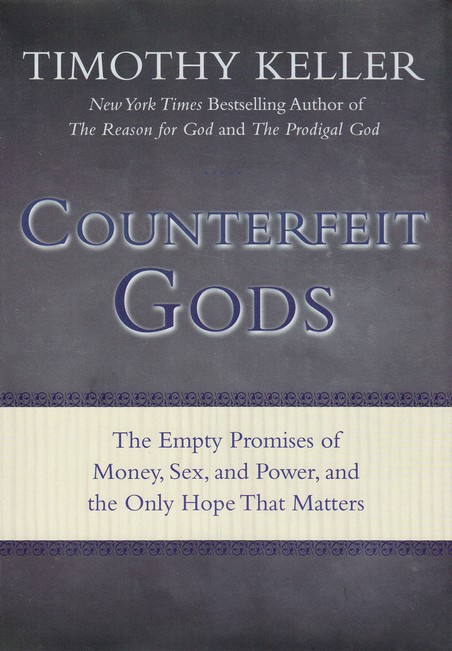
But I suppose the editors and publisher decided that that title was a bit too over the top for someone as humble as me, and so, instead, they titled it Counterfeit Gods.

It’s pretty cool to have someone as prominent as Tim Keller write a book about me. But life is like that, isn’t it? Full to the brim with amazing surprises.

Discerning readers of the book will notice that Keller keeps my identity obscured. He never mentions me by name. He writes rather about Jonah (a man in love with his race and place) and Jacob (a man seeking for blessing from a woman and a father) and Zaccheus (a man for whom material possessions provided all the comfort he thought he needed). So, stepping around the true subject of the book, he never mentions me directly. But make no mistake about it – he is writing about me.

It’s not quite what I expected in a book about me. I thought there’d be more flattering stuff, more about the glories of my high school career, more about my dynamic love life, and more about my financial acumen. The subtitle kind of puzzles me as well: “The Empty Promises of Money, Sex, and Power, and the Only Hope That Matters.” (That must have been the product of a bored editorial assistant, something he stuck in there when the principal editors were not looking.) Though the book totally overlooks my stunning pastoral career, it does quite a job of shining a light into the convoluted inner world of this pastor’s heart.

So, I think you’ll agree, should you take the time to read this book. “This is,” you will say, “a book about me.”

Avatar’s World View

These days I don’t have time to do my own thinking, evaluating, writing, about movies. And I wouldn’t want to comment on something I have not seen, and which, admittedly, I have little desire to see.

But I find it interesting who is these days doing our world view evaluation of this movie. Twice recently the NY Times has reflected on this film in a way that Christians should find interesting: here and here.

Helpful stuff.

Page 77 of 142

Powered by WordPress & Theme by Anders Norén