Randy Greenwald

Concerning Life as It Is Supposed to Be

Reaching Fifty

The questions we ask at various stages in life are not bound to the age we actually inhabit, but more to the life situations those ages thrust upon us. So, some may ask questions at 45 that others are not asking until 65, and vise versa. But these generalizations do help us who teach and preach to consider how we might better connect with the real concerns of our audience.

As we ‘reach’ the fifties, Gordon MacDonald, from whose book A Resilient Life these observations come, says that having moved past life’s middle, we have reached a point for sober thinking. The questions that arise include:

Why is time moving so fast?
Why is my body becoming unreliable?
How do I deal with my failures and successes?
How can my spouse and I reinvigorate our relationship now that the children are gone?
Who are these young people who want to replace me?
Will we have enough money for our retirement years?

And, perhaps more than before, this one:

What do I do with my doubts and fears?

In the Forties

We are pondering the questions that people in various stages of life might be asking so that we might better communicate with them. Perhaps these suggestions from Gordon MacDonald are accurate, perhaps not, but they seem to me to be a good place to begin the conversation.

Those in their forties realize that they are beyond the place where they can protest that their mistakes are the product of youthful ignorance. They are mature, and are beginning to realize that they will not live forever. We wonder what has made us what we are and we wonder what we have yet to become. Some questions:

Who was I as a child, and what powers back then influence the kind of person I am today?
Why do some people seem to be doing better than I?
Why am I often disappointed in myself and others?
Why are limitations beginning to outnumber options?

The forties are times of great change. Bodies, children, marriage, financial standing, all change and create uncertainty. Questions can hinge toward hope or despair:

Why do I seem to face so many uncertainties?
What can I do to make a greater contribution to my generation?
What would it take to pick up a whole new calling in life and do the thing I’ve always wanted to do?

Though the word ‘trapped’ does come up more often than we wish it would, the forties can be a time when people are encouraged to focus their energies in a whole new way for good.

Questions of a ‘ThirtySomething’

Continuing to consider the questions that people in various stages of life are asking, Gordon MacDonald considers those in their thirties.

How do I prioritize the demands being made on my life?
How far can I go in fulfilling my sense of purpose?
Who are the people with whom I know I walk through life?

This last question is one of loneliness. With increased demands on time and responsibilities, old friendships drift into the distance, and there often is not the time to build and deepen new friendships.

This increased time demand raises a spiritual component. There is no longer much time for retreats and conferences and times of hanging out. Words like ’empty’, ‘tired’, ‘confused’, and ‘drifting’ come up frequently. And so does the question

What does my spiritual life look like? Do I even have time for one?

And this is complicated by the sense of failure that may begin to peek over the horizon, leading to the question:

Why am I not a better person?

If these thoughts are anywhere near the mark, it speaks of fertile ground for the Gospel.

“20-ish” Questions

In reference to this goal, then, what are the questions that those in their twenties are asking? I summarize MacDonald here:

What kind of a man or woman am I becoming?
How am I different from my mother or father?
Where can I find a few friends who will welcome me as I am and who will offer the familylike connections that I need [or never had]?
Can I love, and am I lovable?

MacDonald finds fear of rejection, loneliness, and the feeling that one might not fit.

Other questions include

What will I do with my life?
What is it that I really want in exchange for my life’s labors?
What parts of me and my life need correction?
and
Around what person or conviction will I organize my life?

Do you agree with these? What would you add or take away?

The Questions of Life

I’ve read about 40% of Gordon MacDonald’s book A Resilient Life and can only commend it with one SERIOUS reservation which, while not stripping the book of all value, places it in a category in which I could not give it to anyone without some explanation. I’ll comment on that when I have the opportunity to finish it.

I draw attention to the book at this point in order to extract from it something that MacDonald very well and which many should find useful. I refer to a portion of the book in which MacDonald helps us understand the questions that people are asking at various stages of their lives. This has value to me as a preacher but can be useful as well to any who are involved in teaching or leading adults.

Preachers, for example, have a message that they want to be heard. It is not merely an intellectual message appealing to intellectuals interested in discussing all the latest ideas. It is a practical message regarding a person’s place in this world and the purpose of his life. If I can preach Jesus in such a way that intersects the questions a listener is already asking, he is far more likely to give the message attention than if what I am saying appears to be ethereal and unrelated to the life he, or she, is living. In preparing a sermon or a lesson, it is good to ponder the questions the listener brings to the table so that one might address the content in such a way that it answers those questions. Do that, and we will be heard.

But getting a handle on what those questions are can be the tricky part. MacDonald has asked representative people from each decade of life to share with him the questions which most concern their peers. He asked this of twenty-somethings, those in their thirties, and each decade thereafter. His read on these questions seems to me to be highly accurate. I would like to share those with the readers of this blog.

But before I do that, I encourage those of you who are reading this and are interested to ponder what you think those questions might be. What questions are those in YOUR decade asking? What troubles them? What do they worry about? What occupies their innermost thoughts? What matters most to them?

Hail, Caesar!

Sometimes I run through neighborhoods not my own, as I was doing Monday when I met Caesar.

The subdivision in question is about a kilometer or so from my own and is a loop that provides a good alternative to the back and forth of my normal route. Besides, I have friends in that neighborhood whom I like to greet when I see them.

I was about a third of my way into the loop when I was joined in my paces by an energetic chocolate Labrador retriever. I thought for a short time that he was just chasing me out of his yard. But as I went on, so did he. He marked everything in sight, but was still able to keep up with me. It’s a dog thing.

Eventually, it was clear that he was going to go wherever I went. When I made the move to leave the subdivision, he made the turn with me. I didn’t want to lead someone’s dog out of their subdivision and into dangerous traffic, so I turned around intent on retracing the loop until someone would be found to claim him. At one point, I thought he had disappeared, and so I turned to head for the exit, but he reappeared by my side. So, on around the loop I went.

Soon, I heard someone calling a name. Apparently, my new buddy was named Caesar, and he was a wanted dog. But Caesar had no intention of abandoning the fun of running for the confinement of a leash. He was going to have to be duped. I stopped and reached out my hand to him. In response, he stopped, flopped over on his back and waited. I scratched his belly until his human reattached the leash.

The video was taken early in our run, which is embarrassing because I am breathing so heavily. Nevertheless, I give you Caesar.

Caesar, it was fun running with you.

Is That a Geek in That Chair?

Yes, and a lazy one at that.

I began reading Is That a Fish in Your Ear?: Translation and the Meaning of Everything quoted in my previous post while seated at Starbucks. What does one do to access the quotes he wants to share when the only thing within reach is a venti caramel latte (yes, I was splurging)?

Turns out that there is an app for that.

The quotes I shared were lifted from the page using a free app called ImageToText. From within the app I snapped a picture of the text I was interested in. The app converted the image to text and sent it to my Evernote account (also free).

That was Saturday. Today, I opened Evernote on my computer, cut and pasted the converted text, edited out the few idiosyncrasies I would expect from a free OCR app, and pasted the results.

The geek in me feels like the circle is complete. The pragmatist says, ‘This is really useful.’

Is That a Fish in Your Ear? – Excerpts

My son (does he know his daddy, or what?) for Christmas gave me a copy of David Bellos’ well reviewed book Is That a Fish in Your Ear?: Translation and the Meaning of Everything which I’ve recently begun reading. My interest in the subject of translation arises partly because I work weekly (possibly weakly as well) with a translated document whose translation is often contested or mishandled and partly because I’m just interested in lots of strange stuff. (And, I confess, the obvious reference to The Hitchhiker’s Guide to the Galaxy in the title was an attraction as well.)

Just a few pages in and I’m already fascinated enough to want to share a couple of random paragraphs. The first has to do with how English has become the predominant language in which scientific work is published. Its reference to an early “Writer on Scientific Topics” is intriguing:

English is the language of science worldwide; learned journals published in Tokyo, Beijing, Moscow, Berlin, and Paris are now either entirely in English or else carry English translations alongside foreign-language texts. Academic advancement everywhere is dependent on publication in English. Indeed, in Israel it is said that God himself would not get promotion in any science department at the Hebrew University of Jerusalem. Why not? Because he has only one publication — and it was not written in English. (I do not really believe this story. The fact that the publication in question has been translated into English and is even available in paperback would surely overrule the promotion committee’s misgivings.)

The second has to do with the number of languages one would have to learn in order to communicate without translation with significant portions of the world’s population.

To engage with all but a tiny fraction of people in the world, you definitely do not need to learn all their first languages. You need to learn all their vehicular languages — languages learned by nonnative speakers for the purpose of communicating with native speakers of a third tongue. There are about eighty languages used in this way in some part of the world. But because vehicular languages are also native to some (usually very large) groups, and because many people speak more than one vehicular language (of which one may or may not be native to them), you do not need to learn all eighty vehicular languages to communicate with most people on the planet. Knowing just nine of them — Chinese (with 1.3 billion users), Hindi (800 million), Arabic (530 million), Spanish (350 million), Russian (278 million), Urdu (180 million), French (175 million), Japanese (130 million), and English (somewhere between 800 million and 1.8 billion — would permit effective everyday conversation, though probably not detailed negotiation or serious intellectual debate, with at least 4.5 billion and maybe up to 5.5 billion people, that is to say, around 90 percent of the world’s population.

Makes me lament my monolinqualism.

Are You Faster Than a 72 Year-Old?

Hannah was a sweet 16 year-old member of my Sunday school class nearly a decade ago when I last ran with any serious intent. I frequently asked about her career as a high school cross country runner, and one day she flipped that on me and challenged me to run in an upcoming 5K, a delightful holiday affair called the “Jingle Bell Run”. I accepted her challenge.

Though I had not run in some time, I soon learned that twice around the figure 8 of our subdivision approximated the 5K I needed to master. I had no clue what kind of time I needed to beat her, but I was thinking that I’d be happy to finish and to give her the joy of beating me.

I did finish. And I finished well ahead of Hannah. And I was immediately filled with guilt. What would a more godly forty-something pastor have done? He would have circled back to cross the finish line in tandem with his young friend. But in the heat of the race, what does he determine to do? To squash her.
IMG 1864
I don’t know if I’ve grown more godly over the years. But I know the competitive impulse has not diminished. At all.

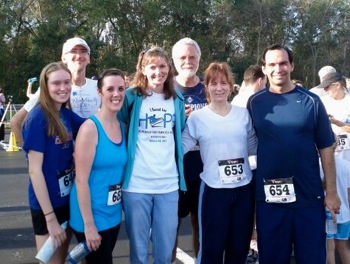
As many know, I took up running a year ago for reasons of health. My initial goal was to be able to finish a 5K by or near my 55th birthday. I did, with a great sense of satisfaction. My next goal is a 10K the end of March. But in between I was encouraged to run in a charity race this past Saturday for a local mercy ministry called Hope Helps.

I discovered that this event would be timed with chips embedded in the number bib, and that race results would be broken down by age brackets. Suddenly, running was not about exercise and it was not about finishing. It was about winning. My age bracket, anyway.

In the course of the race, of course, I had no idea where I was in relation to anyone else. I had chosen the race wisely. It being a new venue, there were not that many participants, so my chances of winning were substantially boosted by the lack of competition.

At 4K, however, I was passed by a man sporting a gray beard. I wanted so much to ask him, “Excuse me, sir. Do you happen to be between the ages of 55 and 59?” in order to determine whether I should try to beat him. But I thought that would be tacky. So, I just presumed he was.

Had he kept his pace, I never would have been able to catch him. But when the finish line came in sight, I realized that I had a real chance of overtaking him. I dug for whatever reserve I had and crossed the finish line wasted, but 2 full seconds ahead of my competitor.

So, yes, I won my age bracket. I beat the other 55-59 year old guy who ran it. I chose my race well.

After I’d recovered, Parry, the man I passed on those last seconds, came up to me, shook my hand, and congratulated me on a good race. I reciprocated.

Later I went to the results board and discovered that my new friend Parry was not in my age bracket at all. No, he left the 55-59 bracket a long time ago. I out-raced a 72 year old to the finish line.

So my racing resume is quite stellar. I can beat 16 year-old girls and 72 year-old men and, when the competition is light, other 55-59 year olds. Be impressed.

The Bullpen Gospels

Years ago when the Harry Potter phenomenon was in its rising infancy, some avoided the books judging them to be nefarious tools of the devil intent on dragging the innocent into the darkness of witchcraft and black magic. Upon reading the books I discovered that they were rather about loyalty, friendship, love, and sacrifice. Magic and spells and wizards only formed the context, the whimsical setting within which these greater themes could be played out.

So, I understand why one who is not a sports or baseball fan may pass by a book with the title The Bullpen Gospels: Major League Dreams of a Minor League Veteran upon the presumption that it is a book about games and stats and standings intent on dragging the uninitiated into the darkness of boredom. Baseball here forms only a context, the whimsical setting for what is really far more a book about life and how it is lived.

Dirk Hayhurst is a minor league veteran, a pitcher recently released by the Tampa Bay Rays minor league system who is now living in Ohio with his wife and dog. While he labored in the minor leagues, and for a brief stint in the Bigs, he passed his time observing and writing. I’m not sure what kind of pitcher he was, but as a storyteller, he is among the best.

Yes, we get here stories of life on the road and in the locker rooms of single-A and double-A baseball, memorably and humorously told. Readers should know that he records what he sees and hears. Locker room topics and language can be raw. You have been warned.

The stories he tells about himself, his family, and his teammates are true. But as a skilled teller of tales, he causes us to care about these people as characters in a larger story of struggle, conflict, disappointment, and redemption. It is often funny, occasionally poignant, always full of wisdom, but never sentimental.

Last Friday I was at my son’s basketball practice, reading this book. What cooler stuff to be reading among other ‘sporting’ parents than a book ‘about’ sports. It was a good cover, until I found myself fighting back tears. It is definitely NOT cool to be caught crying in the bleachers of your son’s basketball practice.

It is, as I said, a book about life. Honest. True. I’m glad I read it.

Page 40 of 142

Powered by WordPress & Theme by Anders Norén