Randy Greenwald

Concerning Life as It Is Supposed to Be

Really Cool Grace

A casting call has been issued for replacement vocabulary for all the Christian hymns dependent upon ‘amazing’ for their power. We’re talking some biggies here. “And Can It Be” ponders God’s “amazing” love, as does “When I Survey the Wondrous Cross”. And of course, there is (or was?) “Amazing Grace”.

All of them need to be fixed.

According to the arbiters at Lake Superior State University (home of the appropriately named ‘Lakers’) “Amazing” is one of the words which should be banished from use, along with “Baby Bump”, “Occupy”, “Man Cave”, and “Ginormous”. LSSU receives nominations for its annual banished word list throughout the year, and this year the greatest number of nominations mentioned “Amazing”.

Say the judges,

Many nominators mentioned over-use on television when they sent their entries, mentioning “reality” TV, Martha Stewart and Anderson Cooper. It seemed to bother people everywhere, as nominations were sent from around the US and Canada and some from overseas, including Israel, England and Scotland. A Facebook page – “Overuse of the Word Amazing” – threatened to change its title to “Occupy LSSU” if ‘amazing’ escaped banishment this year…

Pretty intense.

So what are we to do? Send Wesly, Watts, Newton, and Co. back to the drawing board, I guess.

Awesome grace, how sweet the sound…

Love so mind-blowing, so divine…

Stupefying love, how can it be.

Hmmm. This presents a potentially ginormous problem.

—–

As a footnote, let me praise the folks at LSSU. I am generally in total agreement with their judgment. Last year’s list included “epic”, “fail”, “man-up”, “viral”, and my personal dis-favorite, “the American people”.

Theological Soundtrack

Monday morning is my day to pull up to the fuel pump and top off a depleted tank. Sunday takes a lot out of me.

I ordinarily make no appointments other than to spend the morning reading. And I read devotionally, theologically, historically, and practically, normally running four or so books at a time.

You will find me more often than not doing this reading at a local Starbucks. I will run into a few friends, and perhaps make a new one or two, but generally I’m left alone and the ambient noise while sufficient to keep me focused is not so overwhelming that it distracts.

Now and then, however, a conversation arises at a nearby table which is either loud enough or interesting enough that I can’t help but listen and hence be hopelessly distracted. This is particularly difficult when the work I’m reading demands a high level of concentration.

When that happens, I pull a set of earbuds (of which I’m not fond) from my case and queue up a classical playlist in iTunes. The classical music can be turned up to a sufficient volume to obscure the conversation around me while being itself generally non-intrusive. And choosing shuffle keeps it interesting.

So it was that I found myself reading this morning Fred Sanders’ The Deep Things of God: How the Trinity Changes Everything with earbuds uncomfortably in place.

Slowly, I became aware of a serendipitous overlap between the words I was reading and the music I was hearing. A soundtrack to my theological reading was forming.

As Sanders made much of the dramatic centrality of the Holy Trinity of God in our salvation, Tchaikovsky’s 1812 Overture was building to a noisy climax. Theological and musical drama fed each other.

And then, as Sander’s content drifted into a consideration of the meaning of grace in trinitarian terms, J. S. Bach took the stage with the appropriately chosen Sheep May Safely Graze.

I’m not so mystical as to say that the Holy Spirit would have chosen that moment to serve as something of a divine DJ (or ‘iTunes Genius), but it would not take much to push me to that conclusion.

Turtle Life

On the theme of ‘doing less‘, and ‘doing other‘, comes this E. B. White (of Charlotte’s Web fame) New Yorker column, published on January 31, 1953.

Enjoy. Reflect. Preferably relaxing in the sun on a partly submerged log.

We strolled up to Hunter College the other evening for a meeting of the New York Zoological Society. Saw movies of grizzly cubs, learned the four methods of locomotion of snakes, and were told that the Society has established a turtle blood bank. Medical men, it seems, are interested in turtle blood, because turtles don’t suffer from arteriosclerosis in old age. The doctors are wondering whether there is some special property of turtle blood that prevents the arteries from hardening. It could be, of course. But there is also the possibility that a turtle’s blood vessels stay in nice shape because of the way turtles conduct their lives. Turtles rarely pass up a chance to relax in the sun on a partly submerged log. No two turtles ever lunched together with the idea of promoting anything. No turtle ever went around complaining that there is no profit in book publishing except from subsidiary rights. Turtles do not work day and night to perfect explosive devices that wipe out Pacific islands and eventually render turtles sterile. Turtles never use the word ‘implementation’ or the phrases ‘hard core’ and ‘in the last analysis’. No turtle ever rang another turtle back on the phone. In the last analysis, a turtle, although lacking know-how, knows how to live. A turtle, by its admirable habits, gets to the hard core of life. That may be why its arteries are so soft.

“A turtle, although lacking know-how, knows how to live.” Something to be said for that.

For Understanding

This is from novelist Ian McEwan’s piece on his relationship with Christopher Hitchens.

THE place where Christopher Hitchens spent his last few weeks was hardly bookish, but he made it his own. Close to downtown Houston is the Medical Center, a cluster of high-rises like La Défense of Paris, or London’s City, a financial district of a sort, where the common currency is illness.

This complex is one of the world’s great concentrations of medical expertise and technology. Its highest building denies the possibility of a benevolent god — a neon sign proclaims from its roof a cancer hospital for children. This “clean-sliced cliff,” as Larkin puts it in his poem about a tower-block hospital, was right across the way from Christopher’s place — which was not quite as high, and adults only.

The highlighting is mine.

That sentence is a call to arms for every apologetic cell in a Christian’s body. But for a moment, let’s just listen.

This is also a very clear, and very poignant, insight into how many think about God. If we have been enabled to reconcile the benevolence of God with a children’s cancer hospital, then let us be grateful to God, but let us as well be sympathetic to those yet to make peace with one of the hardest realities in a broken and fallen world.

And let us pray that we all, especially at Christmas, may have a clear vision of a benevolent God’s breaking into this broken world through a Child.

Resolving To Do Other

The need to do less is clear.

Those of us for whom “production = personal value” are compelled to be busy not necessarily by the inherent good in the thing we do, but by the fear of a perceived disvalue arising from our inactivity. Driven by a need for approval, by a lust for attention, by an insatiable interest in everything, or by a deeply ingrained ethic equating godliness and hard work, we apply ourselves to excel, or at least do more than the next guy.

So, for those of us so driven, the need to do less is clear. But the issue is not simply that we are doing too much. It may be that we are doing too much of the wrong thing and not enough of the right thing.

I’m a huge fan of (New College of Florida alum!) David Allen‘s Getting Things Done. (My first introduction to this came through this article.) More than anything else, Allen’s common sense approach to work flow and modern life has enabled me to keep whatever grip I have on my fractured life. I commend it highly.

Allen’s principle thesis is that we can reduce stress by getting all that clamors for our attention out of our heads and into some kind of orderly system. He’s right. Even though his promise of ‘stress-free productivity’ may seem an illusion, it is true that there is value in systematizing all of those competing commitments creating an undefined noise in our heads.

When we systematize all of our commitments, and carve away the fantastic which we know we’ll never accomplish (it’s too late for me to learn Greek well enough to read it without helps, you know), we begin to see two things clearly. First, we begin to see all that we are not getting done, which is a traumatic revelation. And secondly, we see that among those items on the list of tasks not being accomplished are some very, very important things. That can be very jarring.

The reality is that we may not need to simply do LESS in our lives, but OTHER. We may need to reorder what we do, striking from our plates some commitments which overly drain us or otherwise keep us from the important things. Allen commends making such assessments, and the end/beginning of the year is a good time to do so.

I labor (interesting choice of words) then to do less in order to find simplicity, and to do other, because it is important.

Tim Tebow and Idolatry

Dirk Hayhurst is a professional baseball player and a writer with a depth and maturity of insight that I admire. His comments here on the “Tim Tebow Affair” (Tim Tebow: Are His Celebrity and Football Success False Idols?) are full of insight. Speaking neither for nor against Tebow, he rather challenges our temptation to wrap truth in the success of others. Odd it is that we who follow a savior who died in obscurity can be so caught up in celebrity.

The piece is so full of quotable wisdom that I simply must plop the final couple sentences here and encourage you to read the whole.

“…let us not continue some temporal media spectacle focused on production and sports celebrity. These things can evaporate like dew on morning grass.

“Instead, let’s focus on the same boring, consistent, and yet oh-so-exciting promises that have always been in front of us—that God sent his only Son into this world to die for our sins so that through his death we might have peace with God and new life. If that doesn’t get you pumped up, nothing any sports star can do will.”

I’m rooting for Tebow. I’m impressed by Tebow. But I’m once again reminded of how easily we create and then unwisely rest in idols.

—–

Garfoose promo1By the way, Hayhurst is, uh, a character. His alter-ego is a ‘garfoose‘ – a half giraffe and half moose creation which I find wonderfully appealing. Nothing at all somber and dull about this guy. That’s why I like him.

Both his books are on my Amazon wish list. *wink, wink*

Resolving To Do Less

The end of a year is met with regret over resolutions never met and with hope in anticipation of resolutions yet to be made. But like it or not, this time of year is met with our minds tilting in the direction of those things we might (try again to) change.

Most of the time, resolutions commit us to doing more. More exercise, more financial frugality, and so forth. I need to find a way to resolve to do less. To do less, that is, of the things which distract and make life hectic so that I might do more of that which really matters. How to dissect my life in such a way that those distinctions become clear is the challenge.

J. B. Phillips in his insightful little book Your God Is Too Small challenges my constant anxious activity, as others have done in the past.
“If there is one thing which should be quite plain to those who accept the revelation of God in Nature and the Bible it is that He is never in a hurry. Long preparation, careful planning, and slow growth, would seem to be leading characteristics of spiritual life.

“Yet there are many people whose religious tempo is feverish. With a fine disregard for its context they flourish like a banner the text ‘The King’s business requireth haste,’ and proceed to drive themselves and their followers nearly mad with tension and anxiety!

“It is refreshing and salutary, to study the poise and quietness of Christ. His task and responsibility might well have driven a man out of his mind. But He was never in a hurry, need impressed by numbers, never a slave of the clock. He was acting, He said, as He observed God to act—never in a hurry.” (pages 55, 56)

Hmmm. And of course there IS that thing about his yoke being easy. I need to resolve to do less.

Garbage Stories

Monday is garbage pick-up day in our neighborhood. Thus, my early morning run allowed me to engage in a crude form of curbside archeology. You can learn a great deal from what people throw away. At least you can imagine you can.

There are whole stories of lives being lived behind the walls of our homes contained in the garbage by the curb. Sometimes this may be the only insight we have.

Your interpretations may differ from mine. If so, I’d love to hear!

+ + + + +

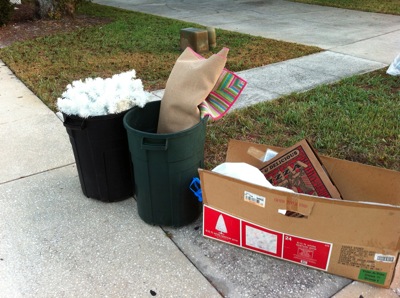
“Hey, kids, I’ve ordered some pizza. We’re going to decorate the new tree tonight.”

IMG 1669

+ + + + +

“Oh my God! It’s Monday already?”

IMG 1670

+ + + + +

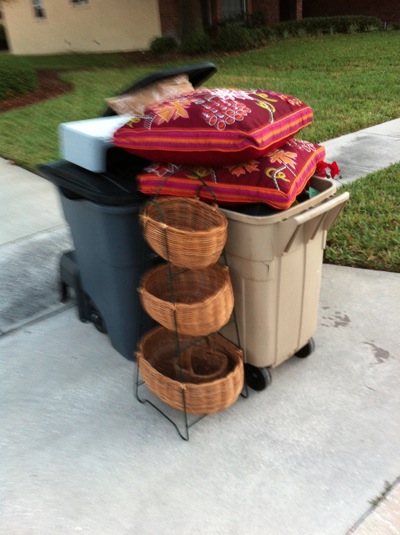
“Where are we going to put the tree?? Some of this stuff has to go!”

IMG 1668

+ + + + +

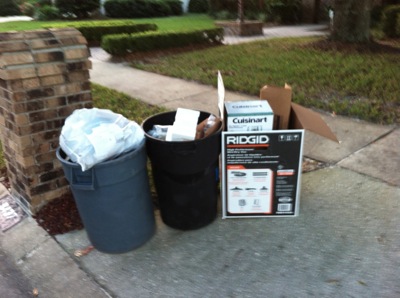
“No, really, Dear. If you let me open it NOW I can use it to make some gifts for the kids.”

“Okay, then. But I get to open the coffee maker, too. Deal?”

“Deal.”

IMG 1671

+ + + + +

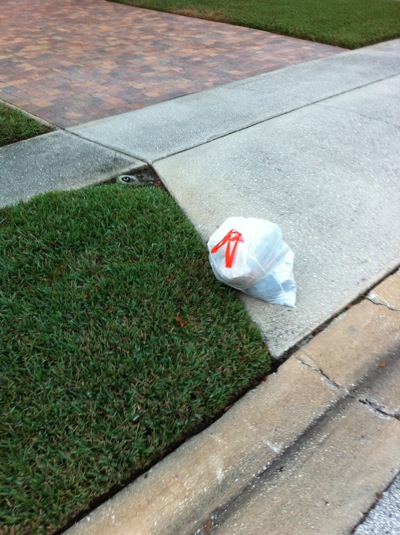
“I recycle. A lot.”

IMG 1672

+ + + + +

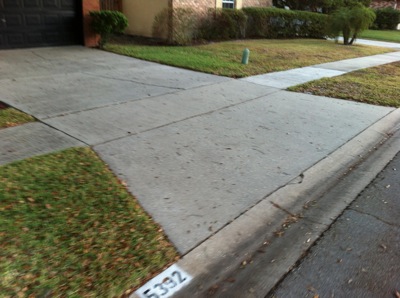
“I thought you said the gate was unlocked!”

“I thought it was! But you weren’t supposed to hit it at full speed!”

IMG 1673

(Sorry for the blur in this one. It was near the end of my run; hands were not stable.”

+ + + + +

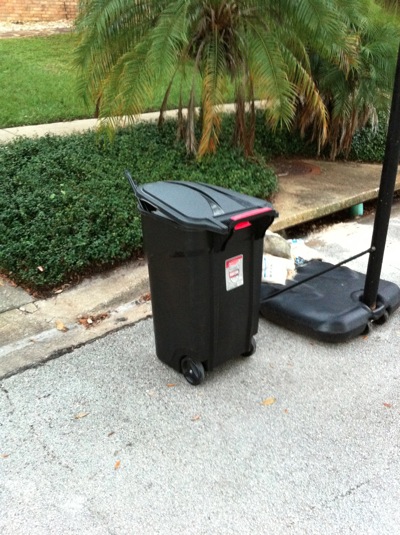
It’s a wonderful life. Somber, and at times dull, but orderly. It must be orderly.

IMG 1667

+ + + + +

Sometimes God Knows We Need a Laugh

Sometimes God just knows that we need a laugh. I needed a laugh this morning….

> Forty years ago a book was published.

> A copy recently was spotted in a used book store and perused by just the right person.

> This person wrote about the book on a blog, noticed by a friend of mine.

> She retweeted a notice about that book. The tweet came with appropriate warnings.

> I saw her tweet and following the link and read the blog post. I was supposed to be reading my Bible.

> It was 5:00 AM and all through the house no sound was heard except my suppressed, my poorly suppressed, laughter. I clearly was NOT reading my Bible.

> Poorly suppressed laughter sounds strangely like crying. It could have passed for Bible reading, but fortunately, no one heard.

Sometimes God just knows that we need a laugh. In the intricacies of providence a book published 40 years ago was his vehicle for me, through a bookstore blogger, through a reader and tweeter, and through my innate propensity to follow distractions.

You must read this. But do not do so while sipping anything.

You have been warned.

Two Front Teeth, and a Couple Other Things: An Instant Read Thermometer

While I’m in a kitchen kind of mood, I would like to recommend one more critical piece of kitchen equipment for this Christmas season.

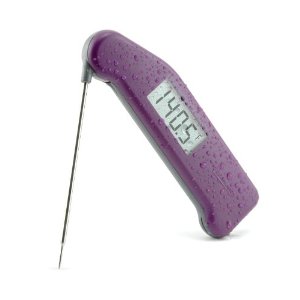
Though I like cooking and baking, my repertoire of kitchen creations is rather limited. More often than not I will be grilling something or baking rolls. And before I discovered the wonders of the Thermapen instant read thermometer, my burgers would be burnt, my chicken pink, and my rolls fallen. All was not good. But the Thermapen has rescued me from all that.Thermapen

This gadget is a slick piece of design which can measure the internal temperature of meat, breads, and even, because we’ve tried, swimming pools. It is accurate and very, very fast. Within seconds, you can have an accurate read on your food’s internal temperature and know whether to shove it back in the oven or get it off the grill.

The usefulness of this thermometer is pretty obvious when it comes to meats. The ability to measure the internal temperature of a piece of chicken quickly on a hot grill keeps me from over and under cooking chicken, which I did frequently before. An undercooked turkey can be a frustration on Thanksgiving or Christmas, as some may have recently discovered.

But the real value of the Thermapen for me has been in baking. Breads are not necessarily done when the outside is brown. The rapidity of browning varies based upon the moisture content of the bread and the proximity of the heating elements. Bread is only done when its internal temperature is in the 180-210°F range, depending upon the bread. The ability to test this quickly without losing oven heat is so, so helpful to impatient types like me. A tray of rolls whose center temperature is only 160°F may look fine in the oven. But when pulled out and allowed to cool, the center will sag and underneath the beautiful brown crust will be a gooey mess of undercooked dough. Ugh.

The Thermapen is pricey. It can be purchased from the manufacturer’s web site for $89.00. I suppose one would want to rescue a whole lot of rolls for that price. And I have. We’ve used ours for a few years now and should this one break, which it shouldn’t, I’d buy a replacement without hesitation.

So would, apparently, a host of reviewers more celebrated than I, including, according to the Thermapen web site, Alton Brown. But, hey, why trust anecdotal preferences when you can turn to the guys over at Cooking for Engineers dot com (yes, that is a real site) to run a series of tests on it? The Thermapen won the day there, and has persuaded me here. Perhaps there are less expensive options out there, but I can’t see trusting my rolls to another.

Page 41 of 142

Powered by WordPress & Theme by Anders Norén