
Randy Greenwald

Concerning Life as It Is Supposed to Be

Dr. Jeremiah, Reprise

Thoughts this week have been driven by a desire to see the hope of Christ rekindled in those for whom it has burned dimly, that as we come to the celebration of Easter we might indeed be renewed in the joy of life given by the life of Him raised from the grave.

These thoughts lead me to a post made a couple of years ago. I repost it here for the sake of those who struggle. Some have found it helpful. I trust others might as well.

———————————

Prone to self-pity, I told my wife the other day that I must like despair like some like ice cream since I indulge so often. But though our thoughts may be trained to flow down well-worn channels, we are never meant to stay there.

My Bible reading plan for the other morning had me reading the book of Lamentations. This is by no means the first place I’d go to or recommend going to when one is feeling the weight of life, and I had little hope of the morning’s reading bringing much comfort.

But the prophet Jeremiah, the book’s reluctant author, has been nicknamed ‘the weeping prophet’ not because he curled up in a useless puddle in the face of the affairs of life, but because he gave expression to the frustrations that life brought to him. He took those frustrations to the One whom he believed to be the source of life.

He wrote as the city of Jerusalem fell apart around him under a Babylonian siege. That siege, Jeremiah had repeatedly pointed out, was the judgment of God upon the squishy, superficial spirituality of Israel. God had had enough and was bringing his promised judgment.

As I sat in “Dr. Jeremiah’s” couch, he showed me that affliction and sin all mixed up and confounded can drag one from freedom to bondage.

“She who was a princess among the provinces has become a slave.” (1:1)

He showed me as well that it is okay to trace this to its source.

“…because the LORD has afflicted her for the multitude of her transgressions.” (1:5)

The cause may be my sin, but the source of the affliction is and always will be God. It does not help to try to sidestep God’s sovereignty when we are suffering. In fact, it is appropriate to give full vent to how this makes us feel.

“The Lord has swallowed up without mercy all the habitations of Jacob….” (2:2)

It seems wrong to accuse God of acting “without mercy”, but when that is the way it feels, that is what we need to say. But in Jeremiah I see as well one who, giving vent to bitter honesty, cannot remain at the place of bitter honesty. That is the case with any who truly know God. Yes speaking with such honesty is good, but we must at some point emerge elsewhere.

“The steadfast love of the LORD never ceases; his mercies never come to an end; they are new every morning; great is your faithfulness.” (3:22, 23)

I want to live in that verse, but I often don’t. I think that one of the reasons public worship is so important is that being with God’s people under the ministry of God’s word is a place where, if even for a brief moment, God can move us from the despair of 2:2 to the affirmation of 3:22, 23.

But we want to be there always, not just for a brief moment, we protest from Dr. Jeremiah’s couch. He knows that. But he also knows that in God’s wisdom there is ordained a time for everything under heaven, and for some times we must wait.

“The LORD is good to those who wait for him, to the soul who seeks him. It is good that one should wait quietly for the salvation of the LORD.” (3:25, 26)

Waiting is something foreign to me and to many others. Waiting is not what spoiled and soft children are prone to practice. But waiting, nevertheless, is what God demands.

It does not take one long to realize that the afflictions facing the Israelites and observed and experienced by Jeremiah were far worse than those faced by the readers of this blog (both of us). Nevertheless, ours FEEL as real and as painful and the hard place for all of us is to wait quietly. Quiet waiting is a far better place than quiet (or noisy) desperation.

And so Dr. Jeremiah dismisses us from his office with a prayer purged of complaint and focused as it ought to be.

“Restore us to yourself, O LORD, that we may be restored! Renew our days as of old….” (5:21)

The ellipses can be used to hide things to make the text say what I want it to say. Many writers hide behind abbreviated texts. Here note that I have dropped an important qualifier from the text.

“…unless you have utterly rejected us, and you remain exceedingly angry with us.’

What Jeremiah could only sense is what we know to be fact – that we may trust in one who was utterly rejected for us, so that we might know that God would never remain exceedingly angry with us.

With that hope we leave our appointment with this soul doctor. And the good thing is that his consultation was free.
Dark Night Rises

Eugene Peterson, in reflecting on the longing for intimacy with God, often elusive, of which I wrote yesterday, speaks these hopeful words:

“The appetites that God has created in us lead to the satisfactions he has promised.”

That is hopeful, but it does not promise immediate satisfaction. And so Peterson reflects on the role of pastoral ministry in guiding struggling Christians through what has been called such ‘dark nights’ of the soul. The counsel he gives pastors is applicable to all Christians as we come alongside of others who are struggling.

Too often all we know to offer those struggling spiritually are trite and simple “fixes” to their struggle of doubt and loneliness. Rather what they may need are friends comfortable with walking with them through the valley of the shadow doubt and even death. They need friends who understand that such spiritual struggles are not abnormal and cannot be rushed.

Peterson’s words are not only wise and refreshing, but counterintuitive in our technocratic age. It is good for us to hear them.

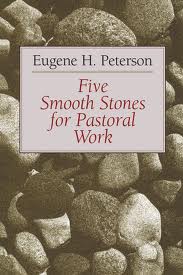
5 Smooth Stones

“The accounts of saints who tell of the ‘dark nights’ of the soul are familiar. Their search for God seems endless and futile, but is broken into by moments of ecstasy when they find (or our found by) the one they sought….”

“Pastoral work acknowledges the difficulty and the pain of the quest and shares it. It does not attribute the agony of longing to a neurosis, it does not search for a cause in moral deficiency, it does not try to ‘cure’ it by working for an adaptive adjustment to ‘reality.’ It honors the quest. The difficult painful moments of unfulfilled longing are integral to the nature of the relationships.

“It is not the pastor’s job to simplify the spiritual life, to devise common-denominator formulas, to smooth out the path of discipleship. Some difficulties are inherent in the way of spiritual growth — to deny them, to minimize them, or to offer shortcuts is to divert the person from true growth. It is the pastor’s task, rather, to be companion to persons who are in the midst of difficulty, to acknowledge the difficulty and thereby give it significance, and to converse and pray with them through the time so that the loneliness is lightened, somewhat, and hope is maintained, somehow.”

Eugene Peterson, Five Smooth Stones for Pastoral Work, pages 49-51

Until He Comes

When Christians celebrate the Lord’s Supper, we do so not merely as an ancient ritual celebrating a historical event. Rather, we come to the Table within an Easter framework, believing that he who lived and died is yet alive. Our participation is set in the context not only of ‘what he has done’ but also in the context of ‘until he comes’ (1 Corinthians 11:26).

CommunionRightfully, therefore, we come to the Table looking forward to the consummation when we will join with him at the eternal Table, where sin and pain and death will all be taken away and when we can dwell on his beauty and enjoy him forever. The joy and rest of that is beyond comprehension, and so we take the bread and drink the wine with great longing in our hearts.

But sometimes, we come empty. We come as those who are in the wilderness, whose ‘now’ experience of any taste of that which will be future is weak and diminished. We come lonely and isolated, assuming (often wrongly) that all around us are having a deep and refreshing walk with God while we feel exiled and cut off. We take the bread and drink the wine and walk away unfulfilled, and unaware of what the Spirit is doing deep within us.

Even then, we must come to the Table, and come again, with that Easter longing in our hearts, persisting in our longing ‘until he comes’. The coming we long for in such situations is not simply his return in glory, but his return in intimacy with our souls, which we passionately desire.

Our doctrine of the Holy Spirit dances around Jesus’ teaching that the Spirit ‘blows where he wills‘, coming and going according to his own purposes. We rather think we can by formulae get him to show up. That is, of course, a fiction. He will come when he wills, and he is never late.

The King, our covenanted husband, has his reasons for being away. But we long for him. We long for intimacy with him. We long to love him and to know his love. We come to the Table pursuing these longings until he comes, with the hope that come he will. Sometimes we take the bread and the wine with force, desperate to be fed with the One of whom these are symbols. In the midst of great doubt, there is an act of faith, performed until, in his time, he comes.

Come to the Table, until he comes.

Come, Lord Jesus.

Dead Heat

In Nickel vs. Silver round one, Nickel is holding his own. But probably not for long. For full explanation of the categories below, see here. (But only if you have time to kill.)

At the end of the first round of 32 games, the brackets stand as follows:

Offense: 20 of 32

Defense: 16 of 32

Average: 19 of 32

Silver: 22 of 32

Nickel: 22 of 32

Thus far, massive computers and sophisticated metrics have failed to top a simple coin flip.

Nickel, by the way, is a BIG fan of Florida Gulf Coast University, taking them to the round of eight. We’ll see. Nickel also had Kansas State in the championship game.

Nickel vs. Silver

Nate Silver is the ultra-geek whose statistical analysis last year was successful in predicting the outcome in every state in the 2012 presidential election. But his first love has been sports, and so he has turned his computers in the direction of the NCAA tournament.

It’s pretty impressive, really. He quantifies everything from strength of schedule to pre-season expectations to current injuries. But Nate Silver does not have my nickel.

I’m not going to count the play-in games of the past two nights in the bracket score. However, to whet our appetites for the ensuing battle, note that Silver’s computers generated predictions accurate for 3 of the four games. This beat three of my four brackets (explained here).

Offense: 0 of 4

Defense: 2 of 4

Average: 1 of 4

The one he could not top was my nickel, which matched his success rate of 3 of 4.

Let the games begin.

Bracket Brilliance

In the past I’ve completed my NCAA tournament bracket like I really knew what I was doing. That wasn’t much fun because, truth be told, I really DON’T know what I’m doing and pretending that I did was just another source of stress.

So, last night I stayed up WAY past my bedtime (must have been after 10:00) completing four different brackets, all based on different objective metrics. Take issue with me if you like, but then match your brilliance against mine.

The first I completed is based upon offensive ranking. That is, the team with the highest points per game during the regular season would be assumed to beat the team ranked, say 26th. This proved to be a fairly disastrous approach. I’m not sure anyone is seriously looking for Northwestern State to win it all, even with their insane 81 ppg average. In fact, I’m not sure I could find three people who know where Northwestern State IS. This did make me interested in their Friday evening game against Florida, however. So, it was not all a disaster.

Secondly, I completed a bracket based upon defensive ranking. In this case, the team with the lower points per game allowed is assumed to beat the team with the higher ppg allowed. This proved to be a little bit more interesting, as it produced an unlikely but still possible final four of Pitt, Middle Tennessee State, Syracuse, and Florida, with Florida taking it all. This was the only scenario in which my Michigan State Spartans make it out of the first round.

My third attempt was a composite of the first two. I averaged a team’s offensive and defensive ranking, so that a team that was number 30 in the offensive ranking and number 70 in the defensive ranking was assigned a rating of 50. The team with the lower rating, then, would be the presumed winner in any matchup. Curiously, judging matchups this way resulted in a predictable final four composed of all four #1 seeds. I think I’ve stumbled upon the selection committees assignment methodology. Gonzaga, the current #1 team in the country, wins it all. How boring.

2005 nickelSo, for my fourth bracket, and the one I’m most fond of, I reverted to a method I used in 1981, a method which led to a modest financial return. I took a nickel, and for each matchup assigned heads to the team on the top and tails to the team on the bottom, and flipped. In 1981, that method predicted Indiana to win the championship, which they did. Oddly enough, this year, the method produced the same outcome, from a final four including as well Cincinnati, Kansas State, and Villanova.


I’ll assign one point to each accurate prediction in the first round, 2 points for the second round, four for the sweet sixteen, 8 for the elite eight, 16 for the semi-final games, and 32 for the championship game. I’m saying my lucky nickel bracket wins among the four. I’ll keep you posted.

Bring Snacks

My sermon yesterday seemed to go long. We’ll see after it is posted online just how long it was. But I had to simply summarize the last point, and that weakly, to allow our service to end on time.

The irony of this, of course, is that the sermon was on the shortest chapter in the bible – Psalm 117, a mere two verses. This led one member to quip, “If this is how long you go with the shortest chapter in the bible, when you preach on ‘Jesus wept’ [the shortest English verse] I’m bringing snacks.”

Which led some to whom I told this story to ask how long a sermon should be. I always answer that question with the very wise answer of the British pastor and author John Stott who said something like this: “It does not matter how long a sermon is as long as it seems like twenty minutes.”

But I don’t mind if you bring snacks.

The Most Important Thing

In the car today I heard someone say on the radio with regard to the cardinals gathering in Rome to elect a new pope, “This is the most important thing these cardinals will ever do.”

And I wondered about that.

I understand the context and what the quoted meant to convey. But I wondered if he or they really believe that. These cardinals were no doubt once ordinary parish priests doing ordinary parish work. Is the work of electing a pope more momentous than what pastors perform in their own parish environments every day? Something tells me that it is not.

I rather suspect that the most important thing that any of us ever may do will not be known to us. Perhaps that word idly but fitly spoken settles upon another like an “apple of gold in a setting of silver.” (Proverbs 25:11) Perhaps that act of hospitality easily carried out by us sets a guest thinking about Jesus. We can’t know the importance of our acts.

A college professor changed the tenor and direction of my life by listening to me one day and then recommending a good book. Probably not the most important thing he ever did, but something of great importance in my life and something the impact of which he could never have imagined.

As I said, I suspect that the most important things that we do in our lives are never quite known to us but come about not because we have achieved a place of prominence but because while being faithful in our callings God opens up a door of influence.

And we may never know what he will do with that faithfulness.

They Love Us?!

My brother and his wife from Ohio just called. They are coming to visit.

Tomorrow.

It’s because they love us, right? Sure. But one can’t discount this:

IMG 2786IMG 2785

The History Channel Bible II

Much is being said and written about the success of the pilot for the Bible mini-series. Most reports are stating that it was watched by 13.1 million viewers, a stunning number when ordinarily successful shows draw 2 or 3 million.

But assessment of popularity and assessment of quality are not at all related. Members of a nearby mega-church were being urged to watch whether they were inclined to do so or not in order to boost the ratings and therefore encourage more productions like this. Numbers were inflated as well by the curious. By the time the sixth or seventh in the series rolls around, I wonder how many of those 13.1 million will still be around. My gut says not many.

Page 32 of 142

Powered by WordPress & Theme by Anders Norén