Randy Greenwald

Concerning Life as It Is Supposed to Be

The Value of Worship

Christian worship is far too often judged for its immediate effects and not its long term value. Surely things such as the quality of the sermon, the selection of songs, and even length do matter, but I wonder if we often ponder enough the vital transformative power of regular participation in worship. Is there not something in the character of the liturgy itself with power to integrate itself into our own perceptions and to form and shape our own rhythms of experience? I cannot really recall any of the sermons of my childhood. I cannot reflect any of the hundreds of thousands of words spoken or songs sung. Nevertheless, I am certain that the character of my life and or my thoughts and of my desires has been shaped and directed by those weekly routines of song and word and prayer and, in my case, quarterly sacramental participation.

I cannot PROVE the value and I cannot point to academic comparative studies substantuating my claims, but I sense this is true.

Joking with a newly married couple the other day, they spoke of something they had now done ‘twice’ which had become for them, therefore, a tradition and needed to be kept up. Clearly there are aspects of family life that through repetition and priority form the members of that family into certain shapes and develop within them certain attitudes and passions. As family tradition and ritual can do that, so can regular participation in Christian worship.

A fellow pastor lamented to me recently the low commitment to worship evidenced by members of his congregation. I know the temptation to treat worship lightly. On a Sunday I had ‘off’ a few weeks ago, I faced the desire to just kick off my shoes and sit quietly at home for a Sunday. In nearly thirty years of pastoring, I’ve heard my share of ‘reasons’ for missing worship on Sunday far less substantive than I would have had. But I wonder what sustained and regular absence does to us. I wonder what we lose.

Criticism of sermons is painful, but a part of the job. Complaints about music I take to heart but despair of satisfying. I do want worship to have an immediate positive impact upon all who participate. I do want worshipers to drive home with their hearts full of the power of the gospel and the greatness of God. And yet, I think the real, lasting, deep, and abiding value of worship is in its regularity. It is a discipline that shapes us.

Psalm 84
1 How lovely is your dwelling place,
O LORD of hosts!
2 My soul longs, yes, faints
for the courts of the LORD;
my heart and flesh sing for joy
to the living God.
3 Even the sparrow finds a home,
and the swallow a nest for herself,
where she may lay her young,
at your altars, O LORD of hosts,
my King and my God.
4 Blessed are those who dwell in your house,
ever singing your praise! Selah

The Middle Man

Ron Unz of the American Conservative has thought for some time that so-called ‘gay marriage’ was an inevitability. What is somewhat troubling in his re-statement of his position here is his cynicism regarding the power of the church to shape thinking. I post this not to take a position on marriage, but to encourage thought about preaching. The relevant passage is this (emphasis mine):

Above all, the transformative power of the American media is once again revealed. Some time back I joked with a conservative friend that after a few years of relentless media pressure the very same preachers then denouncing Gay Marriage as the “sin of Satan” would probably be uniting same-sex couples in holy matrimony at their own churches, and so far the social trend lines seem to be supporting my prediction. After all, in modern American society the Word of the Almighty and His Holy Book may have a powerful influence, but they are regularly trumped by whatever our electronic media tells us to believe. Perhaps churches should just install television sets in front of their pews and cut out the middle man.

What do you think? Too cynical?

Wasup Craigslist

One aspect of Mark Twain’s genius was the keen ear by which he was able to duplicate the sounds and rhythms of a variety of dialects. Certainly this too was one of the remarkable charms of Kathryn Stockett’s The Help.

Since I might be interested in purchasing a good quality bike rack for our car, I receive notifications from Craigslist when one is listed. That led to the following. I’m not really sure what to make of it. It’s real (I couldn’t make this up). It’s unlike anything I’ve seen before. It’s worth trying to read out loud. And if this is fiction, there is another master out there waiting for his break.

Wasup craigslist i got a clean 93 honda civic eg hatch this car is like a 9/10 has a super fresh jdm b20 with a bout 85k on it has a b16 tranny new axels new distributer fresh oilchange motor is mint its so fresh yu can eat of it! Has a chipped computer with 2step luanch control on a basemap has a check engine shift light. Paint is in good condition but not perfect suspesion i have ground control coilovers with tockicko blue struts its on red gt3 with new tires has front lip hids city lights amber corners i have foglights not installed will come with buyer also has yakima bike rack has rpm tach short shifter headers no oil leaks or kicks or ticks on the motor the ca is super clean and talks for it self im giving it cheap bcuzbi need the money i am asking 4300 or better offer willing to work aomething out the less yu offer the more i take off also chas a system has no ps or ac also has a momo champion stering wheel with nrg quick release also has front and rear red towhooks intirior is in very good condition also car is worth more then wat i am asking hmu txt me or call me

If any would like to submit a translation, post it in the comments. I think it’s English, however….

O, Death

Those who lived for any time in Tampa Bay hold former Tampa Bay Buccaneers coach Tony Dungy in high esteem. I’m sure the same can be said for those who live in Indianapolis where Dungy ended his NFL coaching career.

He is esteemed not only for his success on the football field – he was fired in Tampa, we should note – but for his character, character formed and molded by his Christian convictions. Dungy’s Christianity was not a PR image, but something real and deep impacting the life he lived. And people noticed.

But people also noticed with sadness that this righteous man had a son, a student at the University of South Florida, who in the depths of depression took his own life.

I don’t know much about Pastor Rick Warren, but controversy aside I sense that he, too, is a man who loves God and has sought to live faithfully before him. His son, like Dungy’s, has taken his life.

Pain and tragedy, and yes, the deep darkness of depression, does not spare the faithful in this broken world. My wife and I this morning recounted the names of those we have known who have taken their lives, attempted doing so, or have expressed the desire. It breaks our hearts.

I have often been asked by those trembling with the pain of suicidal loss to weigh in on their loved one’s eternal state. There is a tradition in Christianity suggesting that those who commit suicide go to hell.

When asked, I respond, I must respond, with a question: “What saves us – Jesus’ sinlessness or our own?” Clearly the Christian gospel trumpets “…nothing in my hands I bring / simply to thy cross I cling…”. Self murder is unquestionably a sin, a desperate, horrible, selfish abandonment of faith and hope. But it can no more undo the sufficiency of the work of Christ than any other sin. Jesus saves us, not our sinlessness. Those trusting Jesus are saved by him, even if their final act was a sin.

Some argue that suicide is different, that one cannot repent of the sin of suicide. But without diminishing the value and importance of regular repentance, of particular sins, particularly, nevertheless, our hope of salvation rests in Jesus not in repentance. Jesus, not repentance, saves us.

Do we not, though, by speaking thus encourage the suicidal to hasten a path to peace that seems to otherwise always elude them? I have been asked bluntly, “If I killed myself, would I go to hell?” Warren reports his son saying, “Dad, I know I’m going to heaven. Why can’t I just die and end this pain?”

A superficial understanding of grace will always make sin seem easier. And yet, in reality, an understanding of the love of God behind grace makes sin ultimately harder. Love, not fear, best keeps us from sin.

And yet, we still sin. We forget his love and we act contrary to it. And some, in such a moment clouded by a deep darkness which others cannot comprehend, flee the pain in the only way they know how. Can we not see, though, that the Man whose cries of despair echoed from the cross probably understands that despair and darkness better than most? Jesus loves even, perhaps especially, the despairing.

Our hearts break. And that is a good thing, for only from broken hearts will flow words of grace, not law. My preaching, and your speaking, is to broken people, whose brokenness we cannot fathom, and often cannot see. We need to speak, and to hear, but one wonderful and comforting truth: the steadfast love of a gracious God.

O, Father, enable us to hear it and hold on to it.

===

In 2002 friend and fellow pastor Petros Roukas took his own life. Bryan Chapell’s funeral sermon on that occasion stares the demons head on and fills the occasion with grace.

Bag of Water?

Sugar1The question of the month for me is this: “If you take all the carbon out of sugar, what do you have left?”


Those who actually know biochemistry tell me it depends, but that basically one would be left with nothing but a collection of H and O atoms in some configuration. I say, “Water” because I don’t really know what I’m talking about.

What spawns such a silly question is an even sillier label on this bag of sugar I bought last week.

Sugar2

I know what is meant, but context is everything, and this being a bag of sugar, a CARBOhydrate par excellence, I could not help but be amused.

I wonder if Dr. Atkins would approve?

Bono and Grover

It is inscribed in the lore of Hope Presbyterian Church in Bradenton the Sunday that the preacher, showing off his “acquaintance” with pop culture, made reference to the lead singer of the band U2, pronouncing Bono with both o’s long. Whatever point I was making was quickly lost as those in the know snickered with silent amusement mixed with pity.

That was then. I’m far more careful now.

Sort of.

Easter Sunday at Covenant Presbyterian Church is one of two or three Sundays each year that we do not dismiss the children to children’s church before the sermon. So since my audience was much larger and much younger than normal, I made an extra effort to speak to the children.

My opening reference to The Wiggles went fine. No problem there.

But then, trying to give the children something to look forward to, I assured them that Elmo was going to make an appearance in the sermon. A brilliant strategy, thought I.

Twenty minutes in, when the slide with Elmo’s picture appeared, I expected, properly, for the children to perk up and some to say, “There he is!”

But they didn’t. I was surprised. Shocked, almost. I really expected them to be excited.

And then it was pointed out to me that the slide in question was in fact not Elmo, but Grover.

Grover

One child reportedly said to his parents after the sermon, “But Elmo never came.” This is a failure of Bono proportions.

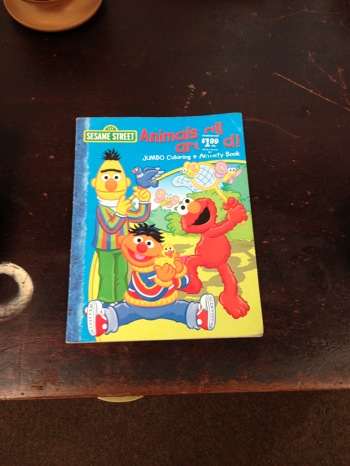
As a follow up, after the service, I found this on my desk.

SesameStreet

I will be studying my Sesame Street characters this week.

And how to pronounce the names of major pop artists.

What will you be doing?

Easter Celebrates the Impossible

When the Sabbath was past, Mary Magdalene, Mary the mother of James, and Salome bought spices, so that they might go and anoint him. And very early on the first day of the week, when the sun had risen, they went to the tomb. And they were saying to one another, “Who will roll away the stone for us from the entrance of the tomb?” And looking up, they saw that the stone had been rolled back— it was very large. And entering the tomb, they saw a young man sitting on the right side, dressed in a white robe, and they were alarmed. And he said to them, “Do not be alarmed. You seek Jesus of Nazareth, who was crucified. He has risen; he is not here. See the place where they laid him. But go, tell his disciples and Peter that he is going before you to Galilee. There you will see him, just as he told you.” And they went out and fled from the tomb, for trembling and astonishment had seized them, and they said nothing to anyone, for they were afraid. (Mark 16:1-8)

To be a Christian is to be a part of something impossible.

People struggle with Christianity as long as it contains vestiges of the impossible. An invisible God. A body of water split in two. A man raised from the dead. Things which our minds cannot comprehend.

That we are Christians is a glimpse into the impossible. Born children of wrath, we are welcomed as children of God. Inclined by nature to deify ourselves, we are moved to cast our crowns at the feet of Another. Those unable to imagine a god who can care for them find themselves comforted by his favor.

To be a Christian is to be a part of something impossible.

I might list the various persons who influenced over the years my Christian convictions – parents, pastors, friends – and sketch in great detail how their influence molded my ways of seeing God, but in the end they were channels he used to impossibly capture my heart. It was he who enabled me to delight in what my stubborn heart would otherwise have refused to see.

I think of others in my congregation, who sit with us on a Sunday morning, and I ponder why they are there. There is no plan or scheme that could have drawn them there. Only God. We are all a part of something impossible.

The Christian church by worshiping on Sunday is reminded that is a part of something impossible. It was on a Sunday, the first day of the week, that a group of women gathered at a tomb and found it empty. And at Easter we gather with them to once again peer into that empty tomb and declare, “He is not here. He is risen!” Impossible though it was and always will be.

Easter is that grand reminder that what is not possible for humanity is possible for God. To be a Christian is to be a part of something wonderfully impossible. And the God who did the impossible continues to surprise us with the impossible.

I cannot tell you where the next member of my church or yours will come from. But I can tell you that he or she will surprise us. There will be something impossible in their story, and the path that led them to us. And so we build relationships and probe our networks and live the gospel among those around us knowing that if any respond, it will be a surprise. It’s impossible. But we are a part of something impossible made possible.

This Easter, you may be facing impossible situations in your family, in your marriage, in your health, in your work, in your financial situation. Some hopes and dreams and expectations may have to die, and pain may have to be endured. But what God resurrects will be glorious, and we cannot now imagine it, because it may now seem impossible.

God calls us to ministry, to show mercy, to seek opportunities to speak the gospel into the lives of others. It’s impossible, we say. God cannot use us. Sure he can. To be a Christian is to be a part of something impossible.

I’m not easily aroused to hope. I stand at the edge of the Red Sea and prepare to die while Moses lifts his rod and the sea parts. I do not easily grab hold of the impossible and move forward. But that is what God calls us to.

This Easter my prayer is that we will once more be reminded that to be a Christian is to be a part of something wonderfully impossible.

Note: this was adapted from ConTent, the newsletter of Covenant Presbyterian Church of Oviedo, Florida

Nickel, RIP

He had a good life, my nickel. But with Indiana’s loss, his run is over.

If anyone is interested, I will give him free to a good home.

The Cornerstone

The New Testament writers are united in identifying the ‘stone the builders rejected’ which has become the ‘chief cornerstone’ with Jesus (Psalm 118:22, and Matthew 21:42, Mark 12:10, Luke 20:17, Acts 4:17, and 1 Peter 2:7).

A Christian’s faith can often be shaken and challenged. Doubt can be a real companion for sensitive souls. Easter returns us to the cornerstone of our faith, Jesus Christ once rejected now raised from the dead.

And this effects everything.

“The resurrection gives coherence to the entire New Testament: to the story of the virgin birth, to the miracles, to the transfiguration, to the titles ascribed to Jesus, to the worship accorded him, to Pentecost, to the idea of ‘en Christou’, to the perception of his death as an atoning sacrifice, to the expectation of the parousia, to the hope of resurrection and to the belief in a final judgment. It explains the disciples’ faith and martyrdom, the survival of the church, the expansion of Christianity and the existence of the Gospel of John.” (Donald Macleod, The Person of Christ, page 237)

Nickel Fading Fast

At the end of the second round of the NCAA tournament, my precious Nickel is showing his limitations. He’s not doing badly, but his stellar first round picks were not matched by his second round. Silver’s were more, well, sterling.

So, here are the scores following the second round (second round games score two points/victory).

Offensive Ranking: 20
Defensive Ranking: 30
Average Ranking: 35
Nickel: 34
Silver: 44

Nickel does pick FGCU to beat Florida. Bet your bracket doesn’t even have FGCU PLAYING Florida. So there.

Page 31 of 142

Powered by WordPress & Theme by Anders Norén