Concerning Life as It Is Supposed to Be

Month: September 2016

Helping “Somber and Dull” Find its Future

There are two (or three!) ways you can help this blog map its future. The first is easy. I’ve created a simple survey which shouldn’t take you more than a minute or two to complete. Please click here. This will help me think through what has resonated with my readers and how this content gets to them. (A link to this survey is also on the sidebar.)

Survey
The second is a bit more difficult. I am deeply grateful to those of you who have generously supported this blog over this past year. Your generosity is enabling me to take the steps that are necessary to move forward. The need for financial support will continue on into the future. So, if any would like to help us as we move forward, you can contribute by clicking here. I am very grateful. (There is a link to this also on the sidebar.)

Finally, any time you can direct traffic to this site, do so! If something strikes your fancy, pass it on to others. It’s the only way, really, any will find their way here. This will especially be true when we kick off the new site.

Thanks!

The Future of “Somber and Dull”

I love writing this blog, and I am gratified by the kind words many of you often pass my way in response. Some of what has been written here has resonated in an encouraging and helpful way with some of you. When “Somber and Dull” lay dormant for a couple of years, a few of you kept prodding me to resurrect it, and so I did. I like to think I have things to say that are worth saying, and this blog gives me the space to say them. I am trying to contribute something positive and helpful regarding how we are to live as Christians and the church in the modern world.

So far, I have written for a core of very loyal readers, a core who either are fond of the name “Somber and Dull” or who are not put off by it. But as I consider ways to grow the readership of the blog, I think the time has come to put the title out to pasture.

“Somber and Dull” was chosen as the title of this blog on a whim when I started it in October, 2006. You can read about that here and here.

The title and its ironic sensibilities grew on me and a few others. Others, however, are puzzled by it. In fact, the title confuses even internet sales algorithms, one of which thought this week that it would be suitable to inform me that the domain name ‘somberandstupid’ was available if I wanted to purchase it.
Somberandstupid
I’ll pass, but the point was received. The title is too obscure.

Soon, therefore, I will be giving this site a good makeover christening it with a new name and a new URL. You won’t see the changes soon, and I’ll give plenty of warning.
By Enrico Mevius - Self-photographed, CC BY-SA 3.0 de, https://commons.wikimedia.org/w/index.php?curid=12807129
As I was thinking through this, I drove by a pond and watched a duck start at one end and madly flap his wings trying to gain altitude and speed. That will be me trying to move this blog along. I may crash into the far end of the pond, but that’s okay. There may also be a chance to soar.

Cry, the Beloved Country

My friend Roy (whose blog should be added to your regular reading list as he will one day publish a book and become famous and you will be able to say your were a fan before being a fan was cool) has not read Alan Paton’s Cry, the Beloved Country, the novel from which the title of this blog is (ever so inaccurately) lifted. Apparently the novel had been assigned to him as a high school student and been therefore mentally blacklisted ever since. I hope to change that for him, and for whomever else I can. It’s simply a great novel that bears multiple readings. It is one of my favorites.Cry
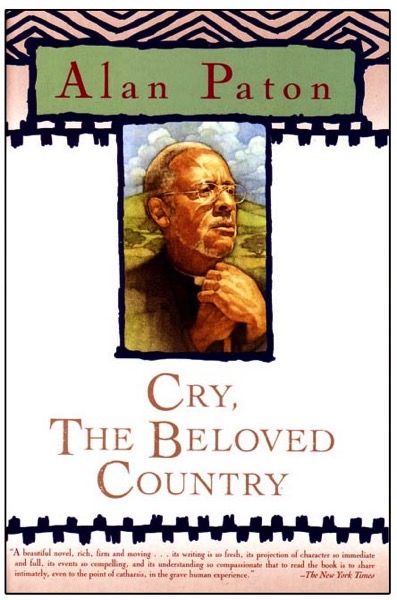
Paton constructs a story of two men whose lives are lived in geographic proximity and cultural isolation. One is a poor black Anglican priest, Stephen Kumalo (“a parson, so(m)ber and rather dull no doubt, and his hair was turning white”) and the other, James Jarvis, is a wealthy white farmer living nearby. Events in the crumbling 1940s culture of South Africa bring these two men together in a dramatic and surprising and tragic way. South Africa was on the cusp of formalizing the racial divisions that were existent in the policy of apartheid and against that backdrop, lives play out, mercy is displayed, and reconciliation is glimpsed. But much here breaks the heart.

The Rev. Kumalo is genuine, a pastor who loves his God and his people. His heart breaks for his country, his land, his parish, his family, and his church. He is honestly drawn as a man who struggles with temptation, loses his temper, and is not above acts of manipulation, but who also repents of his anger and acts with great compassion to those who cross his path. Like the friend he meets in the city of Johannesburg, he is “a weak and sinful man, but God put His hands on me, that is all.” There is a potent reality to these men.

With these men, the heart breaks for the beautiful land that is South Africa.

There is a lovely road that runs from Ixopo into the hills. These hills are grass-covered and rolling, and they are lovely beyond any singing of it.

The land is beautiful but it and the people living on it are broken. For that, there is mourning.

Cry for the broken tribe, for the law and the custom that is gone. Aye, and cry aloud for the man who is dead, for the woman and children bereaved. Cry, the beloved country, these things are not yet at an end. The sun pours down on the earth, on the lovely land that man cannot enjoy. He knows only the fear of his heart.

But the crying and the fear can lead to something greater, even to something beautiful in small acts of grace and in the softening of the hearts of men.

Yes the book breaks the heart, but it heals it as well. It leaves us hopeful, knowing that even though there is death in the land, and that things are not as they are supposed to be, yet small acts of grace can bring significant reconciliation, and sacrificial love can bring life in the midst of death. Maybe we are to realize as well that we are weak and sinful people on whom God has put his hands. One can hope.

As one can hope that my friend and many like him will finish that high school assignment that they might be blessed by this book.


In Debt to Our Trespasses

For the first nineteen years of my life, I attended Methodist churches in which we possessed ‘trespasses’ needing to be forgiven, according to the form of the Lord’s Prayer we regularly recited. For all but three of the years since (I’m now sixty) I’ve attended Presbyterian churches where the ‘trespasses’ had become ‘debts’. I’ve been confessing debts twice as long as trespasses. And yet…

Some months ago I was sitting in my study troubled by many things and seeking to pray. I prayed, as I am prone to do in such times when I don’t know how to pray, the Lord’s Prayer. In the intensity of that moment, I found myself praying for the forgiveness of my childhood Methodist trespasses and not my adulthood Presbyterian debts. Praying from within the context of desperation, those childhood liturgical forms welled up from deep within me where they had been disciplined to reside until needed most. Liturgy has an ability to shape the young and formative mind in powerful and lasting ways.

I was reminded of this in a comment by journalist James Fallows, not a particularly devout man if his blog and other writings are any indication, and yet he says this:

“I spent my youth hearing the cadences of Thomas Cranmer’s Book of Common Prayer repeated roughly one zillion times and still feel they are my main guide to the proper shape and pacing of a sentence.”

Somehow our youthful liturgical exposure is formative in ways that transcend the merely spiritual.

And yet, we’ve persuaded ourselves that children get nothing from public worship. I beg to differ.

A Time to Refrain from Speaking

Advice is easy, listening is hard, and advice given without first listening can be hurtful. So I often pray for the grace to be silent. Sometimes I forget.

Years ago, my mother had had some surgery after which she was confined to a rehab facility until she had recovered sufficiently to return home. She hated it and let me know. On the phone she told me about how the place was full of crazy and demented people. I immediately told her that it couldn’t be that bad. I told her to just go sit at a table and start talking to people.

We had a joke in our family that Mom could carry on a fifteen-minute phone conversation with a wrong number. Where I got the notion that she was not already trying to befriend people in precisely the way I suggested I cannot say. Nevertheless, I did not hesitate to give her the advice which, when followed, would clearly make everything okay.

Except that it wouldn’t. I was not living near her and so when I had the chance to visit her, I met the people I was telling her to befriend, people whose mental acuity had long since departed. I suddenly understood her loneliness and to this day regret not being more quick to sympathize than I was to advise.

Sometimes people trust us enough to share their sorrow with us. That is a gift before which we need to be quiet. We need to believe that they in fact know what they are talking about and that their sorrow or confusion or hardship is real and that it will not bend or bow to our hastily spoken simplistic solutions.

There is a time to speak, but not before we’ve listened and made every effort to understand. And even then, the best move might be to simply be quiet and wait for the words that God will give.

The Spirit of St. Theresa

I know a priest who writes books and self-publishes them. They are good books, born of his heart and experience. These are books I believe could be published by a genuine publishing house. Maybe they should and maybe someday they will be.

But this is not the spirit of my friend the priest. He is not seeking the renown or satisfaction that would come (or which wannabe writers IMAGINE would come) from publication. He does not write in order to see his name printed on a book or to get invited to all the best conferences or to supplement his income.

Rather, the books he writes and self-publishes he gives away to his flock. He writes them for his church as a way of extending his care to his people. He writes them based on the needs he sees and the changes he longs to see among his people. His act of writing is the act of a shepherd concerned for his sheep, and is detached from any interest in fame or attention or glory or riches.

I suppose there are many ways the spirit of the newly canonized St. Theresa can be reflected and carried out in a person’s life. My friend’s selfless and quiet giving of himself and of his gifts is a reflection of that spirit.

May that spirit be born in a fresh way in many more of us and especially in me.

Eddie’s Dad

Recently we watched a movie called Eddie the Eagle, a 2016 biopic about an unlikely Olympian ski-jumper, Michael “Eddie” Edwards. It was an okay movie, part Cool Runnings and part Rudy, both of which were better. This was okay for a Saturday night movie night. (If it matters to you, spoilers follow – but honestly, if you’ve seen either of the above movies, the ending has already been given away.)

Eddie the eagleEddie, as in all underdog sports movies, has a dream that seems unlikely, impossible, and foolish. And, again, as in all underdog sports movies, Eddie has a father (or a mother, if the protagonist is female, my daughter-in-law points out) who does not believe in him and reiterates throughout the film how disappointed he is in his son’s outlandish and impractical ambitions. Predictably, Eddie succeeds, opening the way to the dramatic and ostensibly emotional finish where Eddie’s dad meets Eddie at the airport after his triumph with “I’m Eddie’s Dad” embroidered on his sweater and “I’m proud of you, son” on his lips. And everyone goes, “Ahhhh.” Including me.

Until I thought about it.

Throughout the film this dad has ridiculed and derided his son incessantly. BUT, because the son is successful, he has now earned his father’s love and support. Really? This father who has never hugged his son now hugs him because he is a success. The father’s affection is linked to the son’s performance and, as my son would say, “That’s messed up.” What would have happened had Eddie returned a failure? What if Eddie’s dreams had crashed and burned? What then, when he would have needed love and acceptance and a hug even more? I hate to think.

I’m so grateful that a father’s genuine love is not dependent upon a son’s success. I’m so thankful for the love of a heavenly Father whose embrace is ready even when I severely fail. I’m comforted knowing that even if the dreams of this old and crusty sixty-year-old never materialize or if they end in smoke and flames, I have a Father who will still see me as his beloved son. And I don’t need to ski-jump to earn it.

Prayer and Broken Relationships

[This is a post in our ongoing series looking at the themes raised by David Crump in his book Knocking on Heaven’s Door: A New Testament Theology of Petitionary Prayer. We began this series here.]

Several weeks ago, a reader asked in a comment for clarification regarding what we called one of prayer’s ‘limiting factors’. Circumstances prevented a rapid response, so it now seems better to reply here as one more post dedicated to prayer.

The questioner asked for clarification regarding the fifth limiting factor. This suggested that prayer might be hindered by ‘broken and unreconciled relationships’. The kind of relational brokenness in view is pictured here:

Likewise, husbands, live with your wives in an understanding way, showing honor to the woman as the weaker vessel, since they are heirs with you of the grace of life, so that your prayers may not be hindered. (1 Peter 3:7)

As a husband, this verse is sobering. Mistreatment of my wife will not be tolerated by a just and compassionate heavenly Father and may even cause him to turn a deaf ear to my prayers. Crump is very careful in how he develops this, however. One might say that in my weakness, I’m rarely treating Barb in an ‘understanding way’. Am I always to despair of my prayers being heard? Crump anticipates such concerns.

Persistent mistreatment of brothers and sisters in Christ inhibits our ability to communicate with the Father, and this Father never turns a blind eye to domestic abuse. Until the perpetrators repent and seek the necessary reconciliation, their petitions will remain ineffective.

The question whether there are relationships unreconciled in our lives and hindering our prayers is one that is worth asking. Nevertheless we should not become desperately self-critical.

It would certainly be disheartening to imagine that none of my petitions have any hope of ever being heard by God until every aspect of all my relationships are put in perfect working order. If that were the case, all petition becomes hopeless again! Fortunately, by revisiting the original contexts we are reminded that the New Testament writers were addressing deliberate, persistent misbehavior. The sinner refuses to change despite (a) the sin having been openly confronted and (b) the necessary correction having been explained and then ignored. Consequently because the culprit willfully ignores God’s word, the Father may choose to ignore his or her prayers.

Self-examination is always appropriate, but perfection is never in view. God welcomes prayers from his most broken and inconsistent and weary disciples. Just keep praying.

Not Nice, Flan

Flannery O’Connor, America’s first mistress of the dysfunctional family, wrote a story called “The Enduring Chill”. In it, the son of a rural Georgia widow returns to his hated (of course) home from a failed attempt to make it as a writer in New York City. He is convinced that he is dying and writes and seals a letter for his mother in which he chronicles his bitterness against her hoping to leave her with an ‘enduring chill’ of doubt and remorse.

Instead, he reveals a chill of his own, and one shared by many others, I suspect.

“I have no imagination. I have no talent. I can’t create. I have nothing but the desire for these things.”

Thus is encapsulated the chill lurking in the back of any who wish to create: the fear that they lack the capacity to do what their heart longs to do. Its creeping icy wind stirs and grips artists and preachers alike.

My own version of hell is having an ear good enough to know that my guitar is out of tune, but one insufficiently skilled to bring it into tune. Cursed forever to be out of tune, falling short of the music one wants to make, leaving only the options of playing poorly or not at all. That is an enduring chill.

Thanks, Flan (is that what your friends call you?) for awakening that specter for us.

Powered by WordPress & Theme by Anders Norén