Concerning Life as It Is Supposed to Be

Month: May 2016

Prayer and Its Misconceptions

Prayer is life for the Christian. It is the spontaneous and necessary cry to God arising from the struggles and hopes and failures and dreams of living in a broken world. Prayer is something we cannot imagine being without. At the same time, prayer is a mystery. It is a discipline and it is hard.

And for most of us prayer is a weakness which becomes, in the end, a burden.
KnockingBut is prayer a weakness because it is hard and unnatural for us, or do we find ourselves weak in it because of a misconception of what it is to be? If one trains to be a painter using a faulty and impossible standard, even though he may be good he will judge himself to be weak because he is using erroneous evaluative criteria. Perhaps we are overly critical of our practice of prayer because we are building our critique upon a false model of prayer.

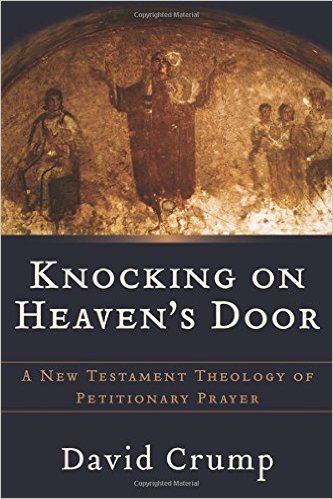
Any book that would seek to correct our false ideas of prayer could, in fact, free us to pray. Such is, in my opinion, the value of David Crump’s Knocking on Heaven’s Door. It’s not well known, but surely any book whose title riffs on a Bob Dylan song is deserving of at least a glance.

A glance was all I needed. The book’s subtitle promises that this is “A New Testament Theology of Petitionary Prayer”. David Crump, a professor of religion and theology at Calvin College in Grand Rapids, Michigan, sets out to ‘explain’ prayer as it is presented in the New Testament, which means rescuing prayer from the misconceptions of a well-meant but often mistaken evangelical and fundamentalist heritage. Crump treats that heritage with respect, but his commitment is to Scripture, and it is in opening the Bible to careful attention that he excels and is most helpful.

In reading (and then re-reading – VERY rare for me) I found his explanations of the biblical text careful and thorough and his conclusions convincing. And this book did what few other books on prayer have been able to do. It made me want to pray. In this case, it made me want to pray not because of the effect prayer has had upon some great saint, and not because of some great promise made about prayer. It made me want to pray because I was able to better see it for what it is, and God for whom he is.

I want to spend the summer walking through this book giving readers of this blog a glimpse into Crump’s arguments and conclusions. I want us all to think more clearly about prayer. As well, I want this book to be more widely known. The content is good, the writing accessible (though, at times, more ‘scholarly’ in feel than some may want), and the exegetical model is exemplary. As with any book, I cannot agree with everything in it. But what is here has shaken my world in a good way and is inviting me to change the way I look at and practice prayer as little else has done. Crump’s goal and mine, as I attempt to summarize his work in these posts, are the same:

“May this study so transform both the author and the reader that we will learn to ‘always pray and not give up’ (Luke 18:1)” (page 19)

Yes. May it be so.

Click to go to the next post in this series.

The Runner’s “Hi!”

I run with the hope that it will help me live, not because I particularly enjoy it. The only ‘runners high’ I ever get is the exhilaration I feel at being done and knowing that I don’t have to do it again for at least two days.

HelloSo when I passed a man in my neighborhood the other day who was walking his dogs, I said, “What you are doing looks like a lot more fun than what I’m doing.”
He replied, “When I get the urge to do what you are doing I lie down until it passes.”

When I passed him again he said that in truth he would do what I was doing if he had not had a knee replacement. I pointed out that I ran because both my parents died of heart disease.

As I ran off, I thought about our two situations. And I wondered whether having a good dog might be a better preventative against stress-induced heart disease than running.

Tempting.

Surviving Ministry

I posted a few weeks ago a post in which I pondered the oddities of Amazon’s book reviews. No matter whether the book was good, bad, or so-so (in my judgment, at least), every book’s profile eventually assumes a certain ‘shape’. Most reviewers love it, and few hate it.

It was as I was thinking about these things that my friend Mike Osborne gave me a copy of his recently released book, Surviving Ministry: How to Weather the Storms of Church Leadership, on dealing with the struggles of ministry. Mike has been through the mill, as they say, which is a powerful image when you think about the mill stones used to grind grain into flour. Who wants to go through that?

Which is precisely the question. But many pastors do, and some do not come out the other side. Mike’s heart and desire in this book is to help pastors endure, survive, and flourish. And he does a great job in reaching that desire.

But when Mike asked me to review it – on Amazon – I was inwardly conflicted. What if I only thought the book was ‘so-so’? What if I didn’t like it? I can’t write a glowing review of something I find less than stellar. I know Mike’s heart, but I did not know how that would translate to the page. If I had to write critical things, what would that do to our friendship?

As I say in the review (and what follows is taken largely from my Amazon review) that was an unfounded fear. I can honestly say that this is a wonderful book. It is deeply helpful for the pastor entering ministry or struggling to survive conflict. Mike is genuine and transparent. He is a good pastor and a man committed to Christ’s church and Christ’s people. And he cares for pastors.

He gives practical guidance for those seeking a call to a church, for those seeking to survive one, and for those who have come through a difficult experience. His words ring true because he has lived that of which he speaks. He has made the mistakes he calls us to avoid. From the vantage point of one who has survived, he reaches out a hand to guide us through.

The book is well paced, showing a careful balance between instruction and illustration. It is practical and biblical and thoughtful. And it is SHORT which in itself is a virtue. Mike gets to the point quickly, and I consider that a gift (one I do not have).

Having read the book, the best testimony I can give is to buy it and give it to others, which I have done. I recommend other pastors buy it and read it themselves.

The only problem I have is the book’s price. Amazon has it listed for $22, pricey for a book of 150 pages. The publisher explained to me the reason for that, but that does not make it easier for us on a budget. What does make it easier is to buy the Kindle version ($9.99) or to buy it directly from the publisher ($17.60 plus shipping). And yet, I say, ‘Pay it’. I’ve paid such prices for books far less helpful.

Trust the Run

Being a pastor, as I am, is in many respects a sedentary job in which people want to feed you a lot. Pay a visit to someone and they offer you cookies or brownies. Offer to meet someone and they suggest you meet over lunch or coffee. Pastors do a lot of sitting and eating and therefore exercise, of some sort, is essential.

And so I run. Someone ‘accused’ me the other day of ‘liking’ to run. I don’t, really. I love to have run. But running itself is something else.

I run because it is good for me (though I’ve needed some pushing recently) and because it has become for me a habit. It is a discipline (something we’ve addressed sporadically before in these pages) which from frequency has become a habitual routine I am loathe to lose.

It is a habit, and habits can have multi-layered benefits. Herman Melville in Moby Dick, speaking of the preparation of the harpooneer who can spring to action and hit his mark in a moment’s notice, praises the value of habit and says this:

“Yet habit — strange thing! what cannot habit accomplish?”

What is the habit of running accomplishing for me? When I run, I hope I gain a stronger heart. But I know that I gain insight.

Since I don’t listen to anything when I run, my mind is free to wander. And in wandering, it wanders its way into solutions I don’t think I could have found in any other way. I’ve solved insoluble pastoral conundrums when I run. I’ve re-written whole sermon outlines, ones that had resisted more linear analysis. I’ve mapped out financial goals. I’ve written blog posts. And sometimes I’ve done none of the above. When I run, my mind is set free to solve problems by looking at them obliquely and not directly and the time is available to do so.

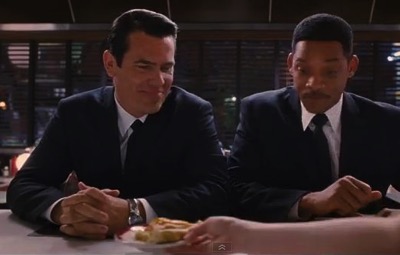
Trust the pie 2In the movie Men in Black 3 Agent K (Tommy Lee Jones / Josh Brolin) illustrates this point by taking his partner, Agent J (Will Smith), to a diner where he orders pie. He’s convinced that the best way to solve a problem that is resisting a solution is to not look directly at it but to put it aside and let the answer come over a piece of pie. “Trust the pie” is his mantra.

Mine is, “Trust the run.” And that may be one of the few things that keeps me running.

Branding, 3

A while back I posted some thoughts about branding, particularly the wisdom of calling a blog meant to be engaging and playful “Somber and Dull”. That generated some fun feedback and, in the end, I’m happy sticking with the title. There certainly is no competition for the domain name.

While these things were on my mind, I ran across this picture of the Florence (Kentucky) Mall in the online edition of the Atlantic Monthly.
Florence
I was reminded that a branding vs. local ordinance issue led to that distinctive water tower message. Originally, as can be seen here, the water tower was painted with the name of the mall on whose property it resides. Florence2It seemed like a good, though drab, way for the mall to attract the attention of passing motorists.
But then, as I understood it (I lived nearby at the time) local officials protested that commercial advertising was not permitted on water towers or other structures that high. Faced with the prospect of having to repaint the whole water tower, some brilliant person suggested that the two side bars of the ‘M’ in ‘Mall’ be whited over and a stem placed beneath the remaining two lines, forming a ‘Y’. With the addition of the apostrophe, a visual impression was created that is now far more noticed than the original ever would have been. (It has since been re-painted, repeatedly, so that the ‘Y’ looks far more ‘Y-ish’. Originally, it looked like a converted ‘M’.)

There is no moral to this, no reason to point it out other than the fact that I find it interesting and to bemoan that no such event has occurred to make “Somber and Dull” more noticeable to a passing world.

“Hey, Kettle! It’s me, Pot. You Don’t Need to Hate Yourself!”

Is repentance a matter of ‘changing one’s mind’ about sin, or is it something more active, such as changing one’s behavior? Conflicting takes on this have been argued, which is troubling since repentance is so central to the Christian life.

Therefore, I appreciate John Frame’s clear and sensible presentation of the topic in his Systematic Theology (pages 958-960). Building upon his distinctive perspectival approach he reminds us that BOTH a change of mind AND a change of behavior, together with genuine sorrow for sin are each properly considered repentance, each observed from a different perspective. I would encourage any puzzled by the idea to visit these concise pages.

Absent from any proper notion of repentance is self-hatred, though many sensitive Christians somehow manage to wedge it in. When made aware of sin some speed rapidly to the conclusion that they must be worthless and useless people. This is both wrong and hope-destroying.

It is wrong because the Biblical idea of repentance nowhere includes it. We are indeed to hate sin, but our sin does not define us. We are not the sin. We belong to Jesus, we are beloved by him, and we are the adopted children of God. When we sin, he does not begin to hate us or cast us off. When we become aware of our sin, we should not conclude that we are suddenly hateful and not worthy of his love. We have NEVER been worthy of his love, but in Christ we are forever the apple of his eye. Our sin or our awareness of it does not change that.

The church in Corinth was a boiling cesspool of disunity and immorality into which Paul speaks severely and firmly to bring about repentance. In doing so he calls them saints beloved by him and by God.

Self-loathing is wrong AND it is hopeless. When we identify our sin with our person we can despair of there being any hope for change. Sin is a stubborn resident who needs to be evicted, but he is not the householder. If we forget that we will tend to see ourselves as those who will always be the way we are.

It is true that sometimes we do not change. It is true that we may struggle long and hard against the same sinful tendencies and fail time and again. But the only hope for change, the only thing that keeps us from giving up, is the deeply held knowledge that we are, even in our sin, beloved of God. We will only change, that is repentance will only lead to substantial growth, when we know that we don’t need to change in order to be loved by God. He loves us now and forever.

Christian, hate your sin, not yourself. Never forget that you are the beloved of God. You belong to the one who gave his Son to deliver you out of the dominion of that sin into the kingdom of his love. You are now and ever will be a child of God.

And Kettle, I know that calling you black is a bit disingenuous of me. I’m working on that.

People (Not) Like Us

There is great joy in being a follower of Christ. And yet, the more I study the Gospel of Luke the more I am reminded that to be serious in such discipleship will occasion moments of great tension. The Kingdom Jesus brings is different in many key ways from the worlds in which we have been immersed. It should not surprise us, therefore, that his words can bring DIScomfort as easily as comfort.

In Luke 14, for example, Jesus attempts to remove the blinders from a man who had hosted a dinner party.

“When you give a dinner or a banquet, do not invite your friends or your brothers or your relatives or rich neighbors, lest they also invite you in return and you be repaid. But when you give a feast, invite the poor, the crippled, the lame, the blind, and you will be blessed, because they cannot repay you. For you will be repaid at the resurrection of the just.” (Luke 14:12-14)

My wife and I like to think of ourselves as hospitable. But, if I’m honest, I must say that it is HARDER for me to be hospitable to those unlike me. And what is hard, I often avoid. I live with that tension.

I was reminded of the call toward those not like us in the comments from a friend who was reflecting on the movie Spotlight which I’ve referenced here, here, and here. She challenges us to the uncomfortable task of loving, listening to, and trying to understand those different from us, particularly those damaged by abuse and other forms of injustice. Her comments (shared in part here, and with permission) encourage reflection.

They need our love and our support and the only way they are going to have it is when we aren’t afraid to confront the elephant in the room [abuse]. Unfortunately, it’s easier to close our eyes and disassociate from everything that makes us uncomfortable. And I realize this is part of human nature. But I also believe that often so called non-Christians stand up for far more than those of us who call ourselves Christian. We get so focused on historical facts of the church and we are quick to debate theology but we change the subject and refuse to discuss the real issues at hand. We don’t want to discuss abuse, depression, addictions, family issues, or things that aren’t ‘churchy’. This drives people towards hopelessness for where else can they go? We tend to shy away from people that we view as weird or different, and although we claim to love everyone and be grace filled, we avoid those with big issues.

Christians just want to play it safe, to stay in the comfort zone where everything is peachy and…happy all the day. The reality is that there are some not so wonderful things transpiring under our very noses, marriages that are falling apart, children who are hurting because of a divided family, people who contemplate suicide or those that have addictions, people who have been victims of sexual and domestic abuse. We call ourselves family, and promise to stand beside them, to be a ‘hope’ to the community. So, why not discuss it? I think if we got more comfortable with transparency, and tried to get to know the story of those that may be different, we would see an extremely positive affect on our communities.

As one who finds it easier to close my eyes to everything that makes me uncomfortable I need, and am grateful for, these words.

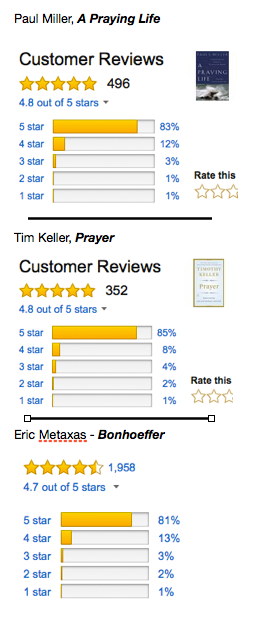
Amazon Ratings

Below is a screen shot of the spread of Amazon ratings for three books. The first, I really liked. The second, I was not too thrilled with, but it was not bad. And the third I thought was awful (also here).

I’m guessing there is a lesson here of some kind, but I’m not sure what it is. At the least, it’s interesting. To me, at any rate.

Reviews

On Meditation

Late in high school I began to read the Bible with a pencil/pen and paper in hand. I don’t know who suggested I do this, or if rather the idea just spontaneously combusted in my still unformed brain. Whatever prompted it, it stuck.

Some time later it occurred to me that there was more value in reading the Bible slowly than in reading it fast. Again, I’m not sure whether this was a conclusion independently drawn or drawn from another’s wise words. Nevertheless, it too stuck.

Both ideas have been a gift.

My current practice is to each morning read a small portion of Scripture, perhaps a chapter, perhaps a portion of a chapter. I opt for bite-sized chunks that I can savor, think about, reflect upon, and remember. The thoughts stimulated by these reflections get recorded in the journal open in front of me and often morph into words of prayer.

I’ve done the ‘read through the Bible in a year’ thing and found it too easy to not pay attention to what I’m reading. I’ve decided to be the tortoise, casually reading through the bible once every four to five years, meditating upon it along the way. Hares consume at a much more rapid pace, but this serves me well.

And it has served others well. Tim Keller suggests a reason why. In his book Prayer (in which I was largely disappointed, but not completely), he expresses a concern that we too easily separate our reading of Scripture from our prayer life. He challenges Christians to engage in the reflective and interactive approach to Scripture known as meditation. As we meditate on the text God speaks to us, and, subsequently, we pray moved by what we ourselves have heard. It is, as Keller rightly notes, a conversation. Sometimes, Keller reminds us in chapter 10 of that book, we are content to grasp what a passage says and don’t take time to think about what the passage says ‘to me’. And that leaves us impoverished.

Recently in preparing a sermon I was confronted with the challenging words of Jesus, “One’s life does not consist in the abundance of his possessions.” (Luke 12:15) It would be easy to treat that text in the abstract and to simply accept that this is something Jesus said and be content to assume we know what it means. Far more value comes from chewing on such a text and asking questions that impinge upon one’s own heart attitude toward possessions. Do I care more for my things than I do for God? If I lost my things would I still trust God? Which is the greater source of my happiness: that I have things or that I belong to God? And so forth.

These are the questions that arise when one is pressing a text hard into his or her own psyche. These are the questions of meditation. Asking such questions may not generate satisfactory answers, but they will produce prayer. As we think about a text we hear God’s voice in it, and our impulse will be to speak back, if even to say, “God, I don’t like what this is saying.” Or, “God, my heart is more committed to things than to you. Will you fix that in me?”

It is true that we cannot see God, and, as someone recently told me, it feels artificial to attempt to speak, to pray, to someone we can’t see. I get that. But meditation helps us hear God so that, though I don’t see him, I hear him. And the one I hear, to him I can speak in reply.

Grab a bible, a pencil, and a composition book. Set aside some time during the week. Once. Thrice. Daily. Read slowly, listen, ask questions, respond, and pray.

And you can forget who made the suggestion.

Powered by WordPress & Theme by Anders Norén