Randy Greenwald

Concerning Life as It Is Supposed to Be

Jumping Ship

I tend to vote Republican because I find that I am in general economically and socially conservative. But it is becoming increasingly more embarrassing to live under this banner.

I did not vote for Barak Obama, primarily because of my pro-life convictions. However, the man is our president. I cannot accept the implication made by many that he is unmitigated evil and the sign of impending apocalypse. I have a greater confidence in the providence of God and the resilience of our political system than most, I suppose.

Today’s local paper says that ‘many’ parents are not wanting their children to listen to President Obama’s speech to school children next Tuesday, and our school district is allowing them to opt out. I find this a bit over the top, but schools will always be composed of eccentrics, and so I can overlook it. What really got me was this quote from the chair of the Florida Republican Party:

“I am absolutely appalled that taxpayer dollars are being used to spread President Obama’s socialist ideology,” Greer said in a statement. “I do not support using our children as tools to spread liberal propaganda.”

I find this not only embarrassing but naïve as well. It is embarrassing because like him or not, he is our president. He will embrace policies with which I disagree, but he is our president, and is owed the respect that that office gives to him.

But it is naïve as well. Does Mr. Greer and the other parents not understand that schools are all about indoctrination? Not just public schools mind you. SCHOOLS. We home school, and we are all about leading our children to understand the world in a certain way. We are, as it were, ‘using our children to spread a Christian world view’. If he or any of the other parents are concerned about a liberal agenda and see it only in the assumed content of the president’s speech, that is amazingly simplistic.

Please understand: this is not a rant about public schools. I know many who do a wonderful job in those schools. I know many Christians who bring their Christianity to bear in amazing ways in those halls. And I know many parents whose children are prospering there, prospering as Christians.

But any parent with their children in a public school knows that he or she needs to monitor and address what is received there helping the child to embrace what is true, question what is not, and discern the difference. That is called ‘education’. And that is exactly how we ought to approach the president’s address.

I think in protest that I will make sure my son watches the president’s speech on Tuesday. He might just be challenged to pursue something good. And if there is a scary liberal agenda operative, I can think of no better opportunity to hear it, critique it, and learn from it.

I’m ready to sign up for independency. Any reason I shouldn’t?

+ + + + +

UPDATE: Similar thoughts from someone better known here.

Tell Me the Story of Jesus

Many, many years ago, I attended a special chapel service at a local Christian School at which a presentation was being made by a storyteller from Iowa.

A storyteller. That is not a career choice embraced by many of us. I’m not sure where one goes to get specialized training in it. All I know is that this guy was good.

For a long period of time, he kept all of us captivated with stories. Young and old listened through every dramatic pause and seeming diversion to get to the end of the story.

If at the time I’d ever heard of Garrison Keillor, it didn’t matter. Here before me was a man who with the mere force of his words and presence held us in his web. And I wanted to do that, too.

Like most ambitions for me, that one got sidetracked by life. I did ask the man for a book recommendation which would be of some aid in learning to do what he was doing. Though I bought the book, I was never able to persevere in this. I now see that to do what he did demands a large measure of acting talent of which I have none.

What, however, this experience demonstrates is the stunning power of a good story well told.

And I’m envious of those who are able to marshal such skill in the service of the preached word.

I am not an advocate of the style of preaching parodied as ‘the sky scraper sermon’ (one story upon another). Preaching is to be more than the telling of stories. There is a truth to be extracted from the Biblical text and applied meaningfully to the congregation.

However, that truth once isolated and examined will be more readily embraced when served up through the medium of a powerful story. The prophet Nathan was a wise communicator. Instead of laying out the truth of David’s unfaithfulness in stark propositional terms, he told David a simple story of a poor shepherd, a powerful lord, and a vulnerable sheep. He did not sidestep truth. Rather, he took a story as his arrow, tipped it with the poison of truth, and aimed it at David’s heart. Story carries truth home like nothing else.

They say that our media saturated culture may be immune to preaching. I think we can say that our media saturated culture is resistant to the theological lecture. But a media saturated culture may be even more vulnerable to the truth, if that truth is conveyed on the back of a story.

I still want to learn how to tell a good story. And when I do, perhaps it will be, as in the fun movie Bedtime Stories, that the stories will begin to come true.

Perhaps.

Why the iPhone Is not myPhone. Yet.

It’s not that I don’t want an iPhone.

In fact, it’s not even the fact that iPhones only use AT&T (problems detailed here).

No, actually I DO want one, and would be willing to put up with AT&T to do so.

It’s rather this that keeps me using my trusty Samsung ‘dumbphone’:

“AT&T’s right to be the exclusive carrier for iPhone in the United States has been a golden ticket for the wireless company. The average iPhone owner pays AT&T $2,000 during his two-year contract — roughly twice the amount of the average mobile phone customer.

Emphasis mine. Full article here.

Books ’bout Brothers

I was wandering around the house the other night going from bookshelf to bookshelf trying to see if we had any “Hardy Boys” books for Colin, our now nine year old, to read. He has not read one before, so I told him that they were about a couple of brothers who are detectives and that he might like them.

So, he started helping me look. This is no mean feat. I haven’t counted how many books we have strewn around the house, but there are many, and the one who has the catalogue in her mind, my wife, was not at home.

Finally Colin, lying face down on the floor to see the bottom shelf of the bookcase next to my bed said, “Dad! Is this it?”

“What is that?” I asked.

“This book – The Brothers Kar-a-ma, uh, Karam – “

“No, Colin, not that one.”

A Love Letter for Books


In the fall of 1894, Southern Presbyterian theologian Robert Lewis Dabney, suffering the afflictions of advanced age, visited Louisville Presbyterian Theological Seminary in Louisville, Kentucky to deliver a series of 18 lectures.

This should be a forgettable bit of knowledge for all but the most zealous scholars of Dabney’s life. However, I own a copy of Dabney’s book on preaching called Lectures on Sacred Rhetoric, a sturdy and aged edition published in 1881. The detailed inscription indicates that it was purchased for 94 cents from a J. E. Wylie by an R. M. Caldwell of “L.P.T.S” (i.e. Louisville Presbyterian Theological Seminary) on October 4, 1893.

If Mr. Caldwell was studying preaching at LPTS in the fall of 1893, it is likely that he was still studying in the fall of 1894. I like to think that this book was held in Mr. Caldwell’s hands sitting in the lecture hall hearing its author speak. The book links me concretely with the sounds and smells and language of another age.

This sentiment would be appreciated by Anne Fadiman, the author of a book about books Ex Libris. This collection of short essays (18 in all), a genre in which Fadiman excels details the author’s life-long love for books and the words they contain. It reflects with heart what only those who love books can understand.

With loving reverie she writes a love letter for books, buying books, storing books, building castles with books, passing on a love for books.

At one point she speaks of books as an integral part of marital intimacy. Commenting on the habit she and her husband share of reading books aloud to one another in bed, she notes, with mature wisdom:

“As [my husband] leans over to kiss me good night, I do not regret having graduated from the amorous sprints of our youths. Marriage is a long-distance course, and reading aloud is a kind of romantic Gatorade formulated to invigorate the occasionally exhausted racers.”

Spoken with the wisdom and passion of a true lover.

Sitting at Starbucks yesterday, I was struck by the t-shirt worn by a woman sitting nearby. The design was in the form of a to-do list which progressed as follows:

☑ Wake

☑ Read

☑ Sleep

☑ Repeat

I found out that the woman was a recently retired high school ‘media specialist’. A librarian. But as we talked, it became clear that books were not simply her job; they were her passion. I loaned her Ex Libris, and while she waited for her friend, she read.

My new librarian friend told me that a friend of hers believes that we like to trick ourselves into thinking that when we buy a book we are also buying the time to read it. Oh that it were so.

My passion therefore for books is limited greatly by the time available to me. But to participate through these essays in this author’s experience of books is to renew and revisit the experiences we ourselves have had with books.

I’ve Waited Five Whole Days


I get it!

Today.

I’m a happy (geeky) camper.

The Best Parenting Advice

I’m a bad parent – I gave up reading parenting books long, long ago because they never seemed to help me and only succeeded in making me feel guilty.

So, today, not reading a parenting book, I came across what is without a doubt the best parenting advice ever offered. I still don’t do it, not with the consistency and intention that I should, because I’m a bad parent. But it certainly aims us in the right direction.

“It is surprising how seldom books on parenting talk about prayer. We instinctively believe that if we have the right biblical principles and apply them consistently, our kids will turn out right. But that didn’t work for God in the Garden of Eden. Perfect environment. Perfect relationships. And still God’s two children went bad.

“Many parents, including myself, are initially confident we can change our child. We don’t surrender to our child’s will (which is good), but we try to dominate the child with our own (which is bad). Without realizing it, we become demanding….

“Until we become convinced we can’t change our child’s heart, we will not take prayer seriously….”

Paul E. Miller, A Praying Life, pages 168-169

To Bleed or Not to Bleed

We bleed for movies.

Really.

Two weeks ago, I noted that Barb and I ‘rarely’ go to movies in the theater. It is actually an oddity that we have been able to attend two films, (500) Days of Summer and The Hurt Locker.

To attend these movies, given the times we went to see them, would have cost $30. We spent nothing.

It’s not that we know anyone working in the ticket booth. Rather, we’ve discovered that doing something we would do anyway, donating blood, comes with a special premium.

I don’t know about blood centers in other parts of the country, but in Manatee County and possibly other areas served by Florida Blood Services, when one gives blood on the first or last Monday of the month, one is given in return a movie ticket to a nearby Regal Cinema.

Donating blood saves lives. I feel privileged every time I give to have the health and history that enables me to serve my community in this way. We commend this to all of you, movie tickets or not. Barb and I would give blood without this incentive, as long as Tracey (at the Lakewood Ranch center) is drawing, the only person in the world who I trust aiming a blood drawing needle in my direction.

But I confess. We like the movie tickets, and we schedule our giving around this incentive. Apart from this, attending a movie in a theater would probably move from ‘rarely’ to close to never.

If you’ve never given blood, do so. I won’t say that I like doing it. I don’t. But it’s not nearly as bad as your imagination tells you that it is.

And if you live near the Lakewood Ranch center, ask for Tracey. Tell her I sent you.

The Perfect Preacher

Someone, I believe it was Calvin, but I can’t be certain, once said that it would be better for the preacher to break his neck ascending the steps to the pulpit than to preach a sermon that he has not first preached to himself.

Okay. I get that. But at the risk of sounding hopelessly schizophrenic, what if I preach it to myself, and I don’t listen? That one twists me in knots.

You may not have noticed, but those of you who are in churches on Sunday are being preached to by someone who is NOT Jesus Christ. Oh, there are times he might imply otherwise, but believe me, he is not.

No one has ever mistaken me for Jesus. However, I have been called to preach the gospel, to preach what Jesus preached and to speak God’s word before a congregation of God’s people. Can a sinner do such a thing?

As preachers we represent a truth which is greater than we are. We preach a standard that exceeds our ability. We expound a word which is divine. It is all beyond us. If we are not humbled by that, then we are not really thinking carefully enough about what we are called to do.

It is right for a congregation to expect a preacher to model what he preaches. Hypocrisy in the pulpit is disheartening to a congregation and dishonoring to God and damaging to the Gospel. And yet at the same time, no man speaking God’s word will be able to completely represent, embrace, enact every truth he is expected to expound.

How dare a sinner preach? And how dare he expect others to listen? Such questions inspire two thoughts. One must be held dear by the preacher, the other must be embraced by the congregation. And both involve grace.

First, a congregation must expect its preacher to sin. They ought to judge a man’s preaching primarily by how faithfully he brings biblical truth to them. The faithfulness of his life is so important and so critical and so necessary and yet it will always fall short of the message that he preaches. Congregations must look with grace upon their pastors as fallible men who struggle with sin and belief in a way similar to other Christians.

Preachers, like other elders, certainly are held to a higher standard, and yet they are not perfect men. They will struggle and they will fail. How much struggle and failure is acceptable is worthy of debate. But preachers must be seen as men on the same road of sanctification as us all. So, look upon them with grace.

That’s the first thought. The second is this: Preachers must rest ever more heavily upon the grace of God. We must be willing to admit our struggles and our weaknesses. Our repentance must be as transparent as possible. Though we might not be able to live the commandments or even always understand all that we must about the mysteries of God, we must have no question or uncertainty about our status before the Father. We must know the gospel and find our rest in that gospel and not in the accolades of people or the supposed perfections of our lives.

Thus, no matter what we preach, our primary message is grace, because it is this gospel of God’s grace which assures us and our hearers of God’s unwavering favor. And it is this same gospel which impels us as we step down from the pulpit to live more and more for God’s glory, and not our own.

The one thing we cannot be in the pulpit is pretentious and fake.

It has been said that the pew seldom rises higher than the pulpit. That is, the passion and commitment and conviction of the hearers will not be greater than that of the preacher. If this is true, it is daunting to those of us who are aware of our grave faults.

But it as well reminds us that the ONE message which we can bring to a congregation is a message that we can preach to ourselves (and embrace) as we climb the steps of the pulpit: that message of grace which draws us to God and sends us into the world.

Addicted to War


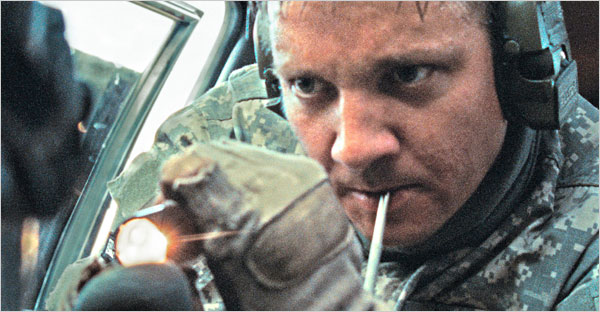
Somewhere Confederate general Robert E. Lee said something like this, that it is good that war is so terrible or else we would grow too fond of it. Lee was a warrior for whom war’s terror mitigated the fascination he felt for it. The recent film The Hurt Locker is a war-action film that explores the character and motivation of a man for whom the rush of warfare is an addiction he just cannot shake.

The film is interesting in a number of ways. It is such a good action film that one reviewer says that if it is not the best of the summer, he will blow up his car. I think he’s kidding. The intriguing thing about this is that this testosterone infused cinema (I estimate it’s EPH* at about 10) was produced and directed by a woman (Karen Bigelow).

It is a film set in contemporary Iraq and follows a team of – I don’t know what they are called – men whose job it is to detect and defuse bombs, hopefully before they detonate. It’s a dicey job, and if the depictions of the Iraqi theater is in any way accurate, it’s a place none of of would want to be. I came away from the film with a deepened appreciation of what those who have been there have seen and faced.

I’m not a big fan of action movies which do not have ‘Bourne’ in the title. This one strives to be something more than an action film. It seems to aim for meaning. I continue to ponder the meaning and potentially redemptive insights of the film. I’m not sure I’ve figured it all out. A second viewing may help me sort that out. Or a third.

What is clear is that these men labor with great intensity and passion to save the lives of others. But there seems to be little offered which will deliver them from the destructive and explosive realities of their own hearts. And that is sad.

+ + + + +

*Explosions per Hour

Page 87 of 142

Powered by WordPress & Theme by Anders Norén