Randy Greenwald

Concerning Life as It Is Supposed to Be

Go, Kaz

For Tampa Bay Rays fans, there is an extra reason to be cheering for the Angels in tonight’s game four of the American League Championship Series (other than the fact that they are playing the Yankees).


We’d love to see Kaz have a great outing. It’s the closest we get to being in the series ourselves.

Church Growth: The End of the Matter


Qoheleth’s hardly startling ‘end of the matter’ in his search for contentment was this: “Fear God and keep his commandments.” (Ecclesiastes 12:13)

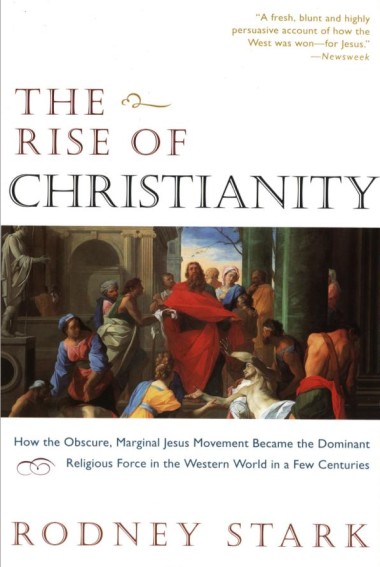
Rodney Stark seeks an explanation for the curious and phenomenal growth of the church over its first three centuries. His “end of the matter” is no less underwhelming:

“Christianity did not grow because of miracle working in the marketplaces (although there may have been much of that going on), or because Constantine said it should, or even because the martyrs gave it such credibility. It grew because Christians constituted an intense community, able to generate the ‘invincible obstinacy’ that so offended the younger Pliny but yielded immense religious rewards. And the primary means of its growth was through the united and motivated efforts of the growing numbers of Christian believers, who invited their friends, relatives, and neighbors to share the ‘good news.'” (page 208)

Let me break that down.

“Christianity did not grow because of miracle working in the marketplaces (although there may have been much of that going on)….”

Christianity does not grow primarily through show and spectacle. Arena crusades and powerful testimonies have their impact – and nothing that is said here is meant to disparage such things – but spectacle is not the engine driving the transforming power of the church.

“Christianity did not grow because… Constantine said it should, or even because the martyrs gave it such credibility.”

Hope for the church does not depend upon the attitude of those in power. Certainly an official act or a martyr’s death will have local impact and implications. But the long term growth of the church and its power over a society depends little upon these things. (This is particularly because the persecutions focused upon leaders while Christianity’s power was not generated from the top down.)

“It grew because Christians constituted an intense community, able to generate the ‘invincible obstinacy’ that so offended the younger Pliny but yielded immense religious rewards.”

The key word here is community. Christianity drew people into a counter-cultural community which was not cut off from the world around it, and as such, revitalized that culture. Christians found ways to address the chronic problems plaguing Greco-Roman cities, and at some sacrifice invested themselves in addressing those needs. That is, the Christian community was obstinately relevant. In an eye-opening chapter on the nature of life in ancient cities, he pulls these things together:

“Any accurate portrait of Antioch [as an example city] in New Testament times must depict a city filled with misery, danger, fear, despair, and hatred…. Christianity revitalized life in Greco-Roman cities by providing new norms and new kinds of social relationships able to cope with many urgent urban problems.” (pages 160, 161)

This is not the place to develop this, but in essence Christians made themselves relevant to the questions and issues which shadowed their neighbors’ lives.

Finally,

“And the primary means of its growth was through the united and motivated efforts of the growing numbers of Christian believers, who invited their friends, relatives, and neighbors to share the ‘good news.'”

Stunning, isn’t it, to discover that the church then grew by Christians having such a passion for this new community and the Christ who was its head that they invited them to share in it.

//// \\\\

The book is a fascinating portrait of how Christianity overwhelmed the Roman Empire. It forces upon us the ‘relevance’ question. What are the social/cultural needs of a community like my own, Bradenton, Florida, which we are overlooking and not addressing and therefore condemning ourselves to irrelevance? Are we providing the answers to the questions the culture is asking, or are we too busy providing answers that the culture is NOT asking? And do we think of ‘relevance’ in strictly a ‘sermon’ sense (“Pastor, you need to preach more ‘relevant’ sermons.”)? It was the whole community of the church that was living and acting and believing and serving in a way that made their presence transforming.

Further, the book may suggest that we depend too much upon the charisma and giftedness of our leadership to the detriment of the ministry and gifts of the community as a whole. When persecutions arose, the Romans focused upon the leaders, thinking that the power of the church flowed from its leadership to its laity. That may be the case today – but it was not in those days in which the church was turning the world upside down.


Pray for Pastors

My prayer life/list is divided into three general categories: family, church family, and friends. And since I am a pastor, it should come as no surprise that on my list of friends for whom I pray there is a disproportionate number of pastors (or missionaries).

So as I prayed this morning for this man and that, it struck me how everyone of them is struggling. The pastors for whom I pray face disappointment, frustration, struggles with their marriages, with their children, with depression and with discouragement. Some are actively seeking other positions, some are doing so knowing their own situation is coming to an end. Some are walking through very dark times. And the needs do not respect the size of church, but strike all equally.

In all of this, pastors are not really unlike the general run of people. However, people can look at pastors and think that they are somehow immune from the common struggles of life. That is a lie that Satan would love us to believe to silence our prayers as he continues to pick apart the stability and peace of mind of these men.

Your prayer list may not have a dozen pastors on it, but it may have at least one. Pray for him.

What to Do?

What to do with the remaining minutes of a Sunday evening?

There is a National League championship game on TV (which the Phillies are winning 4-0). There is an intriguing book by my bedside which everyone says is phenomenal.

Ah, the solution: the mute button.

I know what they say: ‘multi-tasking’ is not really possible. Neither is decision making for some of us.

The Garage Sale

“Who invented the garage sale?”

Not the most earth shattering question to ponder, but it was what was on my mind as I sat lazily this morning behind our particular pile of stuff set out to tempt that curious creature known as the Garage Sale Shopper.

To me the most quality item we had for sale was a 5-disc CD player. (It was in great shape. We just never use it. All our CDs were long ago copied to the computers, and the occasional CD we play can be played on our DVD player.)

The item which drew the most attention was the six-foot tall stuffed giraffe. Everyone wanted to touch it. One mom put her little girl on its back. (“If it collapses, it’s yours,” I thought to myself.)

The things least likely to sell were the first to go. A set of antlers (no head; just antlers) which used to hang on the wall of my wife’s grandmother’s garage went for a dollar, as did a machete brought back from Jamaica by my then fifteen year old son.

“What are you going to DO with these things?” I wondered. I fantasized the murder weapon of some grisly murder being traced to me. I watch, you see, too many movies.

The giraffe was bought by a woman who runs a business which has ‘wild’ as it’s theme. She was quite happy with it, and I was happy to see it carted off down the street. It will make her a nice pet. It doesn’t eat much.

I was loading the unsold items into the trunk of the car to take them to Goodwill. The idea of a garage sale being to empty one’s living space, few items once designated Garage Sale Worthy ever make it back to the closet or shelf from which they were extracted. As I was doing this, a man came up and looked at my CD player. I had removed the price tag and was about to take it to the trunk. I had been asking $20. “Five dollars,” I told him. He took it. I was seconds from getting nothing for it.

When the dust settled, we had another $120 or so stashed away to buy that flat panel TV (we REALLY need it, you know).

I was surprised by the line of cars at Goodwill, and so I commented about it to the nice lady who was helping me unload my donation. She said, “It’s everybody bringing the stuff that don’t sell at garage sales.”

“Really?” I responded in my most shocked and surprised sounding voice.

I don’t think she bought it.

Pastoral Preaching

It’s been a very busy couple of weeks. So, instead of me posting a post on preaching, I’d like Tim Keller to sit in for me.

Thanks, Tim (May I call you that?)

Here is a portion of what he says:

I have often seen many men spend a great amount of time on preparing and preaching lengthy, dense, expository messages, while giving far less time and energy to the learning of leadership and pastoral nurture. It takes lots of experience and effort to help a body of people make a unified decision, or to regularly raise up new lay leaders, or to motivate and engage your people in evangelism, or to think strategically about the stewardship of your people’s spiritual gifts, or even to discern what they are. It takes lots of experience and effort to know how to help a sufferer without being either too passive or too directive, or to know when to confront a doubter and when to just listen patiently. Pastors in many of our Reformed churches do not seem to be as energized to learn to be great leaders and shepherds, but rather have more of an eye to being great teachers and preachers.

As an experienced pastor, I would say that I wish, in looking back, without denigrating one bit the study and preparation for preaching I have done, that I had spent far more time ‘learning of leadership’. As much damage may be done to a body by careless leadership as by weak preaching.

But What If They Didn’t Do It?

The Bible presents a strong case for the death penalty. Because of that I have for most of my adult life supported it as a necessary aspect of honoring the image of God in humanity.

However, asked the other day whether I am a supporter or not, I had to say that I was not. Capital punishment may have its place in a context of justice, but where justice is elusive, I question its use.

Two things in particular shake my confidence in our ability as humans to adequately apply such a final judgment. The first is the inequality of the judicial process, fueled by money. If you are rich, normally white, you can afford a clever and skilled defense team, and stand a far better chance of being freed. If you are poor, normally black, and can’t afford a strong defense, you are more likely to be convicted and condemned. This is an inequity that I cannot countenance.

The other reality which shakes my confidence is the possibility of wrong convictions. When a man imprisoned for life is shown to be innocent, there is at least a chance for him to regain some experience of life. When one who is executed is exonerated, it is too late.

My convictions were formed prior to reading this article, but it is a fascinating story which reminds us that the uncertainty of human judgment may have tragic consequences. Do any of us as human beings really want to have such power over life and death?

A Sequel

I don’t normally look forward to movie sequels.

This is an exception.

HD trailer here.

Common Sense Anyone?

This is really hard to fathom.

I always want to give people in these situations the benefit of the doubt. I’m sure the school officials here really are bound by the law and have no choice. I suspect that they see this as being as absurd as I do.

But when we attempt to regulate every behavior by law and not wisdom this is what results.

I suppose that the next time Zachary or any other wants to take out the eyes of a classmate (a fear mentioned in the article), he’ll need to use a pencil.

Oh, wait… are those still allowed?

Context and Rethinking

N. T. Wright uses this sentence to demonstrate how important it is that we read a text in the context of its author, its audience, and its cultural and historic setting:

“I’m mad about my flat.”

To understand this sentence, we must know whether the speaker is American or British. Will the speaker soon be heading off to the tire store, or will he be showing off his new living quarters?

We may believe in the inerrancy of the biblical text, but if we are careless in reading it, what we read in that inerrant biblical text may be errant if we fail to read it as the author and audience in that cultural and historic setting would have heard it.

I’ve been reading The Rise of Christianity: How the Obscure, Marginal Jesus Movement Became the Dominant Religious Force in the Western World in a Few Centuries. Stark is a sociologist asking the question which the subtitle states. He notes that when Constantine gave Christianity official recognition in the 4th century, he was bowing as much to the inevitability of numbers as he was to principle. Christianity simply grew and overwhelmed the empire.

Stark is not a Biblical scholar, nor an historian. He calls himself ‘a sociologist who sometimes works with historical materials.’ I am not sure whether with that admission he is inviting us to question his historical conclusions, but they are nevertheless fascinating.

Some are more well known – that Christianity grew through greater fertility, with prohibitions against abortion and infanticide, common practices in the ancient world among pagans. Christianity grew as well through a willingness to nurse and care for those suffering through plague and other culturally devastating diseases.

Two things, however, in my reading have challenged my perceptions of the ancient world and how one reads the biblical text in the light of that.

First, he makes a strong historical case that women were granted great authority in the early church, particularly functioning as deacons. My denomination appoints only men to the office of deacon, and this has been a subject of significant debate recently. Stark makes an intriguing case for seeing that women were indeed accepted as deacons from the earliest days.

Intriguing to me as well is this:

The epistles of 1 Corinthians and 1 Peter both give instruction to Christian women regarding how to behave when married to non-Christian husbands. We who read that today make the assumption that this was pertinent to the (assumed) many women who were converted after marriage to non-Christian men. No doubt this situation existed. But Stark notes that in the church, because the church treated women with far greater equity and decency, the proportion of women to men was lopsided. The result was that for the Christian girl of marriageable age, there were not Christian men enough to go around. It is possible, therefore, that our assumption that the counsel of Paul and Peter was only to women who converted post-marriage may in fact be wrong. The early church may not have encouraged marriage outside of covenantal considerations, but it certainly may have been forced to permit it.

I’m not making any case for changing how we counsel young men and women regarding marriage partners. That’s not the point. The point is for biblical interpreters to be diligent to know the context of the biblical text and to take care how they interpret and apply that text. We handle God’s word. People will hear it preached as God’s word. And if we speak what is NOT God’s word, we are wielding a dangerous weapon carelessly which may do more harm than good.

Page 84 of 142

Powered by WordPress & Theme by Anders Norén