Randy Greenwald

Concerning Life as It Is Supposed to Be

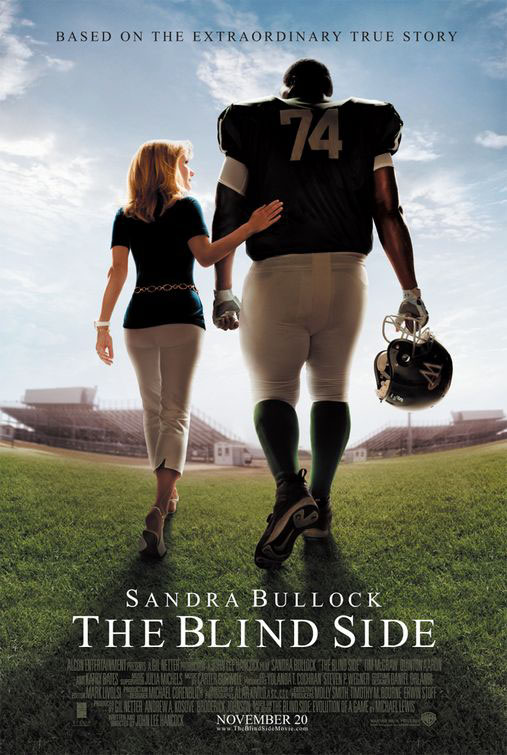
The Blind Side

A couple of Christmases ago, HPC associate pastor Geoff Henderson gave me Michael Lewis’ book The Blind Side: Evolution of a Game which I read with interest, knowing nothing of the book’s human subject, Michael Oher, and nothing about its technical subject, the importance of an offensive left tackle to a right handed quarterback. I watch both with greater interest now.

But I never imagined the book would be turned into a movie, much less a movie starring Sandra Bullock, and even less of a movie starring Sandra Bullock in which she is receiving kudos for her acting. (Trailer here.)

I’ve not yet seen the movie, but I will.

Here is the fascinating thing for me. Ordinarily, a movie is released to much fanfare and to blockbuster receipts, and then plummets to more average takes. Occasionally, a movie opens to average receipts and then increases its take in subsequent weeks.

New Moon, for example, dropped 70% in the second week, and an additional 63% in the third. In contrast a movie like The Sixth Sense opened strong, and then for three weeks decreased only minimally, and then began to increase its take.

What explains the difference is word of mouth. A movie which generates the kind of ‘you have to go see this movie’ kind of conversation will begin to attract new people weeks after its initial release. And that is the kind of film that I think must be worth seeing. A couple of other movies which followed this pattern that come to mind are O Brother, Where Art Thou? and Little Miss Sunshine.

Add to that list The Blind Side. Released the same weekend as New Moon, it increased its second week take by 18%, and though it fell by 49% the third week, a traditionally poor week for movies, it still maintained enough oomph to surpass other movies for the top spot in the weekend draw.

All that to say that people are talking and saying that this is not only one good story, but a well done movie as well. I’m not expecting it to be in the category of great, but it sounds like one to see.

[Stats are from Box Office Mojo.]

On The Road Again

For fans of Cormac McCarthy’s book The Road, recently made into a film, this interview for the Wall Street Journal will be of interest.

Some extracts here:

I have a great sympathy for the spiritual view of life, and I think that it’s meaningful. But am I a spiritual person? I would like to be.

I have the same letter from about six different people. One from Australia, one from Germany, one from England, but they all said the same thing. They said, “I started reading your book after dinner and I finished it 3:45 the next morning, and I got up and went upstairs and I got my kids up and I just sat there in the bed and held them.”

There’s not much you can do to try to make a child into something that he’s not. But whatever he is, you can sure destroy it.

[Link courtesy of Bruce Kirby.}

PC Culture

In our house, we have two computers running Mac OSX 10.6, one running XP Professional, and two running XP Home. I win the job of being network administrator.

So, today, I was working on updating my daughters XP computer. The antivirus software updated without a hitch. (I was reminded, of course, that I do not need such on my Macs.) Then, Java wanted to update itself. I concurred, and it began to load in the background.

Before long there was a requester which, if I had not clicked the proper boxes, would have loaded the Yahoo! Toolbar as well as Java. I did not want the Yahoo! Toolbar.

After that, I downloaded Ad-Aware so that I could check her computer for all those nasty things that seem go be attracted to PCs. In the process, again, I had to click carefully, or the download would have installed in addition to what I asked for also Google Chrome web browser. I might have wanted Chrome, but when I want it, I’d like to go get it, thank you.

I have to conclude that this is simply one of those things which distinguishes Mac culture from PC culture. In nearly four years of using a Mac, and downloading and trying tons of shareware and freeware, I have not once run into a situation where a program tries to install something I did not ask for.

That is one of the reasons I use a Mac and have no desire to head back to PC-ville regardless of arguments about price or the slickness of Windows 7. Mac-ville is a much more pleasant – and courteous – place to live. No one tries to slip into your house uninvited.

Where Have All the Robins Gone?

For all our friends up north who are worried about your robins and whether they made their flight successfully, I can assure you that they have arrived and appear to be in good condition.

At present, they are using the retention pond behind our house to take their post-migration baths.

They’ll work on sending postcards later.

The Buzz

How does a business (or a church, for that matter) generate ‘buzz’, that positive reverberating acknowledgment of its existence in a community? Can’t say that I know. But for the past couple of weeks from sources I cannot now all recall I’ve heard tell of a new coffee shop in town, and I’ve been told that it was top notch.

I was there today. Nearly all day. The advance billing was not out of line.

Over the past five years I’ve watched all but a couple independent coffee shops in Bradenton bow to economic pressure and go out of business. Those who have survived have done so by radically abandoning in some way their commitment to being a coffee shop. I’m not a Starbucks hater. I like Starbucks. But I’m also a huge fan of the distinctive character of independent shops. I’m sad to see them come and go.

A while back I watched as a ‘Barnies’ coffee shop opened, existed for a few months, and then shut down. It never looked appealing, I was never drawn in, and by the time I finally determined to visit, it was out of business.

Out of the ashes, in the same location, has arisen ‘Lov A Da Coffee‘. I don’t know if it will last, but everything about this place indicates the owners have done things with the intention of making it work.


I was at Lov A Da working (I work a lot in coffee shops) between an early morning hospital visit and a noon lunch nearby. In between I needed to take my car to a mechanic which was also in the area. After my lunch appointment, the car was not done, so I moved a 4:00 o’clock appointment to Lov A Da and simply spent the rest of the day there, consuming in the process three cups of coffee, one caramel cappuccino, and one Café Americana (I think that is what it was called). I had plenty of time to evaluate the place.

What can I say? The only fault to me is the odd and difficult-to-say name.

The space is large, divided into two rooms. One room has a traditional coffee shop feel, lots of tables, a service counter, and sounds of grinding beans and steaming milk. The other has the feel of a large family room, carpeted, with a dozen or more stuffed chairs and coffee tables. It has as well a well appointed stage for live music. This room is already filling a niche for a comfortable meeting space. I sat there with my 4:00 o’clock appointment, and with nearly 20 others in small groups doing the same, he and I spoke as comfortably as if we were alone. It was wonderful.

As one who lives on his laptop, the first thing I do when entering a new place is scout out the outlets for my power adaptor. This place is loaded with outlets, most discreetly hidden on the bottom sides of the tables, a clever, handy, and aesthetically pleasing solution. For those without laptops, there are a selection of computers scattered around the space, both PC and Mac. (I’m told that the owner is a Mac guy. Of course he is.)

The background music was alternative rock when I first got there, but it soon changed to real (not ‘smooth’!) jazz. It fit.

Every cup of coffee is freshly ground and brewed to order. My cups were excellent as was the service. After my first cup, I asked the barista, “Are refills free?” Very pleasantly he replied, “This one can be.”

I understand that a coffee shop, where a guy may sit for four hours or more, can’t have a free refill policy. I’m okay with that. So, I insisted on paying for my second cup. Later, he brought me a third cup, free. A cheap way to buy a customer’s favor!

The business here was brisk. Very brisk for a store that has only been open for six weeks and has yet to have a sign installed at the road.

Someone there told me that this coffee shop used to exist as ‘Java Moon’ further down the road. The contrast between what that was and what this is could not be more striking. I tried to visit that shop a couple of times, but felt like a CEO in a tattoo shop. It just wasn’t comfortable. Whatever muse led the owner to relocate and redesign, it was a good one.

This, then, is the secret of ‘buzz’: replant, relocate, rename, remake yourself, and do it with a deep commitment to quality. Of course, what is ‘buzz’ other than friends inviting friends. That drives coffee shops as well as churches.

* * * * *
Up, Reprise

I’ve already weighed in on Pixar’s Up. That I am a fan is no secret.

It has been wisely pointed out that a book is not fully enjoyed until it is read by friends and discussed. The same must be said about movies. I suppose it is true with any art. Though it can be experienced individually, it is meant to be experienced communally.

Since Uphas now come out on DVD, I’ve had the pleasure of watching it three more times. The pleasure now comes in watching the movie with others.

We recommended the film to some film lovers the other day, and they were hesitant, saying they were not great fans of animated movies. I was reminded, though, that this is one of those unique movies which SEEMS to be for children, but which has layers that make it worth the attention of the more discerning adult. My daughter-in-law pointed out a theme in the film that I had totally overlooked, which enriched the experience for me.

Art, I repeat, is enhanced when experienced communally.

* * * * *

I commented earlier that I did not think the 3D features of the theatrical release added anything to the movie. Having seen it now on my tiny 27″, low definition, analog TV, I find that nothing is lost. The power is not in the 3D effects, but in masterful storytelling.

Out from under the Rock

Sort of.

When I posted this morning about the Rudolph’s pottery sale, I was surprised to find that it had been a week since I had posted anything.

That is the result of several things.

1) I normally write several posts on a Tuesday night trip to Chik-fil-A with my son and grandson. Last week I broke with tradition and took a book. That led to an interesting conversation with another customer, so it was worth it.

2) We were blessed to have the majority of our immediate family gathered for the Thanksgiving holiday. We so enjoyed this that I was loathe to plop the laptop on top of my lap to post anything.

3) For a variety of reasons, my day job has been particularly time consuming recently (and may be for the foreseeable future).

When I emerged from exile a year and a half ago, I aimed at one post per week. I’ve exceeded that and am compulsive enough to continue to do so. I’m grateful for loyal readers and friends who encourage me in this.

Pottery Sale

If you are in the Bradenton, which means anywhere in Florida, this weekend, and want to buy some gifts for you or others which will really make them happy, take note of the Rudolph Clay Studio Holiday Pottery Sale.


I have before drawn attention to their work. I greatly encourage you to drop by.

(There is a rumor that Friday night might feature, in addition to the normal line up of art-show-type cheese and cracker type snacks some samplings of cinnamon rolls. That rumor is as of yet unconfirmed, but comes from a reliable source.)

UPDATE: If you can’t read the fine print on the postcard, the show is Friday, Dec 4, from 5pm to 9pm, and Saturday, Dec 5, from 10am to 8pm. Even if you don’t buy anything, this is worth attending.

UPDATE #2: Further fine print resolution. They are located here:

The Color of Water

This past Sunday night, Hope Presbyterian Church, the church I pastor, shared a worship service with our friends at St. Paul Missionary Baptist Church. We will do the same this Thursday, Thanksgiving morning, which is for our two churches, an annual affair. Hope is predominantly white; St. Paul predominantly black.

As much, though, as we enjoy these times of cross cultural fellowship, we all are realistic enough to know that our worlds, black and white, are simply intersecting at these times. We do not live in each other’s worlds, and we don’t understand each other’s worlds.

To cross that bridge to understand would require a type of immersion that few of us will ever experience. To read about one who made that transition cracks a window into that world, ever so slightly, and yet positively so.

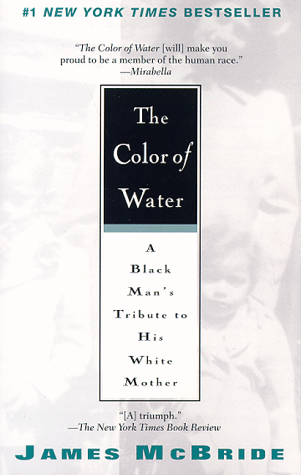
A few months ago, in a random conversation with a woman at a Starbucks, a woman, recently retired as a librarian at a local high school, directed me to a book which is apparently often assigned in schools. The book is called The Color of Waterand subtitled “A Black Man’s Tribute to His White Mother.” The subtitle captures what the book is about.

James McBride is a journalist and musician who is one of twelve children born to Ruth McBride Jordan. Ruth was born Rachel Deborah Shilsky. She was raised by her Jewish parents (her father was a rabbi turned shop keeper) in a Virginia town that did not like Jews any more than it liked blacks. Rachel was so traumatized by the experiences of her childhood, not the least of which being her domineering, abusive father, that she would never speak of it, until prodded by her grown son.

When she married a black man, this white Jewish girl was considered dead to her Jewish family. Changing her name to Ruth, to obscure her background, the couple moved to New York and began to raise a family. Her husband died after 16 years of marriage, but not before Ruth came to trust in Jesus, a trust that was real and sustaining for her (and celebrated in the book). In that time the couple jointly founded a church which her husband pastored and, along the way, they became the parents of a brood which would eventually number 12 (some born to Ruth’s second husband).

The family was raised in the neglected projects of NYC, but Ruth was a woman who would not allow that to be the downfall of her children. Taking advantage of every cultural offering one could grab and using every tool available to get her children into the best possible public schools, this woman made it happen. Though she lost direction after the death of her second husband, all of her children not only went to college, but two became doctors and one a PhD professor chemistry, along with the journalist-author, nurses, and other professionals. It’s an amazing, though often sad and painful story.

I will never enter that world. I will never be black, or Jewish, or amazingly both at once. I will never know the anguish of living in fear simply because of the color of one’s skin or the ethnic heritage one has inherited. I will never know the racial confusion that one raced in this setting is forced to confront.

But this is one of the reason we read books. McBride has cracked the window to allow me to peer into his experience and that of his mother, to glance at their worlds. If this helps me to better understand the worlds of those friends with whom we worship on Thanksgiving and other times, then the read has been worth the time spent.

Practical Theology

Seminaries run students through a gamut of theoretical studies which touch upon a myriad of seemingly esoteric topics. This can tend to divide the students into two groups – those who desire to be scholars and to spend their lives wrestling with such issues, and those who tire easy of such theory and take up quickly those courses called ‘practical’, courses addressing preaching and counseling and church administration and the like.

That is really a false divide. Perhaps it was the gift I received from the quality of my seminary training, but as I look back over nearly 25 years of pastoral ministry, I cannot think of ONE ‘esoteric’ discussion that has not been brought up in some form by real people in a real church looking for real answers.

In seminary, we pondered the question of the ‘necessity of the atonement’. Why did Jesus have to die? Was it an arbitrary decision of an arbitrary god? Was it an absolute necessity somehow arising from the character of God himself? Was it an act of ultimate child abuse? Was it a theoretical necessity?

Wading through the possibilities can seem so abstruse for a seminarian trying to get to the end of it and ‘get out there’.

Well, as one ‘out there’, I can report that I’m glad I went through the process.

The other day, a young man came to me, one whose understanding of the gospel is new, his grasp fresh. He wanted to know, “Who decided that Jesus had to die for sins?”

Great question. In fact, it is one I faced before, though framed differently as “Why did Jesus have to die?” I faced it in the clean, clinical, reflective environment of the seminary classroom, but it is the same question, now relevant to a young man trying to put flesh to the gospel he has recently embraced.

Theology well considered and well taught, seemingly theoretical, seemingly irrelevant, can be the most practical tool at our disposal.

Not just for pastors. For all.

Page 80 of 142

Powered by WordPress & Theme by Anders Norén