
Randy Greenwald

Concerning Life as It Is Supposed to Be

A Crooked Stick

I can’t remember who first impressed upon me the fact that God can draw a straight line with a crooked stick, but I have often drawn encouragement from it. I am a decidedly crooked stick who harbors hopes that God would draw something straight from his labors.
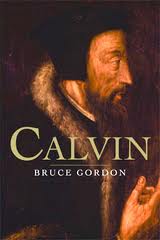
Calvin
It is, though, as well important to recall that history is full of straight lines drawn by crooked sticks. Our tendency to want our heroes all straight runs counter to our comprehension of human nature. Every year in mid-January, for example, well-deserved praise pours forth in honor of the courage, passion, and vision of Martin Luther King, Jr., and a backlash emerges from bitter pens wanting us to see his moral faults. He was a crooked stick God used to draw some long needed straight lines.

Of course, all God has to work with are crooked sticks. We should expect nothing else from fallen humanity.

Knowing all of this, then, I find that completing Bruce Gordon’s biography of John Calvin Calvin, has made me sad. Calvin, it appears, was a crooked stick.

Calvin’s own Institutes of the Christian Religion has had a huge impact on my life and thinking. So instructed have I been by its logic and restraint, and so moved by its warm, pastoral approach, that I find it easy in reading it to overlook the polemical tone that settles upon many pages.

That combination of pastoral warmth and polemic aggression reveals the two sides of Calvin’s personality that make it difficult to offer a simplistic picture of him.

This was Calvin’s divided self: the confidence in this calling as a prophet and apostle set against his ever present sense of unworthiness and dissatisfaction….These were two sides of the same personality. It was his acute sensitivity to the gap between what was and what should be that distressed him. (page 334)

A complex person is easy to attack but harder to understand. And when that complex person is a spiritual person, and especially a prophetic person, he becomes an easy target for those wanting to attack him as one who did not well represent the principles he preached. Gordon’s portrayal is sympathetic, insisting that we need to understand Calvin from within his own cultural context (a good rule of thumb for any historical character), and at the same time his portrayal feels honest.

At the end of the day, I judge that I would not have liked him very much. The Calvin that emerges from these pages is one whom I wished were different. He comes across as being hyper-sensitive to criticism, not very politically astute, at times harsh in his expression, and one whose work-ethic was so intense as to be idolatrous.

And yet I need to understand that Calvin existed in a time of great contention. Christian truth was not only disputed academically, but blood would flow when persons would differ. The church was in a position of needing to be re-formed, and that was a messy business.

I leave the biography respecting Calvin’s work and being drawn to aspects of his person. That he determined to live by the truth’s reflected in his Institutes is perhaps illustrated by his desire to not become the center of any cult of idolatry. He shuddered to think that a theological system would emerge bearing his name. When he died, per his instructions, he was immediately put in a box and buried in an unmarked grave, to prevent idolatrous adulation of his body.

It didn’t work, of course. Idolatrous adulation still occurs. Honest biographies are necessary to remind us that we are to idolize no person. All are crooked sticks, and crooked sticks are harder to idolize.

But the straight lines they are used to draw reveal that they are useful instruments in the hand of an Artist worthy of our honor. We thank God therefore for the work of great men, and we pray to God that he will draw something straight with us as well.

Super Bowl XLV

Truths gleaned from last nights gladiatorial contest:

1. Joe Buck is the best sports announcer ever. No contest.

2. I will stop at Publix on the way home to complete our kitchen makeover. And I don’t even drink beer.

3. I would drive there in my VW Passat if I had one.

4. And I will NOT soon be downloading any Black-Eyed Peas songs. Or ever.

Oh, and good game.

Pitchers and catchers report 2/14. I knew there was something special about that date.

I Learned Dog

Clearly one of the hottest topics out there among parents priming their tots for Harvard is Amy Chua’s Battle Hymn of the Tiger Mother, currently #10 on the Amazon sales lists.

I heard Chua interviewed on the radio a few weeks ago and she sounded kind and charming, but I’m not going to read her book. I already have enough reasons to feel guilty about my parenting disabilities. I don’t need to add another. There have been some interesting responses to Chua’s hard nosed style, so I’ll lean on those .(And await another here.)

David Brooks takes on Chua as being insufficiently challenging as a parent. She would make her daughters practice music for two hours a day and would threaten severe discipline if they came in second to anyone in anything. And, she banished sleepovers. No time for that. Curiously, Brooks does not criticize her for being too severe, but for coddling them:

I believe she’s coddling her children. She’s protecting them from the most intellectually demanding activities because she doesn’t understand what’s cognitively difficult and what isn’t.

Practicing a piece of music for four hours requires focused attention, but it is nowhere near as cognitively demanding as a sleepover with 14-year-old girls. Managing status rivalries, negotiating group dynamics, understanding social norms, navigating the distinction between self and group — these and other social tests impose cognitive demands that blow away any intense tutoring session or a class at Yale.

Lane Wallace, while not addressing Chua directly, or consciously for that matter, in a post on entrepreneurial and life passion, reflects on the kinds of things in childhood which fuel the ability to imagine and create. She lists as the second factor, this:

Support and enthusiasm for trying new things. To imagine something that doesn’t yet exist and have the confidence to pursue or invest resources in that vision, a person has to believe a) that exploration and experimentation are good things and b) that [there] isn’t just one right answer. (So kids raised in regimented households tend to have a harder time coming up with highly creative visions that challenge accepted ways of doing things.)

I can’t help but wonder if the parenthesis had a target.

But the best response I’ve seen sidles up next to those of us who stumble through parenting and graciously assures us that if we are bad at this child-rearing thing, we are probably worse at dog-rearing. She notes that Amy Chua’s dog is no match for some top flight canine scholars. This author’s own dog is an accomplished teacher.

The dog who now sleeps in front of our fire is Sophie, a cross between a Labrador and a setter, who, like most of our dogs before her, has shown little interest in the niceties of human language. In fact, my ability to communicate my needs and wishes to her is quite limited.

She has, however, managed to teach me to carefully — and, I might say, correctly — interpret every bark, whine, ear twitch, needy moan and shift in posture, and to respond accordingly. She didn’t learn English. I learned Dog.

This, I encourage you to read from beginning to end.

We Report; You Decide – the Evidence

I managed to snap a photo of the previously alluded to sign as I drove by today. Enjoy!

Photo

Previous messages on this board encouraged people to not leave pets locked in car “…due too heat” and announced a discount on “sugeries”.

Top Ten

I’m no David Letterman, and can’t afford top notch writers to form amusing top ten lists, but I’ve got you, my readers, to help me.

There are of course Bible passages which have seeped out into the public consciousness which are often quoted, but not always with understanding or accuracy. Over the past few weeks I’ve had to deal with a couple of them which I think would make a top ten list:

“Let him who is without sin cast the first stone.” (John 8:7)

“The truth will set you free.” (John 8:32)

These are well known to those who may not know the Bible well, and are invoked sometimes appropriately and sometimes not.

So, what I’m looking for are other passages to include in a top ten list of ‘Bible Sayings Familiar to Those Unfamiliar with the Bible’. Can you give me some help here?

And for those of you not immersed in the conservative Evangelical church culture as I by vocation and sentiment am, I invite you to nominate verses to populate a list called ‘Bible Sayings Mis-used by Those Familiar with the Bible’. I know there are a number of those out there as well!

We Report; You Decide

Near our house is a veterinary clinic/horse boarding business. They have had trouble with accuracy in their signage in the past, inaccuracy sufficient for me to question the competence of the personnel inside.

Currently the sign makes me wonder if they are running a side business supplying all that a potential bride needs for her dream wedding. And I mean all.

The sign reads:

“February: $5 off all grooms”

If that’s a deal, grooms must come cheap these days.

How SHOULD We Then Live?

I recently posted my frustration related to the way some DEMAND that others respond to the issue of abortion. I was disappointed that a particularly confrontational and uncharitable approach had been (apparently) sanctioned by The Gospel Coalition’s Justin Taylor.

My concern is somewhat ameliorated by Taylor’s subsequent post of an interview with Robert P. George on the subject of abortion. In that interview, Mr. Taylor asked Professor George how the church should respond to abortion. The heart of what he says is in stunning contrast to what Mr. Taylor’s previous post encouraged:

Let us treat everyone, even our opponents in this profound moral struggle, with respect, civility, and ungrudging love. Loving witness is something all of us can give. And lovingly witnessing in our churches and communities to the sanctity of human life is something all of us are called to do.

I reproduce his answer here in full, and with enthusiasm:

First and foremost: Pray. Pray for the unborn victims of abortion and for women who are, so often and in so many ways, truly abortion’s “secondary victims.” Do not judge them, but rather pray for them and love them. Pray for those who have dedicated themselves to working in politics and the culture for the pro-life cause. Pray for our leaders at the state and federal levels—including judges—whose actions will literally determine who lives and dies. Pray for those whose hearts have been hardened against the unborn, and who defend and even promote abortion. And pray for those who perform abortions. God has already turned the hearts of some such people. Bernard Nathanson, a prominent abortionist and one of the founders of the pro-abortion movement in the United States, was converted to the pro-life cause by the loving witness and prayers of pro-life people. Who knows how many other abortionists and defenders of abortion will follow his path? Let’s give up on no one. Let us treat everyone, even our opponents in this profound moral struggle, with respect, civility, and ungrudging love. Loving witness is something all of us can give. And lovingly witnessing in our churches and communities to the sanctity of human life is something all of us are called to do.

And there is more that we can do. Pro-lifers do a wonderful job in pregnancy centers around the country in reaching out in love and compassion to pregnant women in need. These pro-life heroes need our financial and moral support. Moreover, they can always use another pair of hands, so I hope that many people will join those volunteering in these efforts. They save lives, and they bring God’s healing and practical assistance to our sisters in distress. Politically, we need to use our clout as citizens of a democratic republic to influence policy in a pro-life direction. The fight against abortion and embryo-destructive research should be put at the top of the priority list in evaluating candidates for state and federal offices. We should support pro-life candidates with our money as well as our votes. Moreover, I hope that some who read these words will take the very practical step of running for office themselves. We need more people who are dedicated to the defense of human life to step forward as candidates for Congress, the state legislatures, and other public offices.

Dear Diary…

I mused a few weeks ago about the lost art of the diary.

Apparently, according to the New York Times, I’m not the only one musing along those lines. The Morgan Library and Museum in New York has apparently brought together an exhibit focusing on the art of keeping a diary. Oh, to be able to visit. If the previous post sparked any interest at all, this article will be worth the read.

As I did, the author here sees the relationship between the diary and things such as Facebook and Twitter.

Our own era, of course, has turned spontaneous journalizing into something of a fetish, as 140-character tweets supposedly spring spontaneously from the thumbs of celebrities; scores of electronic walls sprout on which “friends” post tirelessly about their socially networked activities; and blogs are tossed into the electronic ether like rolled-up notes floating in virtual bottles. And though far less distinguished, the contemporary mix of self-invention, self-promotion and self-revelation is probably not that different from what is on display here.

But the most interesting observation she makes is on whether written self-reflection is true. Some diarists clearly wrote for history, and tidied up their lives to make themselves look good. Others wrote for themselves, and might have been excessively hard on themselves. For honesty, she commends the author of the Christian hymn “Amazing Grace” John Newton:

An enormous volume by the British slaveholder John Newton recounts his spiritual conversion (which led to the composition of the hymn “Amazing Grace” and to his later opposition to slavery), but also his “repeated backslidings”: “I have been reading what I have recorded of my experience in the last year — a strange vanity. I find myself condemned in every page.”

My own journal keeping occurs early, early in the morning, when sometimes my soul is as dark as the sky is outside. It’s not necessarily an accurate description of my whole view of life!

Anyway, fascinating reading.

Steps to Home Audio Excellence

1. Cajole 26 year-old son into giving you an unused powered sub-woofer.

2. Set sub-woofer next to audio system for seven months.

3. Move to different city.

4. NOT connecting sub-woofer to receiver saved having to disconnect for move. Make note of brilliant foresight.

5. Set sub-woofer next to audio system for another seven months.

6. NOT connecting sub-woofer to receiver sets baseline audio quality so that women-folk are prepared to be impressed upon connection. Make note of brilliant strategy.

7. Plug sub-woofer in to power source.

8. Connect sub-woofer to receiver using suitable RCA cable.

9. Crank up Lord of the Rings: The Return of the King in DVD player.

10. Eat some potato chips while pondering still silent sub-woofer.

11. Move cables around on back of receiver. Push random buttons on front of receiver.

12. Eat more chips. Pound top of sub-woofer.

13. Ask wife where receiver manual might be found. She knows, of course. Add crow to chips. Get manual. Womenfolk have yet to be impressed.

14. Follow instructions to screen that says: “Sub-woofer: Off”

15. Change to “Sub-woofer: On”. Feel pulse rising.

16. Discover “Double-bass” setting. Turn it to “ON” of course.

17. Excitedly resume movie. Sadly note silent sub-woofer. Note cable plugged into wrong spot. Move cable.

18. Hear sub-woofer rumble. Look at ten year-old son with that “isn’t that cool” look.

19. Watch “I-Am-No-Man” Eowyn slay the Nazgul at top volume, no longer caring if womenfolk are impressed.

20. Cheer wildly. For multiple reasons.

Type Crimes

As those who work with me soon find out, I have particularly strong feelings about certain aspects of the written page. To fail to use ‘smart quotes’, for example, is a particularly grievous crime in my book, and so I expect conformity. And, of course, there is the matter of where to put the comma after a quote.

I’m also bothered by the ‘two-space’ offense. I rarely correct this in others, but I have a macro which searches for places in my documents where I’ve inadvertently typed two spaces between sentences and replaces them with a more aesthetically appealing single space. I confess.

This, apparently, is not a passion held solely my me. Recently I’ve seen a few references to this as being a lively contemporary debate. Historians will note the hot topics of 2011: health care, “don’t ask/don’t tell”, the Iraq/Afghanistan conflict, and the ‘single-space’ standard.

The case for the single space is made in this recent article in Slate.

The author makes a good point. In these days of proportional fonts and computer typography, one space is all that is needed between sentences. That is why all major style manuals recommend it. There is really no need to argue further.

But apparently I’m dead wrong on that last statement. That one would write an article attacking the two-spacers and have it published in a major on-line magazine is surprising enough. That that article would in ten days time generate 2227 comments is astonishing.

Who said that post-moderns don’t argue absolutes?!

+++

UPDATE: When researching this controversy (I’m hopeless. Let’s all face that fact and learn to live with it.) I stumbled across this from a “two-spacer”. A point of agreement between us, it seems:

If you see me “making mistakes with comma placement”, please rest assured that I’m doing it deliberately. In most cases the comma doesn’t belong to the phrase delimited by the quotation marks that enclose it. Placing an exclamation point or question mark to the left or right of a close-quote is a weighty decision! That we violate the atomic purity of quotations with injected commas is an outrage.

Preach it, brother. Just preach it with single spaces, please.

Page 53 of 142

Powered by WordPress & Theme by Anders Norén