Randy Greenwald

Concerning Life as It Is Supposed to Be

Hipster dis-Cred

I’m confused, not hip.

I’m confused on the one hand because some, but not all, of the things I read about so-called ‘hipster’ Christianity ring true for me.

What makes a church a “hipster church”? Does it have a one-word name that is either a Greek word or something evocative of creation? Does the pastor frequently use words like kingdom, authenticity, and justice, and drop names like N. T. Wright in sermons? Does the church advertise a gluten-free option for Communion? If the answer is yes to all of those questions, chances are that it’s a hipster church. (Brett McCracken, “Hipster Faith”, Christianity Today, September, 2010)

I answer yes to some of these questions, but not all. Somewhere a few years ago, I took an online ‘hipster quiz’, an unhip thing to do, and scored 78/120. Not sure what that makes me.

I wear sandals, so suspicions are quickly raised. But I wear them because 30 years ago I met a very square and un-hip Scottish pastor who wore sandals and they looked (and are) comfortable. Sandals are hip, but so are the oft mentioned ‘skinny jeans’, and whatever those are I’m sure I’m not going to wear them. Goatees are hip, but they make one look sinister.

The Coen’s are interesting and often brilliant, but they have their lapses. (That’s hip to say!) Wes Anderson is beyond mystifying. (Not hip.) I love liturgy and literary fiction. Mumford and Sons is on my play list and I believe the kingdom certainly includes elements of social justice. (All fit the hip profile.) But I can’t cuss very well, much less in a sermon, I don’t like beer, and, as a Twitter post commented yesterday, intinction works better for cookies and milk than for bread and wine. (Not very hip). And a ‘gluten free option’? Simply sounds loving rather than ‘hip’.

I thought about this the other day when I decided to retire another element of possible hipster cred. After having completed the massive bio of Winston Churchill (The Last Lion) I moved on to read the popular fiction of David Balducci. Terribly unhip. Perhaps that stirred the hipster demon in me, for after finishing Balducci I had this uncontrollable urge to read Flannery O’Connor. Flan and I started out well, but the more she spoke the harder it became for me to grasp what she was saying. It dawned on me that I was reading her because I thought I was supposed to. Cool pastors read and quote NT Wright AND Flannery O’Connor, I guess. But not this one. Not now, anyway.

I certainly hope I’m not trying to be hip by claiming to be unhip. It can become all very mystifying.

I’d finish by quoting a pop music lyric (a hip thing to do) but the lyrics I’m most familiar with are over 40 years old. Not hip.

Oh heck (a hip pastor would have phrased that more strongly), I’m going to do it anyway:

But it’s all right now, I learned my lesson well.
You see, you can’t please everyone, so you got to please yourself.
(Rick Nelson, “Garden Party”, 1972)
Read the Beloved Book

A reader of this blog noted a few months ago her intent to read the book on which this blog’s title is based. The occasion was my once again defending the ironic intent of the title ‘Somber and Dull’ and noting that it is based upon the main character of Alan Paton’s wonderful 1948 novel Cry, the Beloved Country.

I’m still waiting to hear whether she kept her vow. If she hasn’t, perhaps I can urge her, and you, to move the book somewhere near if not at the top of your ‘to-read’ list. If you need extra incentive, then note the occasion of the death of Nelson Mandela by reading the book that sets the context for understanding the world Mandela sought to change.

Writer Kevin Roose in a helpful NPR story had this to say about the book and its main character, Stephen Kumalo (“…a parson, somber and rather dull no doubt, and his hair was turning white….”):

Kumalo is a quiet, unassuming man who relies on his faith to get him through tough circumstances. And when he finds out that his son has been arrested for the murder of a white activist and is scheduled to be executed, he begins working for reconciliation and justice. It’s a beautiful book – lyrical without being maudlin, lofty but unpretentious – and Paton captures perfectly the difficulty of nonviolent resistance. In one scene, Kumalo, speaking to a farmer who he fears has become too radicalized, says: “I cannot stop you from thinking your thoughts. It is good that a young man has such deep thoughts, but hate no man and desire power over no man.”

The whole piece is worth listening to (or reading), but nothing can surpass the delight and joy of experiencing the book itself.

Do so, and then tell me what you think.

[By the way, if you don’t know why this blog has the strange name it has, and you WANT to know, then read here or here. Or both.]

Sacrificium Intellectus

Even a non-Latin scholar can figure out the meaning of the title of this post. It reflects what is so hard for us to swallow, isn’t it? There are paths down which our rational intellect can’t lead but for which we need revelation and the admission of the supernatural. But it has always been hard to swallow.

[The virgin birth] is highlighting the essentially supernatural character of Jesus and the gospel. Alluding to Barth again, the virgin birth is posted on guard at the door of the mystery of Christmas; and none of us must think of hurrying past it. It stands on the threshold of the New Testament, blatantly supernatural, defying our rationalism, informing us that all that follows belongs to the same order as itself and that if we find it offensive there is no point in proceeding further.

If our faith staggers at the virgin birth what is it going to make of the feeding of the five thousand, the stilling of the tempest, the raising of Lazarus, the transfiguration, the resurrection and, above all, the astonishing self-consciousness of Jesus? The virgin birth is God’s gracious declaration, at the very outset of the gospel, that the act of faith is a legitimate sacrificium intellectus. (37)

That is from Donald Macleod’s marvelous book The Person of Christ, in a section in which he also says that

“The truth is, man will always find God’s procedure offensive.” (35)

My desire is that my heart and mind will find less offense and more faith and hope this Christmas. I pray that for you as well.

Safe Doubt

Rob Edenfield preached a helpful sermon on doubt this past Sunday at the church I pastor. The reaction to the sermon has shown that many are fearful of sharing their doubts and others (happily) surprised to find out they were not the only ones struggling with doubt. Doubt is real, and real to all honest Christians. Tim Keller has noted that “a faith without some doubts is like a human body without any antibodies in it.” (The Reason for God, page xvi) It’s good to be aware of and to admit our doubts.

But often we do not express our doubts because we are fearful of how others will receive us if they know we are struggling. To ponder how to respond to those giving honest expression to their doubt is a helpful exercise. To that end, I shared with our community group this anecdote from Susan Schaeffer Macaulay, the daughter of noted apologist for the Christian faith, Francis Schaeffer. This story has always been immensely helpful to me. I share it here hoping it will be the same for all of us as we welcome doubt among us.

I started the process of thinking through my beliefs almost accidentally, when I was eleven years old, growing up in Switzerland. What touched it off was a squabble with my two sisters, Debby and Priscilla. We had nearly finished weeding the family vegetable garden, and we were hot, tired, and crabby. As I grew more and more obnoxious in my side of our argument, one of my sisters piped up and said that I wasn’t being a very good Christian example to any villagers passing by.

Without thinking, I said the most shocking thing that came into my head — pretty shocking, at least, when your father is a minister. “Well, I’m not a Christian anyway!” I yelled. “I don’t believe any of it!”
I was received with the dramatic reaction I’d wanted: shocked silence.

As we picked up our hoes and walked down the mountain path toward our home, I suddenly felt a tingle of fear creep up my spine. Inside, I had the dizzy sensation of standing on the edge of a dangerous cliff. I had said that I wasn’t a Christian because I’d wanted to shock Debby and Priscilla. But now I wondered: Did I really believe in God? Was the Bible true? Did I have reasons to think so, or had I just blindly accepted what my parents had told me?

The more I thought about it, the worse I felt. I had loved this God of the Bible since I had been tiny. Now all that I’d heard about his teachings and his love seemed to be turning to ashes in my hand.

At the supper table, Priscilla announced, “Susan says she isn’t a Christian.”

By then I didn’t feel like denying her words, even though I could see that my mother looked sad. I was sad, too, for I felt as if I had lost God and his love. I wasn’t sure that there even was a God.

But I was also determined. I couldn’t believe in fairy tales! I had to grow up.

That easily could have been my last day of knowing God was there, and that I was safe in the order he had provided. It could have been the death of my faith.

Or it could have been the end of my progress into thinking as an adult. All it would have taken was a comment like, “Of course you’re a Christian, Susan,” or, “You’re only eleven; you don’t know what you’re saying,” or, “Don’t be foolish — it’s obvious that the Bible is true.’

But something else happened instead. That night when I was ready for bed, alone and quiet in my room, my father came in.

“Let’s talk, Susan,” he said seriously. “Tell me why you said you are no longer a Christian.”

I confessed that I’d first said the words because I was mad. “But as soon as I said it, I was scared,” I explained. “I can’t call myself a Christian! All this time, I’ve only believed it because you and mother told me about it. Now I’ll have to wait and see if it’s true or not. Maybe the other religions are true. Or maybe there isn’t even a God at all!”

There was a moment of silence. I still remember the quiet, friendly companionship in the atmosphere when my dad finally answered me. “Susan,” he said, “those are good questions. I’m glad you’ve asked them.”

What a relief! That dizzy, lonely feeling left me. It was OK to ask questions! It was important for me to find out for myself if what I’d believed was true.

As we talked that night, I discovered that my dad had asked these same questions about God in his own search for answers. Dad opened the door for me into a new adventure. He said that I didn’t have to go through life with a blindfold on my mind to believe in God, merely clinging to hopes and feelings. Neither did I have to throw my beliefs out the window.

If something is true, he explained, you can look at it hard, and think about it, and compare it with other beliefs, and it will stand. It will be reliable.

I decided to do just that.

[From How to Be Your Own Selfish Pig, pages 15-17.]

The full sermon will be found here when posted.

Feeling Rotten?

When we feel rotten, we want to avoid happy people. Laughing hyenas travel in packs; the depressed ones probably travel alone. Sometimes we just want to be alone and church is not a place where that is easily accomplished.

Often those who feel the worst avoid worship because they are convinced that everyone else is happy and no one knows the misery they are experiencing. No one who is struggling wants to hang out with people who are going to inevitably ask, “How are you?” Maybe they care, maybe they don’t, but when we are upset, we don’t want to be asked.

And so, we stay home. We go to the beach. We watch TV. We feign illness. And we void the very thing that God has created for hurting people.

Hearts that are chewed up and in trouble provide fertile soil for the gospel. Overturned earth is most ready for the seed. Sorrow breaks the hardness of our hearts and brings the possibility of healing most in view. And our Enemy does not want us to find that healing. So he whispers insistently, if not persuasively, “Stay home; you don’t want to be there. Not with THEM.”

When you feel rotten is, in fact, when you most need to be in worship. Go. Be there. And pray that the renewing dew will fall upon your broken heart.

Nostalgia and the Kingdom

To get me to ignore your message, frame it in crisis terms. I’ve become immune to any appeal suggesting that avoiding this movement or embracing that practice is ushering in the collapse of all the we (generally white Americans) find culturally precious. The claims may be accurate. The sky may be falling. But I’ve grown immune to the screaming.

We see cultural collapse when we are gripped with an unhealthy sense of nostalgia. We are persuaded that the 1950s was the height of safe Christian culture (or, for me for a time, 1860) – conclusions which for obvious reasons will be shared by white men far more than others.

Nostalgia links to our sense of shalom. We long for shalom, and sentiment for a time lost is easier to embrace than hope for a time yet unforeseen. Anything which seems to threaten that nostalgic longing is a portent of imminent social collapse. And for many, the harbinger and possible cause of this collapse is pop culture (rivaled only by, and often seen hand in hand with, the ‘other’ political party). The movies and music and media of our day are eroding our national strength and if not stopped or countered will lead to inevitable loss. So goes the argument meant to make me feel guilty if I don’t buy a ticket to Fireproof.

To argue the case one way or the other seems a bit fruitless to me. Lives are won or lost one at a time through old fashioned love and discipleship. Micro-ministry holds greater hope for the kingdom of God than macro-movements.

That said, pop culture does play a role, but it is not universally negative as some too easily assume.Magnolia melora walters john c reilly Signs that pop-culture can SERVE the kingdom and not degrade it are not hard to find. The 1999 movie Magnolia could be seen as evidence of our cultural fall with its sex and drug use and gay lead character. But the biblical themes of judgment are rich and the Christian character is the only one who is not coming undone. There is much positive here.

In 2005 Steven Spielberg directed a version of the H. G. Wells classic War of the Worlds. It was not a particularly good movie, but that’s not what matters here. In an interview Spielberg compared this movie with his earlier Close Encounters of the Third Kind. Both involved families. Both involved aliens. The difference, he lamented, was that in his earlier movie, crisis tore families apart. In this newer movie, crisis took families which were apart and pulled them back together.

Progression toward shalom, and not away from it, should be celebrated. Not all ‘progress’ is retrograde.

Nostalgia can fix our eyes on the past and blind us to the progress of God’s work in the present. Perhaps it is better to fix our eyes on the kingdom and celebrate it wherever we see its fingerprints, in the present, in the past, and especially in our hopes for the future.

Mysteries

Here are a few of life’s unanswerable questions, mysteries to which I have no insight. I’m sure you can add to the list. In fact, I wish you would.

1. How do they get the candy coating on the M&M?
2. Why is it called squash?Squash yellowcrookneck
3. What is “fat-free half and half” half and half of?
4. Do giraffes get hit by lightning with greater frequency than other animals?
5. Do they form the butter into a stick before wrapping it?
6. Why do highly paid professional basketball players ever miss a foul shot?
7. Why is there an expiration date on sour cream?
8. Why are hot dogs always shorter than the bun?
9. For that matter, why do hot dogs come ten to the pack, and buns 8 to the pack?
10. Why does the Virginia Polytechnic Institute go by the initials VT instead of VPI?
11. When does a flashlight ever ‘flash’?
12. Why are smoke detectors pre-programmed to signal dead batteries only at 3:00 AM?
13. Why does someone who believes in the goodness and sovereignty of God worry?

On Significance

Insignificance is the human nightmare. Being nothing and mattering to no one is our existential terror. My recurring fear is imagining myself a researcher who has invested 25 years in her lab following a once promising hypothesis only to lock the lab on a final day realizing that the pursuit was a dead end, her life work irrelevant. Others share such fears.

Florida has spectacular clouds. Towering and billowing and showy and beautiful, they ultimately leave no evidence of ever having been. We shudder to apply that as a metaphor to our lives. We want to matter for more than appearance. We want to leave something of substance in our wake. We fear we never will.

My son confronted extreme difficulty the other day and when I went to him, his first words out of his mouth were not “do you forgive me?” but rather “are you disappointed in me?” The ache of any child’s heart is to hear that he matters, that his daddy is proud of him. It’s the desire of all our hearts, really. If I could hear that, I think the fear of insignificance would simply drift away.

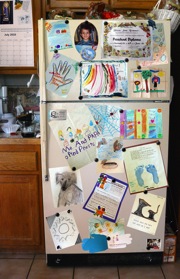
Parents who want to give that message to their children boast of their work. A child sketches and scribbles a picture on a piece of notebook paper, and the parent immediately pins it on the refrigerator. Judged by a purely objective standard, the picture lacks the quality of great art. But the child has significance as she is loved, and as her parent shows his pride in what he considers her well done works.Fridge

The word I long to hear from God is not “I forgive you.” I hear that every Sunday and know it to be true. The word I long to hear is “Well done.” The works I do, judged by a purely objective standard, certainly lack the quality of great works. But my significance lies not in the works, but in the love of my father. I like to think that he has pinned my works on his refrigerator door. He is a good father, proud of me, his son.

All we do we do under the watchful eye of a loving and understanding father. Our works are weak and our production spotty. But this heavenly Father loves us. He puts our pictures on his refrigerator. There is no insignificant child of God.

Ministry for Hire?

I understand that journalism is a contact sport and that the competition for readers is intense. That does not justify the exploitation or creation of controversy, but it does help explain it.

Recently I was directed to an article in the Huffington Post on the compensation of those who head up some high profile religious organizations. Also popping onto the radar was the story of the suspension of the German bishop by Pope Francis after the bishop reportedly spent $42 million to upgrade his residence. As well, a report was recently released charting the compensation of a variety of college majors, in which religious professionals come in near the bottom (at around $42 THOUSAND, not million).

All this attention calls for comment, particularly given our human love for scandal and judgment.

The Huffington Post article especially brought out the worst in my judgmental spirit. That proponents of the so-called prosperity ‘message’ (I can’t call it ‘gospel’) show up near the top of this list, is no surprise to me. I find it odious, but at least their lifestyle is consistent with their message.

Harder to swallow is the presence in this list of those heading up organizations devoted, ostensibly, to ministry to the poor. Franklin Graham of Samaritan’s Purse reportedly receives $500,000 annually, and Jim Wallis of Sojourners $200,000. I could only think of how our small church in Bradenton a few years ago scraped together boxes of basic supplies to be shipped to needy kids overseas under the auspices of Samaritan’s Purse. If these reports are true, Graham could have used pocket change to hire someone to provide these in our place.

Such reactions, however, are precisely what Huffington is after. Scandal used to sell papers; now it produces hits, and hits add up to advertising dollars.

I don’t question the figures (though they are inflated as they include all benefits, something that most in calculating their salaries never do). But we who see such figures should not be so quick to judge.

After the wave of condemnation passed over me, I pondered the situation of Jim Wallis. We do not know what happens to this money once it touches his fingers. The article does not ask those questions. We know nothing of his lifestyle, we know nothing of his giving habits. For all we know, he’s living on $42,000 of it and giving the rest away. He may not be. But we do not know, and yet we judge.

But why is he being paid $200,000 in the first place? Perhaps that is not his request but rather the wise judgment of a careful board. They of course will see Sojourners as an important ministry doing significant work, and they have to know that it takes an extremely talented person to manage, inspire, and oversee such a work. They may be astute enough to know that though Jim Wallis as the founder may be willing to do that work for far less, not everyone would be. Responsibly, then, they build into their budget what would be required to replace one such as Jim Wallis should something sudden happen to him. To be responsible to the ongoing viability of the work, they pay their leader not what he demands but what it would require to replace him. They may do this in order to prevent a crisis in the ministry in the face of his sudden death.

I don’t KNOW that this is the case. I’m just saying that it is a very real, and in my judgment a very responsible, possibility.

John Wesley, the 18th century founder of Methodism, had in the last years of his life an unusually high income, due largely to royalties from his published works and sermons. He no doubt would have made Huffington’s list and we would have wagged our heads in judgment. But would such judgment have been deserved?

Wesley died with almost nothing, having resolved early on to give away nearly all he made. He had vowed:

“If I leave behind 10 pounds, you and all mankind bear witness against me that I lived and died a thief and a robber.”

The point is, giving only one side of a story generates page hits and stimulates our judgmentalism. But it does not necessarily give us the truth.

I don’t know the backstory of these figures. But what I do know is that our sinful and judgmental hearts find in scandal the opportunity at self-justification, giving the occasion for us to stick in our thumb, pull out a plum, and say, “What a good boy am I.” Jesus condemns greed, for sure. But he condemns the judgmental spirit as well. And both are in need of a gospel cure.

A $42,000,000 home makeover may be scandalous (though, again, the backstory and the bishop’s defense never make it into our tweets). As well we may want to judge the average pay for pastors as scandalously low.

But clearly scandalous is our tendency to leap to the most judgmental conclusions on which the worst in journalism and politics depends.

How to Read a Bible

As one committed to historic Christianity I believe in the verbal inspiration of Scripture – that God so moved the writers that what was written was precisely what he wanted written. But I also believe that what was written, being written by human beings in human language, is to be approached and read in most respects as we would approach and read any other book. We need not apply any special code or method (and we certainly don’t need bibles edited for every possible demographic, but that’s for another post).

Years ago, I read what I thought to be a curiously titled book, Mortimer Adler’s How to Read a Book. The premise of the book was that though most of us can ‘read’ words on a page, few of us have developed the ability to read for understanding. I found to be extremely helpful on a number of levels.
Howtoreadabook
It struck me as I read it that if any of us were to apply his insights to the simple reading of the Bible we would come away with a good bit more understanding and, perhaps more importantly, far less mis-understanding.

I get giddy when really smart people agree with me. How to Read the Bible for All It’s Worth is an excellent little book on understanding the Bible written by Douglas Stuart and Gordon Fee. They ask, “How do we learn to do good exegesis? (“Exegesis” is a fancy word for the process of understanding the Bible.) Their answer, among other insights, includes this:

“The key to good exegesis, and therefore to a more intelligent reading of the Bible, is to learn to read the text carefully and to ask the right questions of the text. One of the best things one could do in this regard would be to read Mortimer J. Adler’s How to Read a Book (1940, rev. ed. With Charles Van Doren, New York: Simon and Schuster, 1972). Our experience over many years in college and seminary teaching is that many people simply do not know how to read well. To read or study the Bible intelligently demands careful reading, and that includes learning to ask the right questions of the text.”

I still get giddy when I read that. But I’m weird that way.

Page 28 of 142

Powered by WordPress & Theme by Anders Norén