Randy Greenwald

Concerning Life as It Is Supposed to Be

In the Garden of Beasts

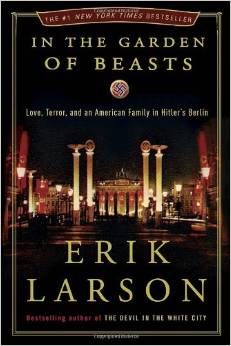
In the Garden of Beasts is Erik Larson’s offering opening a window on the troubling world that was Berlin prior to WWII. Subtitled “Love, Terror, and an American Family in Hitler’s Berlin”, the book follows the experience of the United States’ first ambassador to Hitler’s Germany, William Dodd, his wife Mattie, and their adult children Martha and Bill, Jr. Their life in Berlin paralleled Hitler’s ascension to the chancellory and eventual assumption of complete power. The more power that Hitler assumed, the greater the culture of fear and suspicion and intrigue spread.
GardenBeasts
The realities detailed are not altogether surprising. Larson in all his books finds an intriguing tale to tell (The Devil in the White City remains my favorite), and the tale he tells inevitably involves some unspeakable evil. While in his previous books that evil was hidden and surprising, in this one though the evil was visible to all, few took note of it.

One would expect that nothing evil would trouble an author who writes so frequently about it. (The Devil in the White City is subtitled “Murder, Magic, and Madness at the Fair that Changed America”!) But this story effected him differently.

What I did not realize as I ventured into those dark days of Hitler’s rule was how much the darkness would infiltrate my own soul…. [L]iving among Nazis day in, day out proved for me a uniquely trying experience.

I can still not fathom how evil of this depth can gain such broad acquiescence. I like to believe that it could not happen again. But just over a week ago (on April 19) Matthew Kaminski, a journalist on the editorial board of the Wall Street Journal, tweeted

What’s Moscow like these days? Longtime diplomat suggests reading “In the Garden of Beasts,” Erik Larson’s account of Berlin in late ’30s. (@KaminskiMK)

One can hope the unnamed diplomat is wrong.

—–

If I wanted to follow this book up with something less troubling, I probably should not have turned to this one: World War Z: An Oral History of the Zombie War by Max Brooks. But I did.

WWZ

Faith Anchored by Heaviness

As a pastor, of all the characters in John Bunyan’s Pilgrim’s Progress I’m drawn especially to the faithful and fearless Mr. Greatheart. Mr. Greatheart was a guide guiding pilgrims from the City of Destruction to their hoped for arrival at the Celestial City.

He was, that is, a pastor.

Mr. Greatheart would guide people of every disposition. Those who made that journey were not only men of strength, such as Hopeful and Christian and Faithful, but also Mr. Little-faith, Much-Afraid, Mr. Despondency, and Mr. Ready-to-Halt. Pastors come alongside many people for whom the journey is long and hard and difficult. That is what a congregation looks like.

One of those struggling pilgrims was one Mr. Fearing. A cloud of darkness clung to Mr. Fearing, but Mr. Greatheart hung with him and saw him to his destination. In talking about him afterwards with Mr. Honest, Mr. Greatheart makes some thoughtful observations regarding those for whom such darkness is close companion.

Honest: But what should be the reason that such a good man should be all his days so much in the dark?

Great-heart: There are two sorts of reasons for it; one is, The wise God will have it so, some must pipe, and some must weep: Now Mr. Fearing was one that played upon this bass. He and his fellows sound the sackbut, whose notes are more doleful than the notes of other musick are; though indeed some say, the bass is the ground of musick: And for my part, I care not at all for that profession, that begins not in heaviness of mind. The first string that the musician usually touches, is the bass, when he intends to put all in tune; God also plays upon this string first, when he sets the soul in tune for himself. Only here was the imperfection of Mr. Fearing, he could play upon no other musick but this, till towards his latter end.

Heaviness of mind, depth of thought, even depression, adds a weight and solemnity to one’s profession of faith that holds it steady through much struggle. Too often, of course, as with Mr. Fearing, that is the only note we learn to play.

Bonhoeffer. Again.

A friend messaged me the other day wondering if I was aware of a new Bonhoeffer bio about to be released. StrangeGlory

I was not, and yet the news made me hopeful. As any who have glanced at these pages know, I have felt that Eric Metaxas’ bio is embraced by so many not because of the quality of the writing, which I find wanting, but because of the power of its subject. I would love to see a modern critical biography of Bonhoeffer that tells his story well. (See my review here and follow-up comments here.)

I was given hope about this biography by Charles Marsh by the fact that at least the cover has a picture of Bonhoeffer smiling. I know, don’t judge a book by its cover. But the common pictures of Bonhoeffer are so dour, including the one on the cover of the Metaxas bio, that they make me NOT want to get to know the guy.

To see whether I’d want to pre-order the new book, I searched for some reviews. In so doing I was reminded of how much a minority I am in my evaluation of Metaxas style. The Kirkus review (which is anonymous) concludes with this line:

Though Eric Metaxas’ Bonhoeffer (2010) is a more sensitive and well-written account of the subject’s life, Marsh also serves readers well.

There is much in the Metaxas biography that makes it a useful resource. But I continue to be mystified by those who say it is ‘well-written’. Well researched? Check. Well documented? Check. Thorough? Check. Successfully reclaims Bonhoeffer for a more orthodox Christianity? Check. Well written? No.

The publisher sponsored blurbs on Amazon praise the writing of the Marsh bio. But so do many who praised the one by Metaxas. So, I’m jaded.

The big question for me will be this: do I have sufficient interest in Bonhoeffer to slog through another 500 page bio on his life? At present, no. Knowing there is a well told story between the covers of this book could push me to read it. I wait to hear from others if this is so.

In the meantime, maybe I should just read, well, Bonhoeffer. Now there’s an idea.

The Brothers K

Though I read a lot, the time I get to read books unrelated to my ‘work’ is fairly limited. When I choose a book to read I know that it likely will be my companion for many days.

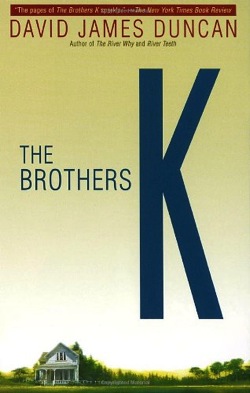
Knowing this, I hesitated picking up David James Duncan’s 645 page The Brothers K. Could I trust the recommendation of the man who loaned it to me? Would it be worth the six week investment it would take to read it?

I have the answers, now. BrothersK

Yes. And yes.

* *
*

I had never before heard of David James Duncan. My fault, of course, not his. It is true that he writes books that attract literary attention (this was a NY Times Notable Book for 1992). It is also true that he generates them slowly. Nearly ten years separated this from his previous release of The River Why.

The title is a clear allusion to another ‘Brothers’ book (one I’d like to read again, the next free ten weeks or so I find), but in this case the ‘K’ refers not to the brothers’ last name, but to the symbol used for a strikeout in scoring a baseball game.

Like Dostoevsky’s novel, The Brothers K follows the lives of four brothers and their relationship with their father. Added in the mix are twin sisters, baseball, Seventh Day Adventism, fly-fishing, the Vietnam War, broken dreams, and reconciled lives. Duncan captivatingly recounts 20+ years of a family’s life from the fifties to the seventies. Hugh Chance is a pitcher whose potential major league career is cut short by the Korean War. His often rocky marriage to his Adventist wife Laura produces four sons, each begging to be assigned a different four-letter code by Mr. Myers and Mr. Briggs: Irwin is passionate, Everett is the skeptic, Peter is the spiritual one, and Kincaid observes and records it all.

I know little about the author other than he, like many, has little patience with religious fundamentalism and blowhard clergymen. And though the book has smoking, drinking, drug use, Buddhism, fornication, swearing, anti-war rhetoric, and religious skepticism, it is one of the richest affirmations of the importance of committed family relationships that I’ve encountered in some time. Family values rule.

* *
*

I’m intrigued by what an author can do, and the relationship he can build with his reader. The details Duncan exposes concerning this family are vast. One might at times judge them tedious. But I can picture the house in which they live and the town they inhabit. Quote me a piece of dialog and I could probably tell you which character spoke it. I fully expect that I could travel to Washington state and sit down with the children and grandchildren of this family, though I know they are fictional. I feel like I understand them, I understand what makes them tick, I understand what motivates them, I understand why they care so much about what they care about.

And I realize that to come to this place, I needed to spend hours with each. I understand these fictional characters better than I understand many real people. And it’s quite possible that I have spent something like fifteen-twenty hours letting their story be told without interjecting my own words and thoughts and judgments. I’ve only been able to listen. How many real people – even those in my own family – get such attention from me? Not many. Maybe none.

* *
*

I’ve been searching for a word that captures a book like this. Like Jonathan Franzen’s The Corrections the novel’s plot lines are not as important as the characters that inhabit them. Unlike Franzen, these characters become ones we (at least I) love though we may fiercely differ with them. The word that comes to mind is ‘rich’.

There are a few books that, after reading them for some time, I have not wanted to come to an end. Matterhorn was one. The Elegance of the Hedgehog was another. The Brothers K, rich, surprising, rewarding, has joined that list.

No More Mr. “Nice” Guy

Fresh reflection on old words is why I’m reading Kathleen Norris’ Amazing Grace. I don’t expect to agree with everything she says, but it is good for me to step out of my tradition and examine the ideas central to my faith from a fresh pair of eyes.

Though I continue to find the book helpful, I’m dismayed that she begins one section like this:

The word “conversion” comes from the Latin for “to turn around.” Thus it denotes….

Whenever one sees such logic in writing or hears it in preaching (and it seems common in both) one’s critical radar should begin beeping wildly. The meaning of a word depends on the context in which an author uses it. It’s etymology might be interesting (“Ah…”), but it is never definitive (“Thus…”). And it at times might be misleading.

It is interesting, for example, that the word ‘nice’ comes from the Latin nescius mediated into English through French and Middle English. It is interesting that in the Latin and Middle English it meant “ignorant, incapable, foolish, stupid”. It is interesting, but you would be justifiably shocked if I punched you for calling me “nice”. And if I tried to justify my action by saying,

The word “nice” comes from the Latin for “ignorant.” Thus it denotes….

you would rightly be mystified that I had so easily misunderstood you.

When we as teachers, writers, or preachers try to prove a point using the etymology of a word, we run into muddy waters. Just because a word I use today in English comes from a word with a certain sense in Latin or Greek or Middle English does not mean that is the sense with which I use it today. My atheist friend will without a doubt say goodbye to me when we part, but I cannot assume that he’s had a sudden conversion (!) and sincerely wishes “God be with ye”.

I’m particularly sensitive to this because I spend so much of my time trying to translate ancient concepts into modern terms. It can be a dicey business to to take biblical language from 2000 years ago and accurately convey its meaning in 21st century English. Biblical interpretation is marred by the dual danger of improperly importing a word’s origins into its New Testament usage, for example, and of importing a modern meaning back into the text which would have been foreign to the original author. Both need to be avoided, and often aren’t.

The sagest advice (of course!) is found in the words of Mortimer Adler whose admonition is to ‘come to terms’ with an author. I wish I had Adler’s How to Read a Book at hand so that I could quote him directly. His point is that we must learn the way an author himself uses particular words and accept the meaning that he embraces. Only THEN will we be in a position to genuinely understand what we are reading or hearing.

Wise advice that if heeded might keep us from getting punched. Or worse.

A Vocabulary of Faith

A few months after I entered college I hooked up with a campus ministry that spoke continually about having a ‘personal relationship’ with Jesus Christ. The summer after that, and often since, was spent puzzling over that terminology, wondering what it meant if I had that of which it spoke. It was not, really, a matter of faith – it was a matter of the vocabulary of faith. The words spoke of a reality in a way that caused me to question the presence of the reality in my own life. I think I know what was meant then, but as these words are not biblical words, I tend not to use them today.

Poet and essayist Kathleen Norris in her book Amazing Grace: A Vocabulary of Faith addresses the power words posses to shape and to repel; to build up and to confuse. This is true in any arena, but in Christianity our desire is to see words open eyes and reveal Jesus. So complex can be the vocabulary that some leave the faith, and others who would understand give up in confusion.

I am reminded of how hard it is to be in a setting where no one speaks my language. To not hear the familiar rhythms and comforting resonance of one’s own language can leave us weary and longing for silence. Norris speaks of her own experience of trying to return to the church after a twenty-year absence.

When I first ventured back to Sunday worship in my small town, the services felt like a word bombardment, an hour-long barrage of heavyweight theological terminology. Often, I was so exhausted afterwards that I would need a three-hour nap.”

And though it is already difficult for someone new to learn to understand basic terms like ‘faith’ and ‘salvation’ and ‘love’ and ‘heaven’, we tend to complicate matters by creating our own internal jargon (which my friend Mike Osborne is busily battling) adding another layer to the fog. But even without that, we can give specialized meaning to words not meant to bear that.

Any language can become a code; in religious terms, this means a jargon that speaks only to the converted. But in my long apprenticeship as a poet I leaned to refuse codes, to reject all forms of jargon. [I have] a preference for the concrete and specific language of poetry….

Norris’ book is her attempt to provide some concrete ways of thinking about dozens of words from our Christian lexicon. I probably will not agree with all she will say, but I’m enthusiastic about the project. Perhaps it might help this preacher open pathways for others to have a ‘personal relationship’ with Jesus.

Whatever that is.

The Glob, Part II

For those who are wondering how in the world one would get a glob from making yogurt….

The process of making yogurt produces a product that is comprised of both curds and whey after the milk (with a starter of some form) has incubated for several hours at 100 degrees F. The longer the incubation time, the more sour the yogurt becomes. Greek yogurts tend to be on the more sour side of the spectrum. Our yogurt incubates for 10 hours, a little longer that what would be needed for whole milk as we are using 1% milk. Regular yogurt is rather soft (depending upon the amount of fat in the milk, the more fat content the thicker the yogurt). Often, yogurt purchased from the store has had a thickener of  some sort added to bring it to the consistency that we normally associate with yogurt.

The last couple of years has seen an explosion of Greek style yogurts hitting the market place. They’ve always been around, but recently they have become one of the most favored forms of yogurt. So what’s the difference between regular and Greek style yogurt? There are several differences, but the most significant factor in relationship to the glob is that Greek yogurts tend to be thicker (without additional thickeners) which creates a higher protein content due to the milk proteins being more concentrated. This is accomplished by removing some of the whey from the curds.

The whey is strained from the curds using a fine meshed material letting the force of gravity do the work. After sitting for 2-3 hours the yogurt has become the consistency of what is known as Greek yogurt. But a glob, it is not. So how does it become a glob? Well, when one gets a batch started incubating at noon it is not fully ready for straining until 10pm. Waiting until midnight or 1am for it to become the correct consistency is not a welcome thought. Instead, into the refrigerator it goes to continue straining until the next morning. And, what do you have the next morning? A round glob of Greek yogurt that looks like and is the consistency of a cheese ball. The whey by that point is mostly in the collecting dish located below the strainer. To get the yogurt back to the desired thickness, just mix whey back into the glob.

Thus, the story behind the story, of the glob.

Mr. Knox’s Courage

In my sermon this past Sunday, I made mention of the period of England’s history in which Edward VI was dying, and others were scheming to retain power by arranging for young Lady Jane Grey to be his successor. (This is all wonderfully captured in a movie called simply Lady Jane which is, unfortunately, very expensive to buy, but can be streamed.)
Lady Jane
In the midst of this intrigue, a young John Knox was given opportunity to preach to the parties involved. He made the most of his opportunity.

The second Sunday in April 1553 the last Tudor King of England went to hear, for the last time, one of his favourite preachers in Westminster Abbey. All the glitter and jingle of a medieval court was there; the glorious, flashing colour, the shields and banners, the velvet and miniver. His Highness Dudley, Duke of Northumberland, a gorgeous figure, famous as a jouster, with his tall handsome sons: Paulet, Marquess of Winchester, the perfect time-server, who was Comptroller, Secretary and Lord Treasurer to Edward, who cursed Mary as a bastard, yet lived to ‘crouch and kneel’ successfully to her in turn; all the dukes and earls and jewelled ladies were there: for sermons were high fashion, for the moment, in England.

Knox, the dour little Scotsman, rising to preach, perhaps looked round from the white-faced boy to the jealous lords: and gave out his text from the Gospel of St. John xiii. 15: ‘He that eateth bread with me hath lifted up his heel against me.’

These words, used by the Lord at the Last Supper, are quoted from Psalm 41, v. 9, in which David laments the treachery of Absalom. Knox turned back to read again those incomparable stories of treachery and heroism in Isaiah, in 2 Samuel xvi and xvii, 2 Kings xviii; stories of three different sorts of traitors: of Shebna the traitor who wormed his way into King Hezekiah’s confidence, becoming comptroller, secretary and treasurer – did the congregation prick up their ears? Of Achitophel who rose to be the highest in the land while he plotted with Absalom to supplant David: whose counsel ‘was as the oracles of God’: of Judas who sold his friend.

The preacher’s voice rose to a climax: ‘Was David and Hezekiah, princes of great and godly gifts and experience, abused by crafty counsellors and dissembling hypocrites? What wonder is it then, that a young and innocent King be deceived by crafty, covetous, wicked and ungodly counsellors? I am greatly afraid that Achitophel be counsellor, that Judas bear the purse and that Shebna be scribe, comptroller and treasurer.’

There must have been a wave of anger – perhaps of laughter – along the gorgeously dressed congregation. Was there too a flicker of satisfaction over the white face of the little King? But whether or not he was the King’s favourite, this sermon went a little too near the bone : Knox was summoned before the Privy Council of England on 14 April.

There were present at this Council, Cranmer, Archbishop of Canterbury, the Lord Chancellor, the Earls of Bedford, Northampton and Shrewsbury; the Lord Treasurer (‘Shebna’), and the Lord Chamberlain, and two Secretaries of State. For obvious reasons, they did not take him up on the sermon; but instead brought up the old complaints against him. Why had he refused preferment? Why had he objections to kneeling, to the special wafer instead of common bread, and the like? Knox had answers ready for all their points: so in the end they ‘dismissed him with fair words’, saying only ‘they were sorry to understand he was of a contrary mind to the Common Order’….

His enemies could afford to wait a little. The sands were clearly running out for Edward. Youth had ceased to fight with death: his days were numbered.

Plain Mr. Knox, Elizabeth Whitley

This scene, unfortunately but not surprisingly, does not make it into the movie.

My Wife’s Blog

As my wife and I were talking this morning, she opened the refrigerator to grab something, and with her head in the fridge she said, “Have you looked at my blog?”

I’ve been married to this woman for almost 36 years. I think I know her pretty well. And what I know is that she is not the kind of person who likes to write (though she writes very well) and certainly not the kind of person who would write for all the world to see. I at least like to think that if she indeed DID start a blog, she would have alerted me to the fact before now.

But all that aside, there she was, with her head in the fridge, asking me, “Have you looked at my blog?”

“What?” I replied.

She turns around with a delighted grin holding a bowl. Barb is a woman who is a scientist at heart. She loves experimenting, and that love of experiment, and love of yogurt, has lead her to begin making her own yogurt. With the pride of a creator of a great work of art, she turned from the fridge with a bowl in hand, pops the lid, and repeated herself: “Have you looked at my glob?”

I must admit, it was a fine looking glob.

For Those Who Are a Mess

I just finished teaching a class at Covenant Presbyterian Church called “If Holiness Is By Grace, Then Why Am I Such a Mess?” It’s been a fun class to teach and is, in essence, an expansion on the thoughts recorded previously on this site. The audio for the class is posted on the CPC web site.

Or at least most of it is. The recording of the sixth and final class got garbled at some point so that it no longer exists. So if you have listened to the classes, and missed the last one, I would encourage you to at LEAST read this as a summary of the content of that class.

For that class, I prepared a list of resources which I thought might be good to share here. It is presented with the hope that any who continue to work through and wrestle with what it means to be a follower of Christ might find some continued help and encouragement along the way from some very gifted fellow pilgrims.

❦ ❦ ❦

Resources / If Holiness Is by Grace, Then Why Am I Such a Mess?

Some of you may want to read more regarding this subject. This listing is in no way comprehensive and it bears no authority. These are simply resources which have had a positive impact on me over the years. I share them hoping that perhaps they might have the same impact on others. (And perhaps I need not say it, but I will anyway – a reference to a book or author does not mean I endorse everything that author says or that book contains!]

About the gospel

If we are to rejoice in the gospel, a great help is good preaching that articulates and applies the gospel.
I recommend listening to the sermons here listed under the heading of ‘The Gospel’.
Clarity about the gospel as well comes through this little book:
Timothy Keller, The Prodigal God

About Jesus

I have come to the conviction that we lose enthusiasm for following Jesus when we lose sight of who he is. To that end, of course, read the gospels. But I have been greatly helped over the years by this little book. It is increasingly hard to find, but I have a loaner copy that I am willing to share. We will want to obey the one we love; this book helps us learn to love Jesus.
R. T. France, I Came to Set the Earth on Fire [Also published under the title Jesus the Radical. Though out of print, this is often available here: http://www.abebooks.com ]
Aimed at a bit more scholarly crowd, this book never fails to move my soul:
Donald Macleod, The Person of Christ

About God

To know God is to know something about the way he works. To know something about the way he works is critical to understanding his role in our sanctification. Helpful over the years for me have been these:
J. I. Packer, Knowing God
John Piper, Desiring God

About idolatry

At the heart of ungodly behavior is idolatry. Some helpful reflection on that is found here:
Timothy Keller, Counterfeit Gods

About Sanctification Itself

Of the writing of books about sanctification, there is no end. These three will help direct your thoughts on the matter, and challenge, perhaps, your previous thinking.
Francis Schaeffer, True Spirituality
Bryan Chapell, Holiness by Grace
Steve Brown, A Scandalous Freedom

On Mortification

The practical matters of the mortification of sin were famously addressed by the Puritan John Owen. Recently, Kris Lundgaard has attempted to repackage Owen’s ideas for a modern audience. The link to Owen’s book is actually a reprint of it with helpful analysis called Overcoming Sin and Temptation but there are many editions of Owen’s original out there.
John Owen, On the Mortification of Sin
Kris Lundgaard, The Enemy Within

And because everything this guy writes is worth reading…

That sounds gratuitous, but it isn’t. I was shaped greatly by John Frame long before I became his pastor, though I never was a student of his. I was not able in the preparation of this material to read John’s discussion of sanctification, but you can do so, with great profit I am sure, in his newly published systematic theology.
John Frame, Systematic Theology

And just because I MUST have a Eugene Peterson book on this list

Eugene Peterson is so level headed and real. He writes about the Christian life from the point of view of a pastor of real people. These are his reflections on the Psalms of Ascent. A classic work.
Eugene Peterson, A Long Obedience in the Same Direction

Finally, avoid books that just tell you to work harder

This will be the bulk of what is written. If you do read such a book, you might still profit IF you remember the context in which our work occurs, and where the source of real change lies.

To God be the glory.
February 23, 2014

Page 26 of 142

Powered by WordPress & Theme by Anders Norén