Randy Greenwald

Concerning Life as It Is Supposed to Be

Fun with Words


I use a lot of words in the course of a week, and though I am no master, I love the intricacies, fluidity, and humor of the English language. To feed that, I subscribe to a free weekly e-newsletter called World Wide Words. The author, Michael Quinion, is a well informed British man whose newsletter is often informative and usually entertaining. I attach a couple of examples from the most recent release.

By the way, I’m attracted to the offbeat and lighthearted entries, but don’t judge the author by my preferences. As a contributor to the Oxford English Dictionary, he comes with some solid credentials.

Mostly Dead? Merely Dead? Really, Most Sincerely Dead?

Dave Hay read in his local newspaper, the Houston Chronicle, about John Wayne’s 100th birthday party. His granddaughter, Anita LaCava Swift, was quoted as saying, “It’s always an amazing thing for our family whenever we are out among his fans because he’s almost been dead for 30 years.”

Amazing isn’t quite the word.

No sex please, I’m a vegan.

The story broke in the Christchurch News at the end of July and has been picked up all over the world. Annie Potts, co-director of the Centre of Human and Animal Studies at Canterbury University in New Zealand, conducted research into the experiences of cruelty-free ethical consumers, who included vegetarians, pescetarians (who eat fish) and vegans (who consume no products of animal origin). Dr Potts found that some of the vegans she interviewed, mainly women, refuse to have sexual contact with meat-eaters because their bodies are made up of the dead animals they’ve eaten. She has coined the word vegansexual to describe this group. I suppose that makes the meat-eaters among us carnisexuals.

I didn’t make this up.

To Die Is Gain?

Geoff and I attended a funeral on Saturday that none in attendance is likely to forget.

Midway through the service, as people were giving thanks to God for their memories of the godly 95 year old woman whom God had ‘taken home’, the woman’s son-in-law, a 61 year old man, suffered a severe heart attack. His wife and daughters were frantic, and most of us too dumbfounded to know what to do.

That is when the miraculous began to break in upon the normal.


Someone shouted, “Call 9-1-1.” Within three seconds, two fully equipped EMTs in blue uniforms were on the scene working on this man, keeping him alive until an ambulance could be brought to take him to the hospital. Later that day he received four stints and was said to be doing well. The doctor who did the surgery said that they often lose people in the hospital to such heart attacks.

So how was he kept alive in this case?

A member of the family was a fireman. After the service started, two friends of this fireman decided to stop by, even though they were late, to pay their respects and offer condolences to their friend. Two minutes after they arrived, they were needed.

Also present in the service was a cardiologist and a cardiac nurse. I’m still amazed.

God, it seemed, wanted this guy to live. Why then the heart attack in the first place? I can’t probe the mystery of God’s providence, but I wonder if at some level He wanted us to reflect upon the ambivalence we have regarding life and death.

At funerals we love to talk about the glories of heaven and the wonder of being with our savior. In the midst of the expression of such sentiments, a man literally tries to leave this earth and go to that place of which we had been speaking so fondly. In response, we pray that he not go and we apply all the skills and expertise in the world to keep him here.

I prayed for him to stay, and I celebrate his recovery, and I praise the expertise of those who saved him. But in my heart of hearts do I REALLY believe what Paul says that ‘to die is gain’? I wonder.

Finished It


Speaking of things that scare us, last night I finished my second Stephen King novel of the year, It. It is well over 1000 pages and has taken me some time to finish. I read such things at night after I go to bed, and since I’ve been getting up at 3:30, I don’t have the energy to read long. So, the pace has been slow.

People warned me about this book, that there were scenes in it they still cannot shake from their memory, and that they had to read it with all the lights on in the house. Though there was a scene or two that I found particularly troubling, and though it is true I may never quite look at storm sewer drains and clowns in the same way ever again, I did not find the supernatural horror all that harrowing.

Once again what I found troubling was the craziness and cruelty of people. It’s the evil that people are capable of that arouses in me the real anxiety. I know that the thing known as It in the novel is fanciful (though one might argue what it represents). But I know as well that the abuse, the loneliness, the cruelty of one group of people to others, these things are real.

In the end It is vanquished. But people are still around. The ordinary horrors still exist. When will they be vanquished?

This, I think, is the justification of the horror genre. Not only can it force us to explore and probe and ponder both supernatural and ordinary evil, but the story always makes us long for a Deliverer. And to long for a Deliverer is a good thing. And to discover, even in story form, that the Deliverer triumphs, this, too, is good.

Sermon Prep


I have an unusual suggestion for those of you who will either be present for or listen to the sermon I will preach at HPC on August 19, God willing. I will be preaching on the last half of Romans 7 (verses 13-25) and so it would make sense to read those verses at some point, of course. But in addition, I would suggest that over the next ten days you set aside some time to read Robert Louis Stevenson’s Dr. Jekyll and Mr. Hyde. You may or may not have this sitting on a shelf somewhere, but the chances are whether you have read it or not, you know what it is about.

Or think you do. Hollywood movie posters aside, this is not the kind of horror tale that one expects. I’m learning that the things that really scare us are the things that are real. This is a story about something real.

If you would like to read it, you need not buy it. The text is in the public domain and you can download it by clicking here. It is relatively short and should not take you more than two or three hours to read. Enjoy!

Commitment a Two-way Street


The interchange on commitment a couple weeks ago generated some good comments, not all of which made it to the blog. One comment which came directly to me is worth being thrown into the ring for consideration. In responding to my post and to the comments to it, this correspondent says

I agree with every thing, pretty much, so far. But I get the impression that the thrust of the articles has only to do with member’s commitments to their churches and not the commitment that the rulers of those churches have to them…. I believe that commitment runs both ways.

This is a valid point which is worthy of reflection. I am curious what others of you think.

St. Paul MB Church


Our thanks to the brothers and sisters of the St. Paul Missionary Baptist Church for their warm hospitality and deep enthusiasm for the goodness of God. Barb and Colin and I were privileged to worship with this congregation this morning, making Barb and I, as far as I could tell, the only white people in the building. Pastor James Roberts, a dear friend of mine, has a wonderful ministry there. The congregation, as always, accepted us graciously and with joy.

For those of you who do not know, Hope Church and St. Paul Church often have joint services on Thanksgiving Day. It is pretty certain that we will be the guests of St. Paul this Thanksgiving.

(If you want to hear a sample of last year’s service, click here. You will hear a portion of Pastor James’ message.)

We are grateful to God for his kindness in allowing us to be with these brothers and sisters this morning.

Evangelism and the Roll

Some of you know that I am moonlighting at a side business/hobby. I bake cinnamon rolls for local coffee shops and diners. As well, I sell them directly to the public. For more information on that side of things, you can visit here. (I am persuaded that I put the ‘moon’ in moonlighting. To do this I get up at 3:30 AM!)


I don’t mention that for the sake of self promotion. Rather, it struck me this morning one of the reasons I like doing this so much. It is not hard to be an evangelist for a cinnamon roll.

Classic example happened yesterday.

I had delivered some rolls, and was visiting with my printer and his father at their printshop. (I pay for occasional light print jobs with cinnamon rolls!) As we were talking, the father said, “You know where you ought to take some rolls — Dianne’s Cafe.” Dianne’s is a diner near my house.

Now, I had some rolls in the car, but I was thinking of taking them elsewhere. I decided to act on his instinct and so I headed for Dianne’s. I met the owner, exchanged about three sentences, showed him the rolls, and he immediately ordered two trays for today.

When I took the rolls to Dianne’s this morning, the waitress held them up, and showed them off to the whole restaurant. I left with a great sense of satisfaction.

How did this happen? The owner was looking for something like this. He saw the need, and immediately knew that these rolls met his need. He was ready to buy.

I suspect that there are those for whom sharing Christ pretty much follows the same pattern, but I am not one of those.

I know there are huge differences between the call of the gospel and the appeal of a cinnamon roll. For one thing, the gospel demands the commitment of one’s whole life. Dianne’s Cafe has only committed $18 and could back out of the deal tomorrow. I know that.

But this reveals a stark problem in me. When I unwrap a pack of cinnamon rolls, I expect people to love them. I expect people to respond positively. I am shocked when they are not wowed. In contrast, I expect people to have no interest at all in the gospel.

The problem is that I have lost confidence in the attractive power of the gospel. I rarely ‘unwrap’ it to people, because I expect them to have no interest. I am shamed to confess that.

The reality is that there must be many people out there hungry for the acceptance and freedom and security and stability that comes through Christ who simply need a faithful Christian man or woman to unwrap him for them. Pray that we would come into contact with such people and have the confidence to show Christ to them.

Comments on Commitment

I don’t know how many of you ever get to the point of reading the comments to my posts, but Fiona (not the princess…), Lori Deitz’s dear friend, and a friend now of ours as well, has posted comments to my post on commitment that are worth reading.

She is very wise. Making a commitment is one thing; being fully engaged in loving the ones to whom you are committed is quite another.

I think she should write a book. Read what she says here.

No Community without Commitment


Pastoring a church confronts one with this question: what is the nature of community? If the church is to be a community described by a variety of metaphors in the Bible (body, family, etc.) what is the nature of that community?

Someone recently told me that there is no real community without commitment. If that is indeed the case, and I am inclined to think it is, then in an age like our own in which commitment is often a foreign thing, real community is rare. People leave churches for other churches. Commitment is broken and community is shattered. It happens all the time. There is no real community without commitment.

But such a statement only removes the question one step further: what then is the nature of the commitment which makes for community? Commitment is the foundation stone of a marriage. I’m inclined to think, however, that the level of commitment to a church is a step below that of marriage. But what does commitment mean for a church? I’m very interested in hearing what those reading this think about that.

One of the books mentioned in my recent appeal for books on race and reconciliation was one call God’s Neighborhood by Scott Roley. In the forward, written by Michael Card, Card speaks of an attempt at community that he, Roley, and others made over a decade ago. The commitment they made to each other included this:

“We pledged to each other that we weren’t going anywhere. We were going to resist the temptation to move away if better opportunities presented themselves to any one of us. Later we promised that even if we disagreed with one another, we would not break fellowship. over the years we have disagreed a lot, sometimes along racial lines, more often between political positions. But the fact that we are all still here… shows that our mutual promise held firm.”

Is this what it takes to establish, build, and maintain community? Is such a commitment — to not separate even in the face of deep disagreement — even possible? Is it what Biblical community consists of?

I’m very interested in people’s reflection on this question, for is not the church to be something more, something deeper, something greater than a Sunday morning club for religious people? I think so.

Techno Lust


When the iPod first came out, I could not see why there was so much hoopla. Who needs a device to carry around 10000 songs? I certainly didn’t.

But then someone pointed out my drawer full of cassette tapes of sermons and conferences. Messages of great value that I never listen too because a) I no longer have a tape player and b) I cannot keep organized a hundred cds and tapes to access what I want when I want it.

The solution was the ipod. A hundred sermons or lectures and I’ve only used a third of my 4 gig Nano’s storage space. I do not play CDs anymore. It is just far too easy to carry one small unit with my hundreds of songs on it.

Geeky cool, of course. But useful as well.

Technology, however, can change us. We would be foolish to think it does not. We are a different world after the advent of the printing press; we are a different world because of television.


A Christian should not, it seems to me, be enslaved to technology, and a Christian should think carefully about the technology he embraces. Neil Postman, not Christian but Jewish I think, has written in provocative ways about the impact of technology, as a prophet trying to hold back the storm. In Amusing Ourselves to Death he chronicles the impact of television upon the way we think, and in Technopoly he expands his view to the impact of all kinds of technological ‘advance’.

My favorite statement from Postman on the subject comes from his very interesting book, Building a Bridge to the 18th Century. The book is challenging and useful in many ways, but this quote not only makes me smile, but drives me always to ask the question, “Do I really need this new technology?” It is more lengthy than I usually use, but I think you will enjoy it.
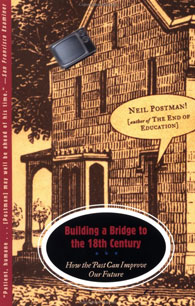
“I find it useful to ask of any technology that is marketed as indispensable, What problem does it solve for me? Will its advantages outweigh its disadvantages? Will it alter my habits and language, and if so, for better or for worse? My answers may not be yours, almost certainly are not yours. I write my books with pen and paper, because I have always done it that way and enjoy doing so. I do not have a computer. The Internet strikes me as a mere distraction. I do not have voice mail or call-waiting, both of which I regard as uncivil. I have access to a fax machine, but try to control my use of it. Snail mail is quite adequate for most of my correspondence, and I do not like the sense of urgency that faxes inevitably suggest. My car has cruise control, but I have never used it since I do not find keeping my foot on the gas pedal a problem.

“You get the idea. I will use technology when I judge it to be in my favor to do so. I resist being used by it. In some cases I may have a moral objection. But in most instances, my objection is practical, and reason tells me to measure the results from that point of view. Reason also advises me to urge others to do the same. An example: When I began teaching at NYU [New York University], the available instruments of thought and teaching were primitive. Faculty and students could talk, could read, and could write. Their writing was done the way I am writing this chapter–with a pen and pad. Some used a typewriter, but it was not required. Conversations were almost always about ideas, rarely about the technologies used to communicate. After all, what can you say about a pen except that you’ve run out of ink? I do remember a conversation about whether a yellow pad was better than a white pad. but it didn’t last very long, and was inconclusive. No one had heard of word processors, e-mail, the Internet, or voice mail. Occasionally, a teacher would show a movie, but you needed a technician to run the projector and the film always broke.

“NYU now has much of the equipment included in the phrase ‘high tech.’ And so, an eighteenth-century dinosaur is entitled to ask, Are things better? I cannot make any judgments on the transformations, if any, technology has brought to the hard sciences. I am told they are impressive, but I know nothing about this. As for the social sciences, humanities, and social studies, here is what I have observed: The books professors write aren’t any better than they used to be; their ideas are slightly less interesting; their conversations definitely less engaging; their teaching about the same. As for students, their writing is worse, and editing is an alien concept to them. Their talking is about the same, with perhaps a slight decline in grammatical propriety. I am told that they have more access to information, but if you ask them in what year American independence was proclaimed, most of them do not know, and surprisingly few can tell you which planet is the third from the sun. All in all, the advance in thought and teaching is about zero, with maybe a two- or three-yard loss.” [pages 55-56]

Good thoughts. But I’m sticking by my iPod.

Page 135 of 142

Powered by WordPress & Theme by Anders Norén