
As I hoped and somewhat feared, you all have responded with a ton of resources with which to consider the issues of race and Christianity. I now have leads on more resources then I’ll EVER be able to consume or pursue. But we at least have a place to begin. Please pray for us as we begin to put this project together.

The pastor is on vacation for the net two weeks. But a peculiar vacation this is.
I am on vacation… but I am going no where. This puzzles us. How does a pastor take a vacation? The problem is that our life as a family is tied up with the church of which we are a part. That is a good thing. But the church of which we are a part is also the work from which I need a clear break. How do I take a vacation from the work, and not extricate the family from our church?
An example of the types of dilemna: Do we go to our small group meeting? Sure… these are the people we love, and love to be with. But, no! This takes me back into the context of the ministry from which I need emotional and mental rest. Such things are not well defined. If someone ends up in the hospital, do I visit them? If a friend from the church wants to meet, do I? Or do I say, “No, I’m not going to meet/visit with you. You are work to me?” Hardly.
If, as in the past, we were leaving town for vacation, these questions are easily answered. I’m not here and so the break is clear. There is puzzlement.
Staying and not going is hard because Barb receives no break. This is no vacation for her, something which she needs but which sadly this year I cannot provide her.
All that said, during this peculiar vacation we hope to wander locally and enjoy some low key time together. Occasionally, I suppose, I shall post. But if I don’t, readers will understand. I hope.
In 2006, two men in Hope Church sponsored, and Hope’s associate pastor Geoff and I taught, a series of lunch sessions on the subject of work for downtown area business people. The idea was to bring Christians and non-Christians together in a non-threatening environment where a relevant topic could be taught and discussed from a Christian world view. The lunches were billed as “Food for Thought”.
These meetings were not an overwhelming success, but the response was positive enough to warrant continuing the idea. So, for four Thursday lunches in October we will hold “Food for Thought II”. Then venue will change, the cost of the food will fall, but the purpose will be the same: to bring a Christian world view to an issue of relevance.
We have settled upon a general topic for these sessions, the topic of race.
Though we who are white like to think that we have put behind us our racial biases and those who are black like to think they have risen above resentment and anger, these reactions to race still plague us. We would like to consider the depth of the current problem together with some Biblical and practical means of moving beyond our pasts and bringing healing first at the relational level, and then (perhaps) at the social, economic, and political level.
Here is the problem: Geoff and I are clearly white. We have never had to sit in the back of a bus and we have never been looked at with suspicion because of our pigmentation. We are thrilled that Pastor James Roberts of St. Paul Missionary Baptist Church has enthusiastically agreed to help us with this. Pastor Roberts knows what it is like to be on the receiving end of racial prejudice, and he has a heart for bridging the divide that still exists between white and black.
But we would like further resources. If any of you know of books, articles, messages, whatever, which address the subjects of race and racism in a helpful way, especially from a Christian perspective, we would appreciate your alerting us to those resources.
We don’t know if we are being foolish or brave (the differences are slight) in taking this on. What we do sense is that God is in it and is leading us. We have no idea what He plans to do with this. Please give us your ideas, resources, and your prayers.
Every month or two, I write a column for the religion pages of the local newspaper. Geoff and I see this both as free advertising as well as an opportunity to share some thoughts creatively with both people who read the religion pages. (Actually, we think readership is much better than that. Perhaps as many as a DOZEN on any given Saturday.)
Honestly, we appreciate the opportunity. The editor who oversees this is becoming a friend of mine, and I like that.
For this week’s article, I wanted to move away from the heavy and the serious and be a bit more light-hearted. The result was the column pasted below.
But here is the thing: I don’t have to submit this until tomorrow (Wednesday, July 11). Until then, I am posting this here in order to get input and help! Any suggestions any of you want to make before this article goes to press? I’d love to hear them.
—–
America’s Next Great Reality TV Show
I heard today that in anticipation of a writers’ strike TV producers are ordering up a new batch of reality shows which do not depend as heavily or at all upon writers.
Here is the chance the church has been waiting for. I propose we push for a new reality series, “America’s Next Great Missionary.” Why not? It could have all the elements of “Survivor,” “American Idol,” and “Fear Factor” all mixed into one.
 The show would begin with auditions set in major venues around the country: Wheaton, Illinois; Colorado Springs, Colorado, and, of course, Orlando, Florida. The hosts, who have yet to be named, will sit behind tables and review video of the Next Great Missionary aspirants working their way through a tough series of challenges under the watch of hidden cameras.
After completing this round of tests, each candidate must stand before the hosts and listen to an honest assessment – spoken in love, of course – and a judgment that will advance or eliminate them. They can expect to hear responses like this:
“Whoa, Alice, you did well on the ‘share-the-gospel-on-an-airplane-ride’ challenge and we were impressed with how quickly you put together the ‘how-to-appeal-for-money-without-seeming-to-do-so’ event. But we are going to have to send you away. Your iPod and your tattoo just don’t pass the muster of missionary standards. And those shorts? Way too short. You can never wear those and be a missionary.”
or this:
“Jack, Jack, Jack. What kind of awful attempt was that in the ‘witness-to-the-native’ test? My boy, you spent 45 minutes talking to that guy at Starbucks and you never ONCE mentioned Jesus? All you did was ask him questions about what HE believed. You are definitely going home. We don’t care that you ate more locusts than anyone else.”
Eventually, twelve clean cut promising candidates will be chosen and brought to Los Angeles for the final taping and selection process. They will be given tasks to perform as teams and they will be interviewed and observed individually. People from around the country will be able to call in and vote for their favorite candidates.
Team tasks will include developing campaigns to reach entire cities for Jesus. If, for example, in this competition one ditches the idea of a billboard campaign in favor of blending works of mercy among the poor with gospel proclamation, the worldwide television audience could show how foolish this is by voting them off the show.
The interviews will focus upon why the candidates believe themselves qualified for the crown of America’s Next Great Missionary. As well, they will be asked where they think their formidable missionary gifts would best be used. A number of candidates can be expected to stumble at this point, giving vague answers like “wherever God would through His church send me” or by mentioning fields and peoples no one has ever heard of. Such answers reveal a sad lack of conviction and fund raising savvy, all of which must be a part of any missionary’s tool bag.
Finally, the field will be narrowed to two candidates who will compete in a final showdown. Each will be required to put together a fund raising appeal. Viewers will call in support, and the one generating the greatest donations will be declared America’s Next Great Missionary – and sent to the field.
We think we have a winning show here. Not buying it? Well, then, let me tell you about “America’s Funniest Preacher Goofs….”
I have not had much time for reading the past few weeks, so progress in The Religious Affections has been halted. I was able to pick it up again today and to plow through part 2 of the book.
In part 1, he defends the case that true religion, that is, saving faith, is rightly accompanied by emotional responses, by affections. In part 2, he seeks to reveal those affections which seem to accompany religious experience but which neither prove or disprove the presence of real conversion.
This is his concern — to demonstrate what are real evidences of true conversion and to distinguish them from the false or spurious. There are spiritual actions or reactions which may or may not evidence true faith. We can greatly err if we rest our hope of eternity upon some evidence which may just as easily arise from the work of the enemy as from God.
As a pastor I have such great trouble in convincing people that some experience they have had may or may not be a sign from God that I often just give up. Edwards is diligent to assess experience by Scripture, and this is a helpful discipline.
“That only is to be trusted to, as a certain evidence of grace, which Satan cannot do, and which it is impossible should be brought to pass by any power short of divine.” [page 159]
In part 3 he will reflect upon what then are the true signs of a real conversion experience. The early reports are that Edwards is so stringent in his assessment of spiritual life that he creates despair in true believers. The other day when I told a friend that I was reading this book, he said with a smile, “So, are you still a Christisn?”
So far, I am, and I will be when I am through. Part 3 is the largest portion of the book, so being ‘through’ will come some time from now.
This guy is great. Enjoy!
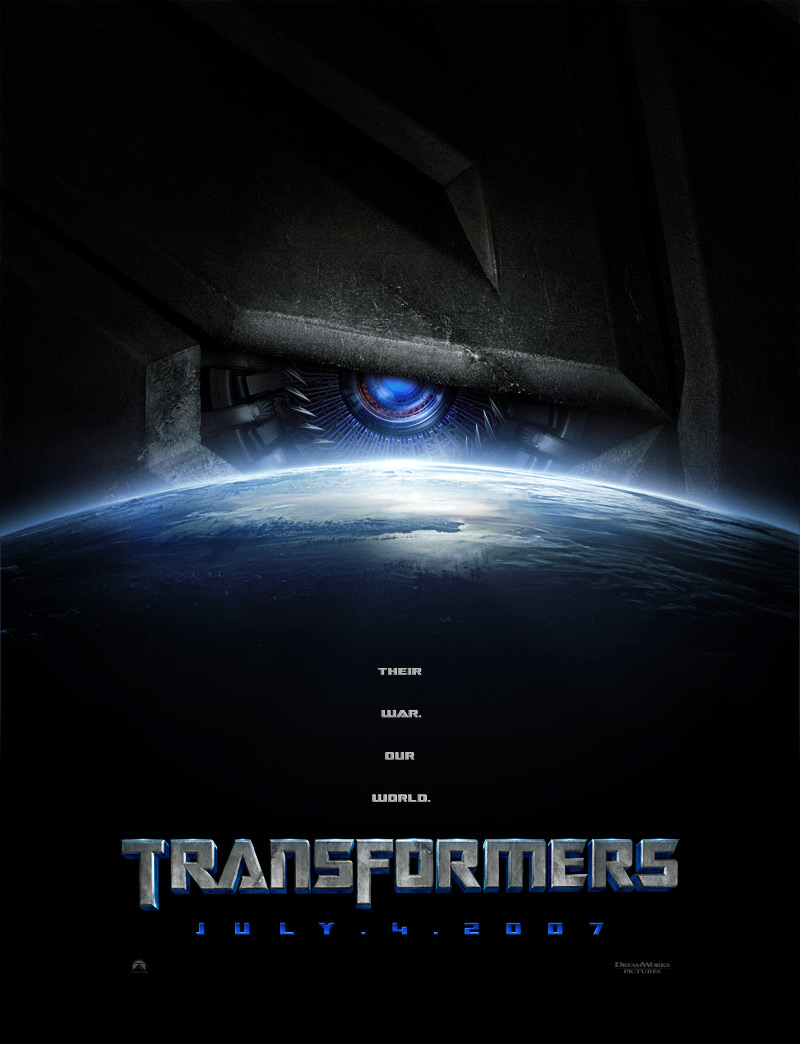
It’s the 4th of July. You have time on your hands, and a Transformer and Bionicle obsessed almost seven year old at your side. What do you do? On an impulse, you hustle down to the nearest theater to watch the new movie Transformers.
You, in fact, buy the last two tickets to the 1:30 showing. You give thanks that you find two seats together as the previews start. You then regret with every bone in your body telling the almost seven year old that the movie might be scary.
You then hope that after you have run your almost seven year old to the bathroom (better there than in your lap, you reason) that the two seats are still available.
On your way back to said seats, you firmly resist the pleas of the almost seven year old who is having second thoughts about a “scary” movie and now wants to leave the theater and go home. You have paid $12.50 for this privilege and you are going to watch the movie.
So, this is what this father did on the 4th of July. And I walked away from the film thinking, “That was a fun movie!” Late into the evening I was chuckling about this or that element of the movie. Yes, it is about ‘non-organic alien life forms’ battling each other for the fate of earth. It is by nature silly. But it is also about the nerdy guy getting the girl, and it is about the slickest car you have ever seen — a Herbie meets ‘Knight Rider’ kind of moment. I had a good time, enjoyed the movie, silliness and all, and came away with a little boy who thought I was one great dad. His favorite, in fact.
This morning, I read some comments about the movie that caught me off guard. A good father who was previewing the film before taking his five year old son said this:
“From the constant use of the ‘s-word’ to the non-stop horndog jokes, about masturbation, virginity, and sex in general, the loving shots of Megan Fox’s cleavage, and the way Michael Bay moves his camera around her midriff like she’s a shiny object that he wants us to long for, this film is wall-to-wall stuff I don’t want my son seeing.”
Oops. Yeah, I guess he’s right. That stuff is all there, mostly, though he exaggerates a bit. If I were a good father, I would have noticed these things and been concerned about them, I guess. But I accept them as life in this world, too easily perhaps.
So, maybe I should not have taken him. But the movie sure was fun. And this much I know: he did not leave the theater fantasizing about Megan Fox’s midsection or asking me about masturbation. He spent the next two hours reliving the battles between Optimus Prime and Megatron, recreating them in his mind and on our kitchen floor. That was fun… and worth the risk.

I know this is trite, but it is one of life’s mysteries.
I think they pump special chemicals into the air of grocery stores. How else can we explain the fact that a couple of bananas which look perfectly yellow, with even a hint of green, instantly develop brown spots and look aged when I take them out of the grocery bag at home.
Treated air. It’s the only explanation. Perhaps you have a better one?
This final quote is the hardest for me to take, for its discomforting blindness. And yet it opens a door into a struggle that few of us have to face. As an adoptive father this quote shocked me.
“It’s hard to convince others about the depth of it… I’d have an abortion any day of the week before I would ever have another adoption — or lose a kid in the woods, which is basically what it is. You know your child is out there somewhere, you just don’t know where.”
(From a book detailing the experiences of women dealing with unplanned pregnancies before Roe v. Wade, and is quoted from a review in the Atlantic Monthly.)

This is stark.
It does reveals the sense of great loss felt by those who place their children for adoption, a loss that good counseling can ameliorate.
It as well, of course, reveals the blindness of those who cannot see their unborn children as children. Would she really rather see her child dead than lost in the woods? I cannot comprehend that.
I have often said, and truly believe, that one of the unsung heroes in the issues of life and death today are the women, often very young, who bravely against cultural resistance and often severe family pressure, choose to give their babies life. We rarely come face to face with the pain felt by those who then, having given their children life, try to give them the best life they can by placing them for adoption. These women suffer greatly for the sake of their children. But they give them life.
The birth mother of our third adopted child struggled the most. What she said at placement, though, will forever motivate me. “I want to give to my child what I never had: a father.”
This second quote comes from a novel that I just finished reading, No Country for Old Men by Cormac McCarthy (there’s a name for you!). In the novel, the action is intersected with reflections of the retired sheriff who figures in the action to some degree. He is looking back upon his life, and wondering how the world had changed over the years he had sought to protect the citizens of his Texas county. At one point in these ruminations on the decline of culture, he reflects upon being at a conference and sitting next to a highly opinionated woman. Here is his report of the conversation he had with her.
“She kept on, kept on. Finally told me, said: I dont like the way this country is headed. I want my granddaughter to be able to have an abortion. And I said well mam I dont think you got any worries about the way the country is headed. The way I see it goin I dont have much doubt but what she’ll be able to have an abortion. I’m goin to say that not only will she be able to have an abortion, she’ll be able to have you put to sleep. Which pretty much ended the conversation.”
Oh, the stark logic of it.