Randy Greenwald

Concerning Life as It Is Supposed to Be

Email Ministry

Most of the emails I send (15,745 since January, 2007!) are routine. More than you might imagine are substantive and pastoral. The value of correspondence has not dimmed. It simply has changed delivery methodology.

I was struck therefore by this quote from Armand Nicholi in his fascinating little book The Question of God regarding the priority that C. S. Lewis gave to letter writing.

“He answered every letter sent him, from those by important leaders to those by a child or a widow he did not know. He answered them daily, before undertaking his hectic work schedule. ‘The mail, you know, is the great hurdle at the beginning of each day’s course for me, ‘ Lewis writes to [a] friend. ‘I have sometimes had to write letters hard from 8:30 to 11 o’clock before I could start my own work. Mostly to correspondents I have never seen. I expect most of my replies to them are useless: but every now and then people think one has helped them and so one dare not stop answering letters.'” (page 185)

Concerning the ‘widow he did not know’, I suggest watching this.

Fifty Is the New 30

To a fifty three year old who does not feel that old, this is an affirmative encouragement.

To one whose drug of choice is baseball not golf, his reflections open an intriguing window on a game that is pretty much a mystery to me.

(To his comment that a PGA touring pro ‘eats what he kills’ I would add the knowledge, told to me by the wife of one such touring pro, that they, the golfers, bear the expenses of their touring. Therefore, a pro could conceivably travel to the British Open, miss the cut, and in the end find that he has lost money.)

Preaching Reflections from an Old Master

Recently I was asked something like this: “Which individuals, living or dead, have been most influential in shaping your understanding of pastoral ministry?” A very good question, that.

To reflect upon an answer is to recognize the debt I owe to so many who will never know the contribution they have made.

A name that was immediately placed on the list was that of John R. W. Stott. Stott was an Anglican preacher and scholar (now retired) and has had a worldwide ministry through his published works and speaking engagements. He qualifies under the ‘living’ category of the above question, but obviously his impact on my life has not been the result of personal contact.

My earliest recollection of reading anything by him dates to the fall of 1978. Barb and I, newly married, were pondering seriously a perceived call to missions. So, to help us process that perception, I was reading Stott’s Christian Mission in the Modern World.

The result of those musings led us to the 1979 Urbana Missions Convention sponsored by InterVarsity Christian Fellowship. The morning Bible exposition was provided by Dr. Stott. So, for five straight days we were able to hear him preaching on the book of Romans. One could not escape his deep concern for the glory of God nor his deep respect for the integrity and content of Scripture.

As a pastor I have had the opportunity to preach through many books of the Bible. On several occasions, Dr. Stott has been my companion and guide. His commentaries (particularly I am thinking here of those on The Sermon on the Mount and Acts) always combine scholarly rigor and theological and pastoral insight and wisdom.

Through a long and careful ministry, Dr. Stott has won the respect of many. But according to David Brooks writing in the NY Times a few years ago, too many have chosen to ignore him.

Ten or fifteen years ago I bought and read Dr. Stott’s book on preaching, titled in the US Between Two Worlds: the Art of Preaching in the Twentieth Century. When one finds a mentor, it is good to spend time with that mentor. From such visits, one does not necessarily extract concrete plans and specific ideas. One may through such contact simply inherit a way of thinking and a general approach. That has been my experience of time spent with John Sott.

I chose recently to read this book again, to revisit Dr. Stott as he speaks in a passionate and personal way about the practice and power of preaching.

It has been a good, worthwhile, humbling, and challenging visit. As I’ve re-read the book, there are times I’ve had to simply go for a walk and ponder the significance of Dr. Stott’s wisdom for my own practice and approach.

These recent visits with Dr. Stott have spawned a number of reflections on the subject of preaching which I intend to post as a series for the next, oh, dozen or so Fridays. I worry that those who are not preachers will assume that these posts will be of no usefulness to them. Please do not think that. Yes, there will be much that applies to the practice of preaching. But the thread that unites it all is the nature of preaching, all the way down to the last, which I intend to entitle “The Art of Sleeping in Church.”

Though the posts will not always mention John Stott, and they will not necessarily reference the book at all, they have each of them been stimulated by the book. I picture this as you and I having conversation (which, of course, I have to initiate) after having visited with the retired master. I hope we continue, together, to learn from him.


Joy at the Ballgame

My friend Jim Jones alerted me through his blog that tonight, August 6, was Lou Gehrig night at the Sarasota Reds vs. the St. Lucie Mets minor league baseball game at Ed Smith stadium in Sarasota. Colin, our eight year old, had wanted to go to a baseball game, and since this was also $1 night at the game ($1 admission, $1 hot dogs, $1 soda, and $1 popcorn), it seemed like an idea that couldn’t miss.

It was great. Four highlights should suffice:

1) Met HPC members George and Linda Donato. George used to play minor league ball.

2) In the fifth inning, a Mets player swung and missed a third strike and lost his grip on the bat. Things became surreal at that point. The bat flew threw the air as if it were floating through open space. It took a while for it to register in my brain what was happening. It landed eight rows back in the section just to the left field side of third base. No one was injured, and a kid (not mine) got to keep the bat. (I told my daughter and she suggested that ball players be required to have the bat secured to their wrist like the Wii controller. I have brilliant kids, of course, but I don’t think that’s an idea that’s going to take hold.)

3) In the sixth inning, while arguing a call at first base, the Reds manager Joe Ayrault (whose major league career consisted of six plate appearances more than mine) put in an Oscar winning performance. He continued screaming in the ump’s face for two or three minutes after being thrown out of the game, tearing up his line-up card into a dozen little pieces and scattering it around the field in the process. Lou Piniella would be proud.

4) The highlight had to be this: We ran into Jim and his wife at the game, but they were having to leave early. They had purchased a couple raffle tickets at the ALS booth, taking a personal interest since Jim’s dad died of the disease. They gave the tickets to us. By the end of the night, Colin was the proud owner of a Dusty Baker autographed bat as the winner of the raffle. Here he is holding it proudly.

Beach Reading

Here are the books to read at the beach, according to NPR listeners.

Anyone currently reading any of the books on this list?

I’m 82% done with number 42.

Had I been reading at the beach, I would be completely burned beyond recognition by now!

Overheard This Week

My five year old grandson referencing his eight year old uncle, aka Colin, my son:

“Grandpa, when Colin’s 800 years old, will I be 500 years old?”

Acceptable logic for a five year old.

This next item, not so much.

Colin and I were standing fifty feet in the air waiting in line to tube down a ride at a local water park. We were all watching the clouds roll in and were listening to the thunder get closer, and remembering that all rides would be shut down when lightning is within five miles of the park.
The teenage girl behind me says to her boyfriend:

“Thunder’s not a problem. It’s only if there’s lightning that they’ll shut it down.”

I faintly heard Vizzini at that point:

“Inconceivable!”

Old Books Bad for Children

I read this with sadness.

I want to attribute it to the law of unintended consequences. But I’m grieved to think about those consequences.

I intend to continue to expose my children and grandchildren to the hazards of the old books.

Against the Critical Wind: Benjamin Button and Inkheart


Movie critics are often good ones to highlight a hidden gem or to warn against an impending bomb. Normally, there are a few I find helpful in choosing how to invest my viewing time.

Not so much in recent weeks.

The Curious Case of Benjamin Button is a curious case of misplaced critical love. This movie received 13 Oscar nominations, winning three, and a 71% rating on Rotten Tomatoes. In our opinion, the movie was tedious, disheartening, and weird.

It tells the story of one Benjamin Button who is born when he is 80 something and as the years progress, he regresses to childhood and infancy. While the world ages, he gets younger. Sort of.

I believe that science fiction and fantasy can be great media through which important questions of life and wisdom can be raised, faced, considered. Benjamin Button really ponders nothing deeper than how awful it would be to grow younger as one ages.

I was happy to find that Barb and I were not alone in our assessment. Roger Ebert expresses our discomfort with the film precisely.

+ + + + +

A similar but opposite experience confronted us Saturday night as we watched Inkheart. Here is a movie that was so largely canned by the critics (39% on Rotten Tomatoes) that I was a bit uncertain in watching it, expecting that we would be disappointed.

We weren’t.

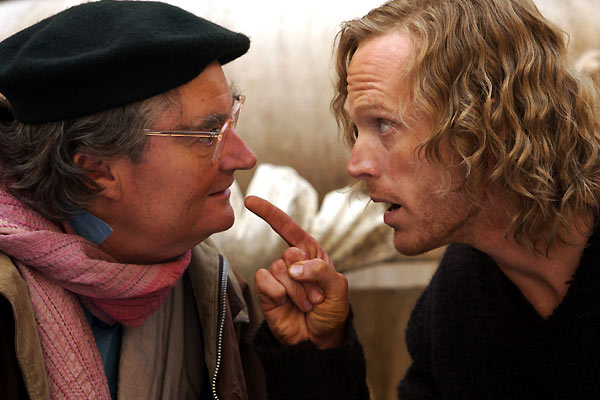
The film was, in my opinion, wonderfully shot, well paced, and intriguing to the end. It’s greatest asset was a wonderfully selected cast including charming performances by Brendan Fraser, Andy Serkis, Paul Bettany, Jim Broadbent, and Helen Mirren.

Perhaps I’m just a sucker for films that ponder the power of the written word to bring worlds to life. Perhaps I find too much interest in the question of how the stories of our lives are being written. Perhaps I bring too much philosophic pondering to movies I watch.

The movie raises such issues for me. But that it does did not dim at all the intensity with which the film was watched by the four children, all under ten, crowded onto our couch watching with us.

A family film flirting with philosophical and theological questions keeping single digit kids on the edge of their seats, with well cast, quality actors. What more could one want?

Rate-My-Church.com

Did you hear that in addition to collating movie and video game reviews, that RottenTomatoes.com will soon begin providing ratings on churches?

No, I didn’t hear that either, but it is not implausible. This article chronicles the proliferation of rating systems on the internet (movies, of course, but also doctors and lawyers and professors and plumbers and so forth).

So why not churches?

My daughter was checking up on some professors the other day at RateMyProfessor.com, and we learned not only how interesting and easy students thought each was, but also how ‘hot’.

I’d love to see what we might begin to rate churches on. I don’t imagine that I’ll have to wait long before finding out.

Risks and Laurels


Erwin Rommel was one of the greatest generals of World War II. Unfortunately, he played for the wrong team, being not concerned for the politics or morality of his situation until later in the war. In the main, he was a military man inspired deeply, ironically, by Confederate general Stonewall Jackson.

Rommel made his reputation in a series of daring campaigns carried out in the North African desert. (The rigors and difficulties of that aspect of the war was fictionally, and yet, I believe, accurately reflected in Steven Pressfield’s Killing Rommel, a book given to me by my son this past Christmas.)

In that rugged and desolate terrain, the supply chain was always of paramount importance. One biographer, David Fraser, says this about Rommel’s attitude and success in that campaign:

“Rommel may not have gained a reputation for painstaking personal absorption in the detail of supply within the North African theatre before campaign…. He certainly sometimes ran out of fuel – and, often by his own initiative, repaired the situation; and he more often ran the risk of running out of fuel.”

That much is the biographer’s report of the facts. What follows is the biographer’s editorial comment on the matter:

“It is likely, however, in the sort of fluid situations, the sort of mobile manoeuvres at which he was master, that the man who never risks running out of fuel is inclined to risk nothing; and he who risks nothing is seldom crowned with the laurels of victory.”

[David Fraser, Knights Cross: a Life of Field Marshal Erwin Rommel, page 239, 1993.]

“He who risks nothing is seldom crowned with the laurels of victory.”

Sometimes, those who risk, fail. But rarely if ever is there victory without the risk.

What is true in warfare is true, as well, in our marriages, our churches, and our lives of faith.

I need to be encouraged to take the risks as well as to not despair when in so doing, I run out of fuel.

Page 89 of 142

Powered by WordPress & Theme by Anders Norén