Randy Greenwald

Concerning Life as It Is Supposed to Be

John, the Predestinarian

When I find myself in a discussion with someone concerning what the biblical doctrine of predestination really means, inevitably somewhere in the conversation he or she will say something like, “But what about John 3:16?”

Of course, I see no conflict between John 3:16 and Ephesians 1:5. Neither do I see a contradiction between the expressed love of God for the world and the free offer of the gospel which is so preciously conveyed in John and the mysterious and yet affirming love for the elect before time which Ephesians or Romans clearly celebrate.

I find it interesting, though, to read this comment by the British New Testament Scholar C. K. Barrett who, as far as I know, has no bone to chew in this argument. Barrett, whose students included J. Dunn and N. T. Wright, among others, sees that this passage, and especially the verses immediately following John 3:16, is in its very tone and direction predestinarian:

“In v.19-21 the predestinarian teaching of this gospel comes clearly to light. Men are divided into two classes, those who do evil and those who do the truth. The former inevitably reject Christ and are rejected; the latter as inevitably accept him.” (The Gospel According to St. John, page 182)

Barrett’s expression of what predestination means as he goes on is not as clear as I would want it to be. I share here what I do just because I find it ironic that the very passage appealed to to reject predestination is said to have a predestinarian foundation and to reside in a gospel whose very nature is predestinarian.

It’s ironic, that’s all.

It should come as no surprise that a guy who names his blog ‘Somber and Dull’ finds delight in irony. It makes me smile.

That Is How You Become Smart

I was looking at the moon last night, and for the first time in fifty three, years of life wondered why some portions of it are darker than others. I suppose the difference is caused by lunar landscape features, light reflecting differently off plains and mountains, but I may be wrong. What struck me is that over 53 years of living, I had never thought to ask the question.

In 1995, Hope Presbyterian Church hosted a conference featuring James Montgomery Boice. Dr. Boice was an evangelical leader of tremendous grace and skill, pastor of Philadelphia’s Tenth Presbyterian Church, and featured speaker on a broadly heard radio program.

He was not only a gifted communicator, he was, it was clear, a very smart man. He was not one, it should be noted, who used his intelligence as a perch from which to look down upon others. He was the paradigm of the Christian gentleman.

I soon learned that in addition to a clear abundance of intellectual gifts, he was smart because he was curious. He would have asked about the moon much, much earlier.

After the conference, I drove Dr. Boice to Tampa to catch a train to return to Philadelphia. Along the way, he asked many questions about the places we passed. Questions I had never thought to ask, and questions, therefore, for which I had no answers.

I told my kids later that this is how one gets smart. But asking lots of questions.

And by reading.

On that same trip, Dr. Boice told me that he was beginning to re-read Will and Ariel Durant’s 11-volume world history set The Story of Civilization.

This was his second time reading it.

He did not tell me this to impress me. I was impressed, anyway.

I’m a late bloomer. By the time Dr. Boice had reached my age, he was nearing the end of his life due to the sudden and overwhelming onslaught of liver cancer. But I’m learning to ask questions, and I’m learning to read (not Durant, but this).

And I’m wondering how many other curious things in my world are right there in front of me but which I’ve failed to see?

Hermeneutics, Life, and Death

Someone asked me the other day, “What’s hermeneutics?”

I explained to her that it is the science of interpretation of a text, and that in our circles it refers to the interpretation of the Bible.

I also told her that the difference between proper hermeneutics and improper hermeneutics can be the difference between life and death.

I was not being overdramatic.

* * * * *

Early in our parenting journey I was given a small booklet which proposed to me that the key to parenting success was the art of the rod. Moving from the proverb which promises a spoiled child to the parent who spares the rod, this booklet taught that the biblical method of parenting demanded frequent and forceful spankings.

Once vulnerable and trusting young Christian parents are told such things, they may just believe them. I did. For a time.

The problem is that the passage does not demand spankings but discipline, and a broader reading of scripture calls for an attitude of grace which views children as God’s image bearers and not as mere Pavlovian dogs or Skinnerian objects.

The difference between the booklet’s understanding and that of the above paragraph is not merely one of ‘point of view’. The differences are rooted in a proper and an improper hermeneutic practice.

And this difference is deadly.

I early saw the fallacy in the ‘beat them into godliness’ school. I also learned that my baser nature made me an untrustworthy bearer of the rod. But though I have grown in my understanding, others have not. I have been blind to the horrible damage, the unconscionable acts, which have been perpetrated in the name of such ‘biblical’ parenting.

Here, here, here, here, and here, my good and gifted friend TulipGirl has shared the sad, sad news of a case of child abuse which resulted in death. This case involves Christian parents who are the followers of such methods. They did not spare the rod, and as a result, a child is not spoiled, but dead.

TulipGirl has written passionately and articulately about this particular tragedy. If you have not done so already, go read what she has written. If you are a follower of Christ, weep not only for the children, but for the honor and reputation of Christ.

If you follow her links, you will see this tragedy set in the larger context of the frightening power wielded by the unrepentant teachers of such false systems. TulipGirl does not relish the role of the confrontationist, and she makes every effort to speak fairly and with grace. But if the name Pearl (or Ezzo) adorns the spines of the parenting books you or your friends trust, you should read and ponder what TulipGirl has to say.

We should be saddened by such stories. But we should be saddened as well by the broader carelessness which characterizes the hermeneutics of those who assume to themselves the mantle of ‘teacher’ in the Christian world. Hermeneutics is a matter of life and death. In this case, faulty hermeneutics has led to a child’s death. In other cases, it leads to impoverishment. In others, to a bondage of spirit from which people with difficulty emerge.

Not everyone who spouts Bible verses or claims to be ‘biblical’ is to be believed or trusted. And I say that as someone who spouts Bible verses and claims to be biblical.

* * * * *

The woman who asked about hermeneutics is following a path that will serve as a healthy antidote to the tyranny of the experts that plagues the Christian church. She has picked up R. C. Sproul’s excellent little intro to the subject called Knowing Scripture. She’ll be okay.

I commend the book to you. But I commend as well prayer for Christ’s church, for her teachers, and for those who teach the teachers. May we all be true to him who gave his Son not to condemn the world, but so that the world might be saved through Him.

At the Risk of Sounding Judgmental…

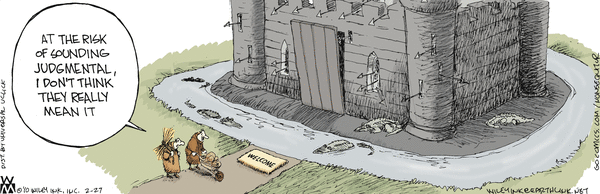
I wonder sometimes, with all our rhetoric about welcoming and care for the unreached cultures around us, if perhaps this is the way the Christian church appears to the outsider:


[Note: I realize that I do not have permission to use the above cartoon. Perhaps I can justify this by pointing you to where I read this regularly, and by encouraging you to read it. Wiley is very perceptive about human foibles, and addresses them with a deft hand.]

Now Up…


Now stepping up to the plate, at the top of my Amazon.com wish list, this. Can’t wait.

Hibernating

I’m really not dead, yet. Just busily consumed with life. I love to write and to post, and my backlog is immense.

I refuse to get on the cart. Besides, it’s against regulations.

And it’s clearly too early to go through my clothes and look for loose change.

Stay put. I’ll return.

Talk to Your Dad


Reelzchannel aired a program I watched at lunch today featuring movie director Gary Marshall (Pretty Woman, Princess Diaries) talking about his films.

In it he spoke about a movie he did called Nothing in Common starring a young Tom Hanks and Jackie Gleason as a father and son. He said that men will stop him in restrooms and say something like this to him: “I hadn’t talked to my father in years, until I saw that movie. Thank you.”

When I heard him say that, I wanted to talk to my father. I can’t. He’s been dead for nearly fifteen years.

But guys, some of you still can. Call him up. It’s not Father’s Day which makes this a perfect time to talk to him, simply because it’s not expected.

* * * * *

Side note: He also said that no one could curse as beautifully as Julie Andrews. I didn’t see THAT coming!

Drive-Thru Clerks Are People, Too

Here is life from the other side of the drive-thru window from two lovely “quick service restaurant” veterans who had bunches of fun putting this together!

Tapping In

On a Thursday a few weeks ago, I had started my work day at about 6:00 AM. At 7:00 PM after a 13-hour, non-stop day, an opportunity opened to attend a Bible study at a nearby college, the invitation coming from the students themselves. I was so tired, I turned down what would have been a great opportunity. But I was spent.

What did this holy man of God do instead?
A) devoted himself to an hour of prayer or
B) popped This Is Spinal Tap into the DVD player to watch 90 minutes of brain-relaxing absurdity.

Yes, it was ‘B’.


This is Spinal Tap parodies the lives of aging rock ‘n’ roll bands (and contrary to what people think, Spinal Tap was NOT a real band). It was innovative for its time, inventing the ‘mockumentary’.

This is one of those movies that is funnier when I think about it later than when I actually watched it. I’ve laughed louder at the 18 inch Stonehenge and the disappearing drummers more SINCE seeing it than I did WHEN I saw it.

Comedy, and especially satire, depends so much on the familiarity of the audience with certain nuances of the subject matter. I didn’t get all the jokes, but it was a great way to rest the brain after a long, long day.

I love lists of movies, but I’m often puzzled by them. This is Spinal Tap is listed as #29 on the American Film Institutes’ list of 100 funniest movies.

It strikes me that in culture there are certain canonical answers to certain questions, answers which are expected but which do not necessarily reflect the studied opinion of the answerer.

So, who was the greatest writer in the english language? Shakespeare, of course.

What was the greatest movie ever made? Citizen Kane, clearly.

And what were the funniest movies ever made? Among others, clearly, This Is Spinal Tap.

Ideas and their Consequences.


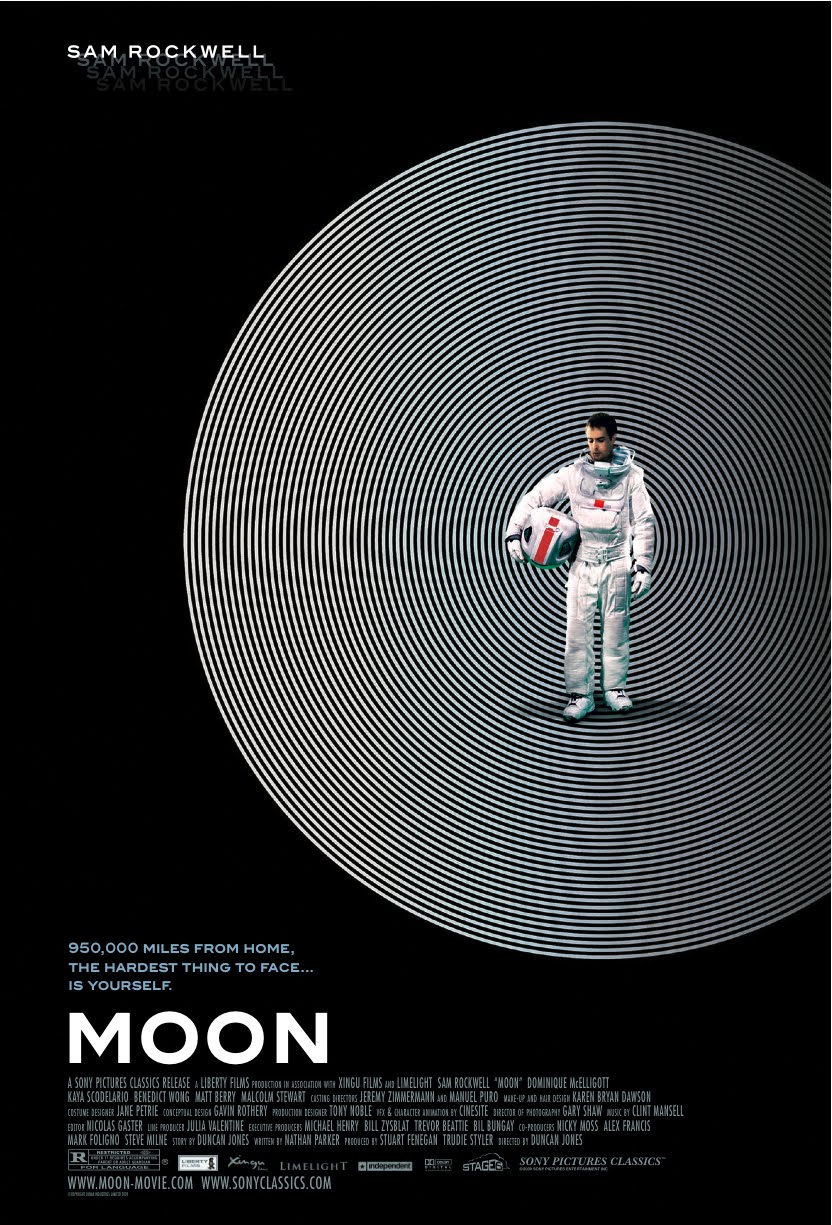
Everyone who has seen the movie Moon raise your hand. Okay, you can both put them down now.

Moon is a remarkably well told story set in a mining operation on the moon. This operation is efficiently overseen by a single human and a seemingly benevolent computer. Together they serve humanity with their isolated and sacrificial labor. The human is praised as a hero.

Sam Rockwell plays the human and does a remarkable job carrying the weight of what we soon discover is a chilling tale.

The best science fiction creates a world in which the implications of scientific and technological advances and possibilities are explored and often critiqued. This film accomplishes that and is worthy of a watch. This is not Star Wars or Star Trek. This is a movie exploring the consequences of ideas.


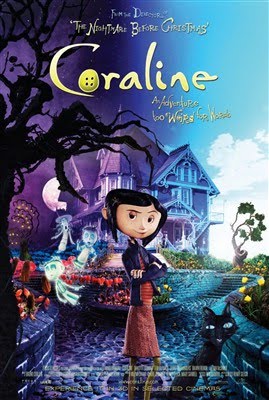
Like science fiction, fantasy and animation also provide venues for exploring alternate realities. Coraline is the story of a young girl lamenting her family situation. Her parents are busy and unresponsive, and have dragged her away from her friends into an isolated house surrounded by weirdness. She wishes for a different life. As the saying goes, be careful what you wish for.

There is terror here, terror in a life that becomes ‘all about me’. This is the stuff of nightmares.

I’ve not seen but a few minutes of the highly touted film Avatar. It is said to be visually stunning. I find it hard to imagine that it could surpass the visual beauty of Coraline, a beauty which in this case is actually wed to a good story.

[In fairness to my snide Avatar comments, a friend has promised me a review of Avatar revealing its redemptive themes. Once I receive it, I’ll post it. I can’t wait.]

Page 73 of 142

Powered by WordPress & Theme by Anders Norén