
Randy Greenwald

Concerning Life as It Is Supposed to Be

On Study Bible Alternatives

In the previous post, I mentioned my hesitancy regarding study bibles. Continuing to quote from my response to my friend, I consider the alternatives, if there are any.

But is there an alternative?

A great alternative would be for a publisher to publish the Bible and the notes separately. This would satisfy my concerns. I wish someone would publish a book called “The Reformation Bible Study Companion” or something like that which would print the notes from a study bible in its own stand alone format. This would make the valuable content available but would keep it separate from the text of Scripture itself.

But no one in our modern era has done that. However, in my mind, there is a great alternative. If one was not to buy a study bible, I would recommend this that as a companion to your bible you have at hand a copy of IVP’s New Bible Commentary.          

This is a commentary on the whole bible written by some of the best of conservative evangelical scholars. The editors themselves are worthy of note. Donald Carson, Alec Motyer, Gordon Wenham, and RT France are all trustworthy guides with no axe to grind other than a love for the biblical text. It does use the NIV as its base text, but that is not really a problem as the commentators themselves take the original text into consideration as they comment. 

The only downside is that it is hard to carry with you. Anyone caught carrying this to a bible study would be instantly labeled as one slightly left of normal, whereas carting in a study bible raises no eyebrows. It is strictly a ‘look it up at home’ kind of resource. But at the same time, you have at hand thoughtful reflection on every passage of the bible and not just those the editors of the study bibles think need explication.

So, for what it is worth, my recommendation would be to keep your own bible in hand, and instead of spending $30 on a study bible, spend it on this commentary. If, on the other hand, one wants the more theologically oriented commentary found in a study bible, then buy the one you are looking at, but use it as a reference and not as your primary portal into God’s word.

[There is another resource I’d pick up if I were you. R. C. Sproul’s book Knowing Scripture really is a great tool for learning how to read scripture. I’d recommend you get this as well, regardless of what route you take in study bibles or alternatives.]

Thanks for trusting me enough to ask my opinion.

Randy

On Study Bibles

I was asked recently by a friend what I thought of his purchasing the ESV Study Bible. If he thought that I had perused and had an informed opinion on this particular study bible, he was wrong. If, though, he imagined that I had an opinion, well, on that score he was not far off. I reproduce my (slightly edited) answer here and in a subsequent post because I think there are some important matters the very existence of study bibles raises.

Several responses come to mind.

1) Since I don’t use a study bible, I’m not a good one to review this one for you. I’ve never held a copy in my hand, never flipped through the pages, never looked directly at any of the notes. So, I have no personal knowledge of it. That said, I can’t imagine where I would quibble with it. I’m sure the comments are sound and trustworthy. I suspect that in the study bible world, you could do much worse.

2) That said, I’m not a big fan of study bibles in general. You may write this off as one of Randy’s many idiosyncrasies, a word which has a lot in common with ‘idiot’ and ‘crazy’, but I think I have some good reasons for my tepid attitude.

a. Study bibles are heavy. Probably not the best reason, but it does play into my thoughts on the matter. People don’t normally spend the money for a study bible and then more money for one to cart around – they cart around the large study bible. There is I suppose the cardio-vascular benefits to consider here, but aside from that, it is something to take into consideration. (Wouldn’t it be great to be able to leave the notes at home and use them only when you needed them? More on that later.)

b. More important reasons for questioning study bibles are these:

i. When studying a text of Scripture, what is the best way to approach a difficult section? The best way is to stare at it, ask questions about it, ponder it, wrestle with it, and think through a few ways of unraveling the puzzle. That is hard, but it is the best way to really chew on scripture and allow scripture to get into our heads and hearts. It’s after wrestling with a text’s possible meanings ourselves, that there is value in consulting what others have said about the text. The major and most weighty problem I have with study bibles is that they encourage laziness in confronting the text. They allow us to too swiftly find an answer, and not just any answer, but, if we are not careful, an answer we consider to be THE answer because RC Sproul (or Charles Ryrie, or whomever) said it.

ii. A subtle but consequent result is that the lines between the text of scripture (fully authoritative) and a given interpretation of that text (not necessarily authoritative) begin to blur because the two occur on the same printed page between covers that are stamped ‘Holy Bible’. This is subtle, I know, but I think it is an issue. Months, years later, we may find ourselves searching for something we read in the Bible, when, in reality, it’s not in the Bible at all – it was in a footnote or a side bar in a study bible we once owned.

These concerns, to me, are weighty and worth your consideration. But I’m not going to condemn anyone for disagreeing with me. And like I said, I think if one is going to get a study bible, this is probably a good choice.

To be continued…

Hell Is Nothing to Joke About…

Hell is nothing to joke about, but moving is. As one who has just come through a move, this seemed appropriate.

Hell and Moving

Life Goes On; Blogging Struggles to Keep Up

The dates on the page don’t lie.

The last post here was posted over two months ago. Were Somber and Dull a pet, I should be arrested for neglect if not abuse. What followers I might once have had have no doubt determined that I am sick, dying, or dead, and have drifted off to more verdant fields. I would not blame them.

What has happened?

The life of a pastor is an erratic and unpredictable thing. Rare is the day that plays out as scheduled. And the life of a father of six can be disorderly, even though only one still requires any direct oversight. Life has pressed hard against my order-loving soul, and this blog has been a victim.

It has not helped that we have had to move. Quickly.

Shortly after leasing our house in 2010, the landlord was foreclosed upon. The house, which had been in limbo since, was sold to Fannie Mae on September 3 of this year. That we had to move out by October 6 we discovered September 23rd.

We have done what we have had to do, and there has been little margin time for other things. Now that I few margins are returning, I hope at least to restore this blog to some regularity.

I hope to restore it for the sake of the discipline of writing. A point frequently made, which I first heard from a crusty old college professor, is that those who want to write need to write. Daily. All the time. With discipline. I have lost, or at least misplaced, that discipline. I want it back.

Oddly, and humbly, I confess that there are those who have told me that they have found this blog (occasionally, at least) helpful. I do apologize to you for my silence. To some degree I see this as an extension of my ministry which I’ve neglected so that in a sense I see that I have neglected you.

I may not have much to say, but I have much to write (there is a difference). If you are among those who find what I write helpful, entertaining, or even diversionary, then pray with me that my discipline might stick.

I’ve learned long ago to make few promises. But my intentions are good. We’ll see where this leads.

Metaxas vs. Me: A Reprise

I give up.

From all that I can gather, Eric Metaxas is a nice guy, a smart guy, a funny guy, and generally, a good writer.

But I also am gathering that my wife and I are the ONLY people on planet Earth and, for all we know, in the galaxy not to fall head over heels over his biography of Dietrich Bonhoeffer.

I went public with my issues with the work just over a year ago: Bonhoeffer vs. Metaxas. Since then, I’ve yet to find someone who agrees with me.

A recent dinner guest when the subject turned to books mentioned being deeply impressed with the book. He was unaware of my take. A good and wise and discerning friend in Bradenton recently told me that he loved the book. He WAS aware of my view. Ouch.

But that’s not all.

The religious news service recently ran an article about Eric Metaxas being something of the ‘new’ Charles Colson. I’m not sure what a new Charles Colson is, but the article mentioned George W. Bush having read the bio and implied that Barack Obama would do the same.

The NY Times then recently asked National Institutes of Health director and human genome decoder and all around really smart guy Francis Collins about the best books he’s ever read. Of all the books in all the world, he has to mention this one:

I was deeply moved by Eric Metaxas’ biography of Dietrich Bonhoeffer, and loved “Einstein: His Life and Universe,” by Walter Isaacson.

Sigh. The irony is that I read the Einstein biography immediately after the Bonhoeffer, and it was so much superior in my mind that the only way to compare them was by contrast. But how do I take issue with presidents and preeminent geneticists?

My opinion has not changed. A biography should tell a story well. Bonhoeffer’s story is great, but this is not a good telling of it. I continue to believe that readers are so drawn to Bonhoeffer that they fail to see the faults of the book itself. So, I guess I haven’t given up after all. I’m just losing.

One Foot on a Banana Peel and the Other in the (Empty!) Grave

Winston Churchill, not unlike many who have a Bible on their nightstands, found Christianity implausible. According to biographers William Manchester and Paul Reid,

”[Churchill] found no reward in theological exercises. He subscribed to the Christian values of mercy and forgiveness, but his beliefs were not dictated by doctrine, and certainly not by clerics. …he rejected the carrot and stick of heaven and hell. The idea of an afterlife was not much more than an afterthought for Churchill, and one he considered equivalent to a belief in ghosts and goblins.” (The Last Lion: Defender of the Realm, page 18)

There are times and senses in which I find his casual dismissal of the supernatural attractive. It seems so easy. So defensible in a modern world.

Illusionist Penn Jillette is no mild agnostic like Churchill, but an aggressive atheist, snarkily and proudly evangelizing for unbelief. When asked what book on religion he would have every college freshman read, he responds,

”The Bible — cover to cover, without someone alibiing it. Just read it. Nothing will turn you into an atheist faster.”

Though he’s trying to be surprising and shocking, I’ve read the Bible enough times to know where he’s coming from. There are parts that are troubling and without clarification hard to understand and to fit into an agreeable picture of the world and of God.

French Philosopher Luc Ferry unlike the two above finds Christianity wonderfully attractive, and would love to believe. But he finds that he can’t.

”I grant you that amongst the available doctrines of salvation, nothing can compete with Christianity – provided, that is, if you are a believer… were it to be true, I would certainly be a taker.” (A Brief History of Thought, pages 261, 263)

Why have I, in contrast to even a willing would be believer, like Luc Ferry, come to believe, when there are plausible and at times attractive alternatives? What’s wrong (or right!) with me? The question drives me in two directions.

The first is the humbling conclusion that if I believe I do so because, in fact, God has enabled me to believe. The description of the conversion of the Apostle Paul uses the metaphor of scales falling from his eyes. What was true but could not be seen was made visible.

That faith is a gift comes with its own barrel full of philosophical questions, but it is clear that this is what the Bible teaches. I can’t answer why faith is granted to me and not to Luc Ferry. But to be where one says ‘Why me?’ is to be in a place where pride has a harder time growing.

With the scales removed, though, what do I see? I see Jesus – a person so attractive in person, teaching, and work that I want to be with him and to be what he wants me to be. I fail, of course, but I can’t deny the attraction. I am drawn not to doctrine, but to a person I want to follow.

But perhaps the stories of Jesus are largely fabrications? The evidence against this suggestion is quite strong and the central feature of Jesus’ life and work is impregnable: Jesus was not only a powerful and attractive person, he is one who was raised from the dead and ascended into heaven.

When the waves of doubt lap at my feet and when questions arise for which I don’t have the answers, I’m reminded again and again that Jesus was raised from the dead. As Steve Brown put it to me last Easter,

“A dead man got out of a grave and said we could too. That changes everything.”

Apart from the empty tomb, I am lost. I don’t merely BELIEVE in the resurrection; I cling to it as a drowning man might to the last thing floating.

And I am not alone in this. Paul clung to this as well:

And if Christ has not been raised, your faith is futile and you are still in your sins. (1 Corinthians 15:17)

The man who first told me about a church that would become my first pastorate said that it had “one foot on a banana peel and the other in the grave”. It was not meant as a compliment.

With a small variation, however, it nails me. Though I always seem to have one foot in slippery places, the other, thankfully, is anchored solidly in the empty grave of Jesus.

Backlog

A friend asked me yesterday if I liked to write. That’s a great question. I do, sort of. I like to complete a writing project. I like getting thoughts on paper. I like having a finished product to tweak. But the act of writing itself is hard, and I, like many, tend to avoid hard work. (Steven Pressfield calls this the “War of Art“. I may not be close to the art side of that, but I understand the war involved in any creative endeavor.)

Because writing is hard work, it requires time. Disciplined time. Time I’ve not had much of over the past 3-4 years. So, writing, for me, as some of you will have noticed, with this blog as evidence, has slowed to a trickle.

That doesn’t mean that I don’t constantly have ideas of what to write. Local Drafts

The screenshot, here to the right, is from the wonderful publishing tool I use called MarsEdit. Ideas for posts often get plopped into the ‘local drafts’ folder for later (theoretically) editing and publishing. In reality, they mostly go there to die. At last count, there were 216 posts waiting refinement or death, the latter being much more likely.

I’ll keep writing. It’s like talking for me, something I’ll only be able to give up if physically unable to continue. And if I find the disciplined time, I might begin by rescuing some of those 216 posts.

Moonrise Sex

There is a title that’s bound to attract some search engines. But that’s not why I chose it.

I have friends who are big fans of the movies of Wes Anderson. Like the Coen brothers, I find that he is an acquired taste, one which I, after seeing Rushmore, The Fantastic Mr. Fox, and Moonrise Kingdom am still working to acquire. Out of respect for my friends, and Anderson’s three Oscar nominations, and the fact that Moonrise Kingdom was nominated for the top prize at Cannes, I’m willing at most points to say that my lack of appreciation is a problem with me. I often simply don’t get Wes Anderson, but I’m willing to admit that that is my problem.

So I may not be the right person to address the question that Moonrise Kingdom raised for me. There is a scene in the film which probably made me, and many others, squirm. It made me ask, “When does a filmmaker’s reputation allow him to get a pass where he should not get a pass?”

The scene in question captures two child actors in a highly sexualized context. The scene itself is not distasteful. What is distasteful to me is the fact that two children were asked to enact it.

Curious what my friends thought, I asked their opinion of the movie. This led to a specific debate with them concerning the scene in question which I preserve below. I think that even for those of you who have NOT seen the film there may be some value in raising and considering the questions the scene raises.

Correspondent #1: I saw Moonrise Kingdom at the local ‘indie’ theater when it opened last May. As always with Wes Anderson, I love taking in the aesthetics – the sets, the costumes, the attention to detail, the soundtracks, the original scores, the cinematography. All those things alone do not a good movie make! I don’t remember being particularly impressed with the story or the characters. I remember a time or two feeling uncomfortable at the pre-teen romance. In general I found it entertaining enough, but it didn’t really ‘stick’ with me, I haven’t looked back at it since.

RRG: All you say about MK is on the money: quirky, visually intriguing, etc.

But here is what bothered me, not only for its troubling nature, but also that so many others, and particularly Christians, were not bothered by it. I can’t say what the definition of child pornography is, but would not filming children involved in sexual activity for the entertainment of others qualify? If that is accepted, then the question becomes ‘what is sexual activity’. When a 12 year old male actor is invited to and does place his hand on a female actor’s breast in the company of sexually oriented conversation, is that not close to, if not actual, child pornography (albeit of a mild sort)? These are not 20 year old actors playing 12 year olds; these are actual 12 year olds. Does it get a pass because it is Wes Anderson? Or am I revealing a level of latent prudishness?

Correspondent #2: Agreed about Moonrise for the most part. Only saw it once and thought that it was a little disturbing. Probably Wes Anderson’s weakest to date. He’s always fascinated by young lust, and those early awkward moments may have gotten the best of him in this film. Cinematography, acting, etc. was great as always, but the story didn’t do much for me. The letter writing back and forth and man/nature aspect could have been interesting if developed more…but as a whole…..eh.

RRG: See – this is my struggle! We ask a 12 year old to fondle another, and the worst we can say is that this ‘must have gotten the best of him’! We can’t bring ourselves to say that that was wrong? Maybe it’s just me enjoying a bit of my own self-righteousness here.

Correspondent #2: Ok…I would imagine you’ve enjoyed some movies with “worse” subject matter, no? And if not, if indeed this is the most offensive I would be curious as to why. They are peers in the movie, and they are both curious, so if in the abuse/fondling aspect I would definitely put it on the lighter end of that spectrum. Again, not condoning, just sayin’. And for what it’s worth, that scene did not bother my wife much who is VERY sensitive to sexual stuff on screen. There are many different trajectories he could have gone with it, but he leaves it there. No further. Still, curious as to why that got to you so much. I’ll continue thinking about this…..and if you’re self righteous, well I’m that plus desensitized. So you might need another opinion altogether.

RRG: There is difference between what I watch and what is appropriate behavior for actors. We would agree that for one actor to actually KILL another actor for entertainment purposes would be wrong. Right? So, we simulate that. I can watch a naked man and woman, within reason, on screen, but at least assume that these are adults who have been naked before and they somehow have figured out how to make this merely a professional engagement. Would I want my wife stripping naked for a camera? No… but I get that it is done and that those who do it are in some measure able to treat it as a job. However, we draw the line at actual intercourse, don’t we? That is reserved for the pornographic, xxx videos. Right? We still preserve a line there which legitimate cinema does not need to cross. Like killing, it is simulated. It does not need to be shown.

But in this movie, it is not the watching of the act that bothers me. It is that for the sake of entertainment, an actual 12 year old is asked to do what he would not ordinarily do (we hope): put his hand on the budding breast of another child actor. Is it okay for us to ask a child to violate another child like that? In actuality an act occurred – not simulated, but really. Anderson may have a fascination with young lust, but at this point his fascination verges into voyeurism which I think wrongly violates two children.

So does that help explain my issue?

Correspondent #2: Yea, it does. I heard a similar argument from a friend regarding people (women primarily) being nude on screen or on a stage, etc. His argument was it should never be done because the actor or actress has crossed the line of “acting” immodestly (if portraying sex or someone scantily clad or something) to being immodest. I get that. For Moonrise, from what I would say is a safe assumption, in the world of prepubescent youths, simply doing what they did is pretty tame and not all that uncommon – at least from what all is out there in the world.

Would you have been okay with the scene if they were shot from the neck up, the words were the same – whatever they were…”I’m going to touch your breasts now” or something like that explaining what he was doing, but it did not show said act OR the act was not actually done, just acted out in that sense? Just curious.

RRG: I understand the nudity issue, but have managed to somehow put that aside. I’ve lost too many arguments with artists who paint from live models. It’s too hard to make an ‘always wrong’ or ‘always right’ case in that regard. But I want to say that it IS always wrong to ask children to act in this way for the sake of entertainment. And perhaps it is mild, but I still think it is wrong to ask them to do it on screen for our entertainment. (And, as a side note, an article written about the film did note that their kiss was their absolute first, which, I suspect, suggests that they have not been out there feeling breasts either.)

And yes, if the words were the same, but they as children were not asked to do the act, I would not be as troubled. I’m troubled with 12 year olds losing their sexual purity, but I know that it happens. But I would not want to be one to encourage that.

Well, there it is. Comment away.

Pascal

I’ve been both busy and away, so to fill up this space and assure you that I am NOT dead (yet), I decided to paste this screenshot of a series of tweets I posted to Twitter this morning (for you who don’t follow me, @rg7878, on Twitter).

I’ve been reading Pascal’s Pensees and wanted to share what Pascal could have tweeted had Twitter been around in his day.
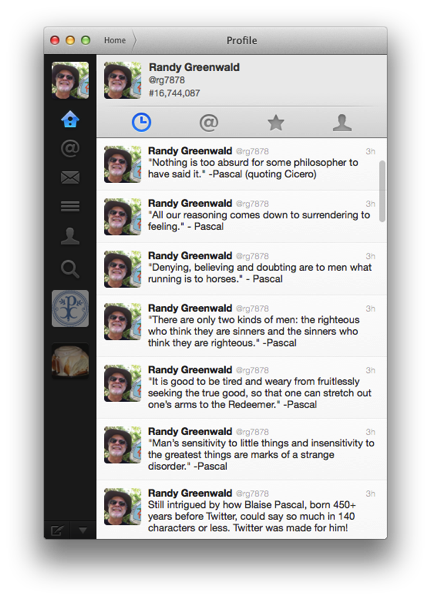
The screenshot is to be read from the bottom up.

Pascal Tweets

Survivor

Last week my wife left my 12 year old son, my 21 year old daughter, and me at home to fend for ourselves while she went to be with my oldest daughter who had just given birth to our newest grandchild. What follows are actual quotes from actual conversations held thereafter.

This first was a phone conversation with my 21 year old daughter on Friday, four days into her absence:

Daughter: You’re mowing the lawn?

Dad: Yes.

Daughter: You know how to do that?

Then, five days out, as my son and I were packing the car to join my wife, this:

Son: We actually made it all week without Mom.

Dad: Yup.

Son: Miracles still happen.

Draw whatever conclusions you like.

Page 29 of 142

Powered by WordPress & Theme by Anders Norén