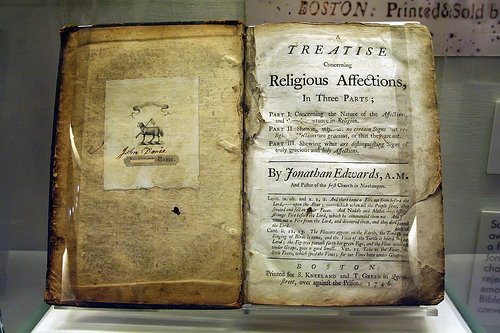
When I expressed to a friend not too long ago that I was reading Jonathan Edwards’ treatise On the Religious Affections (yes, I’m still plodding through), he quipped, “So are you unsaved yet?”
If you have read Edwards, or one of his disciples such as John Piper, you will understand my friend’s comment. There is a sad truth to this: a deep contemplation of Edwards (or of his disciples) can have the tendency to unseat one’s confidence and assurance of his relationship with God.
Edwards pursues a noble, and in many respects necessary, path. What signs accurately distinguish a true and genuine profession of Christian faith from one spurious or casual? The distinction is critical since it is possible to rest upon works or culture or background for salvation when such comes only by the work of new birth wrought by the Holy Spirit in the heart. Are there clear evidences by which one might judge himself to be truly born again?
Edwards looks at the religious affections as the basis for our convictions. For him, the affections are akin to what we consider to be our emotions. With true religious conviction there will be a deep response of the heart, a deep seated and expressive love for the things of God which can only be produced by the work of God in the heart.
However, an emphasis upon our uncontrollable emotional response may leave one wondering if he has faith, and what he might need to do to get faith. Reading of Edwards’ signs of true grace can cause a reader to doubt his salvation. As much as I am inspired by Edwards, Piper, and others, this does concern me. I don’t wish to leave any child of God without hope.
And yet, if we fail to consider the signs of a work of God, if we don’t long to see evidence of God’s presence, is there not the corresponding danger of leaving the unconverted falsely in hope? Yes, there is. James Montgomery Boice once spoke at the church I pastor and cautioned us to consider that a good number of those in worship on any given Sunday may not at all have been converted.
There is a great deal of complacency in the Christian church, people who believe they have been saved, but are truly unacquainted with the work of God’s spirit. Edwards describes the fruit of a true conversion as having
“…a conviction, so clear, and evident, and assuring, as to be sufficient to induce them, with boldness, to sell all, confidently and fearlessly to run the venture of the loss of all things, and of enduring the most exquisite and long-continued torments, and to trample the world under foot, and count all things but dung, for Christ….” [page 303]
So many in our pews seem to lack such a conviction. We are happy to have a church to go to and songs to make us happy, but is there an inner conviction so deep that we would for Christ venture the loss of all things? If there is not, can we really claim to have been born anew? That is the question that Edwards and others rightfully forces us to ponder.
There is therefore a challenge to light a fire beneathe the nominal and complacent, and to do so without wounding the sheep. That indeed is a challenge.
Technorati Tags: Christian Life, Church, Edwards, Grace