
Randy Greenwald

Concerning Life as It Is Supposed to Be

The Freedom to Love, part 3

One needs to be freed from many things before he is free to really love others. If we do not realize that, we will not love and will too easily abandon the call to love those for whom love is difficult to give.

We have considered that we need to love out of reverence for Christ. Our affection and actions for another are to be rooted not in the other’s worth or value to us, but primarily in our love for Jesus. We have also considered that we can only be freed to love others when we find out value in Christ, and do not base our love upon the performance of the other. (We also had some poetic help from Elizabeth Barrett Browning.)

There is one more thing that I wanted to share on this subject. There are two relationship killers that must be exorcised if we are really going to be free to love:

  • Expecting someone to be what they are not and cannot be
  • Expecting another to fulfill all our needs

In a marriage relationship, if I focus upon my spouse’s weaknesses and failings, the relationship will never progress and never know any joy. Never. If I expect Barb to be what she by nature is not, I will never, ever, know how to love her. I will be continually critical and disappointed, ready to love her when she finally achieves my level of expectation (which is constantly shifting). If I act this way, I cannot love her as she is, for I am always waiting for her to be what she is not.

Similarly, if Barb looked to me to fulfill all her needs, as some women do with their husbands, she will be grossly disappointed. In many marriages, this disappointment morphs into a deeply critical spirit of judgment as the wife finds herself unfulfilled and blames that on her husband. She will find it impossible to love the one who lets her down simply because her expectations are too great. He may never be able to fulfill the expectations she has placed on him.

These two wrongly adopted expectations are relationship killers because in many relationships, the disappointment they generate lead the disappointed member to look elsewhere for fulfillment.

The same thing applies to the church. I am not saying that there is never room for critique or even at times for leaving. But what I am saying is that these two things should be avoided like the plague: 1) expecting the church to be what it is not and 2) expecting the church to fulfill all one’s needs. The church, like a spouse, will NEVER be able to measure up under such criteria. When men or women leave a church for personal, not theological, issues, at some level, these expectations will be found.

When those things are exorcised, however, love can be unconditional, and one will then be able to pray for and work for change, in a spouse or in a church. Those two expectations pull people apart. Seeing, however, that Christ fulfills all and is all, draws us to others in service. It is Christ alone who frees us to love.
Technorati Tags: ,

WiFi “Lukewarm” Spot

I reported earlier about my discovery that free WiFi is now available at Starbucks. I’m curious if anyone has tried this and what their experience has been. I’m finding that the Starbucks that I frequent – Creekwood off SR-70 in Bradenton – the hotspot is definitely tepid. Once I connect, my experience is fine. But I’m finding that it takes sometimes fifteen or twenty minutes or more to establish the initial connection. Pretty useless unless I have other things to do while the connection comes about.

Anyone else had this experience? Anywhere?

Technorati Tags:

Crime and Punishment, Reprise

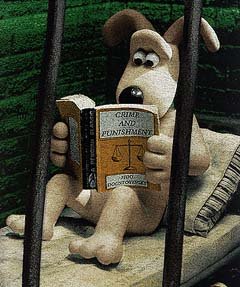
My friend who was having such a hard time with Dostoevsky (see here and here) has finished the book, and mellowed greatly in her appreciation of it. I guess it ‘got better’!

I asked her to share her thoughts with me, and she has given me permission to share them here. She does not think they are profound, but that was not what I was looking for. More, I wanted to get an honest human reaction to what is on the one hand a dark book with some gleaming points of real light. Feel free to interact with her!

My gut about Crime and Punishment is that it scares me how much I am like Raskolnikov (I didn’t really want to own up to it – that’s why you didn’t get a review of the book). I get annoyed at people; yet, I get truly carried away with how much I am irritated by something that they have done, and it takes on an almost inconceivable level of dislike where I rationalize why it’s okay for me to dislike and treat them as I do. He despises the pawnbroker, he despises the police inspectors, he despises everyone, and he doesn’t show them any charity (charity, meaning grace), in interacting with them. He thinks he has a right to hate and treat hatefully because of his superiority.

Sonia, on the other hand, is so full of love, and real unconditional love for everyone she meets. Dounia, too – their characters are almost copies of one another. She doesn’t judge, or hate, she just loves people. Her unfailing love practically drives him crazy because he knows he’s so vile and shouldn’t deserve it, but she never stops reaching out to him with Christ’s love. His pride is one of the things that makes him hate others – and he will not attempt to share in the identities of others. One of my favorite quotes is by a Balkan theologian Miroslav Volf (he wrote a lot about ethnic relations in the former Yugoslav republics), and it says, “We must have the will to give ourselves to others and welcome them by readjusting our identities to make space for them.” That’s kind of along the same lines as Philippians 2, which is also one of my favorite verses that I strive for but seldom achieve:

3 Do nothing out of selfish ambition or vain conceit, but in humility consider others better than yourselves. 4 Each of you should look not only to your own interests, but also to the interests of others. 5 Your attitude should be the same as that of Christ Jesus: 6 Who, being in very nature God, did not consider equality with God something to be grasped, 7 but made himself nothing, taking the very nature of a servant, being made in human likeness.

Sonia gave so much of herself to show love to others who were suffering – Raskolnikov on the other hand was conceited and set himself up as a demi-god, and didn’t consider the interests of others (although he curiously did have compassionate streaks that emerged). And Sonia in the end is a beautiful picture of how God chases us, and we run away, but if He wants us, we can’t hide.

And so, you see why I find this to be such a fascinating book. The one who gives this beautiful picture of God is a prostitute. Amazing.

[Note: the image is of Gromit reading Crime and Punishment by Fido Dogstoevsky in The Wrong Trousers.]

Abortion and the NAACP

This is an interesting op-ed piece from today’s Wall Street Journal. I’m more intrigued by what the piece says about Planned Parenthood than by what it says about the position of the NAACP.

Technorati Tags: ,

The Freedom to Love, part 2


There is a type of Wheaties box love at which we are all too skilled.

Those who get their pictures on the Wheaties box do so because they have performed well in some athletic venue. We fans pay close attention to these ‘heroes’ because of their performance, and we ‘adore’ them. We are good at it.

So good at it, that we transfer such performance based adoration to all other relationships. We love others when they perform well for us and meet our expectations. Our children hit home runs in little league or bring home a sterling report card or otherwise measure up to our standards, and we are all over them with favor. Our wives act according to the notions we have regarding what a wife is to do, whatever that might be, and we are quick with words of love and affection. And our churches or pastors do for us what we expect them to do, and we are their biggest champions.

Such love is easy, but fleeting and ultimately unfulfilling.

For pictures do not remain on the box forever, and those we ‘love’ will some day fail us. When the pictures fall off the Wheaties box, our adulation disappears. The child suddenly hears no words of encouragement, but only words of disappointment and scorn. The wife stops meeting her husband’s standards, and thus stops hearing from him endearing words (as he looks for another woman who will meet his standards). And the church becomes another disposable commodity, not a collection a relationships to be cherished and worked through.

So strange this should be true of us who claim to know something about the gospel of Jesus Christ. When Christ gave his life for us, our pictures were hanging elsewhere than on the Wheaties box. Yet he loved us. And he still does. Christ looks at us with a deep affection, sacrifice, and love that is unrelated to our performance. I fail him and his love for me never changes. For him it does not matter how well we perform, it does not matter where our picture is placed. He still loves us.

We need to see this deeply so that our love for others might be freed and transformed. Only then will we show genuine affection to our spouse or our children or our friends, an affection given not because they perform well for us or satisfy us, but because they are those we want to love. Period.

If we only love when our spouse or child or church is worthy of Wheaties box notice, we will never be freed to love out of reverence for Christ.

Technorati Tags: ,

Chicago

Barb and I had a wonderful week in Chicago. We are so grateful for the hospitality and kindness of our friends Bill and Karen Mills who hosted us on Monday and abandoned us downtown on Tuesday. We are grateful as well to the elders of HPC who carried on so well in my absence.

And we are especially grateful to our two daughters, Hannah and Jerusha, who in such a grown-up way gave us a great anniversary gift by caring for the house and for our seven year old Colin in our absence. You guys are tops!

You don’t want me to give a full report on our trip – that would be too tedious for all. However, two thoughts for which I invite your comments:

What we could give Chicago:

Grits. Would it be so difficult for a northern restaurant to whip up a pot of grits every morning for southern tourists? I just can’t comprehend a breakfast without the grits, and I grew up in Ohio!

What Chicago could give us:

Softball. Real softball. What the rest of the world plays is simply hardball with a big ball. In Chicago they play softball with a ball that is massive (16-inch circumference) and so soft that one does not need to play with gloves. Seemed like a great idea observed from a distance.

Our thanks to God for this great gift of time away.

(The photo, for those of you who do not know, was taken at Gino’s East, a famous Chicago deep-dish pizza place, where one is encouraged to leave graffiti! We did.)

Technorati Tags:

Devil in the White City

So far, I have ignored all your summer reading suggestions and headed down my own path. With my friend Mike 2/3 of the way through the Appalachian Trail, I picked up and nearly finished A Walk in the Woods by Bill Bryson.

But then I hit Chicago and had to begin reading, while there, The Devil in the White City. No doubt this one will trump all my other leisure reading for the summer. Part architectural and technological history, and part murder mystery, this one has it all. Has anyone else read it? Fascinating and freaky at the same time. Its subtitle is “Murder, Magic, and Madness at the Fair that Changed America”. Wow!

Technorati Tags:

Monkeying with RSS


We are back from Chicago, and I’m monkeying around with the way the RSS feed is handled, in order to get a better ‘handle’ on how well read this blog is. So, if you have no idea what I am talking about, you should click here. I think using RSS feeds is the best way to keep up on the blogs I read, so of course I think it makes sense for everyone else!

If you already subscribe using an RSS feed, and something messes that up, LET ME KNOW. I very well could have really bungled things here, and I’ll need to know so I can try to unbungle it. Thanks Like everything else in my life, I only marginally know what I am doing.

The Freedom to Love, a poetic turn


Consider this a poetic follow-up to my post on the necessity of loving others out of reverence for Christ, not out of concern for who they are or what they give to us. Oh to have the poet’s gift!

If thou must love me, let it be for naught
Except for love’s sake only. Do not say
“I love her for her smile—her look—her way
Of speaking gently–for a trick of thought
That falls in well with mine, and certes brought
A sense of pleasant ease on such a day”—
For these things in themselves, Beloved, may
Be changed, or change for thee—and love, so wrought,
May be unwrought so. Neither love me for
Thine own dear pity’s wiping my cheeks dry—
A creature might forget to weep, who bore
thy comfort long, and lose thy love thereby!
But love me for love’s sake, that evermore
Thou mayst love on, through love’s eternity.

Elizabeth Barrett Browning

These are words worth pondering.

Technorati Tags: ,

The Freedom to Love, part 1


The marriage of a man and a woman is the uniting of two very different people. They may not be able at that moment to see their differences, but those will soon become painfully visible.

Similarly, when two or three or more people unite together in a church, this is a union of very different people. They may share many things in common, but they are in the end very different. That, too, soon becomes obvious.

The question is, how do people who are so different from one another successfully love one another?

I would not want to over simplify what is in reality a very complicated matter. But several ideas have been in my head recently, and they all seem in one way or another to lead back to Ephesians 5:21:

“…submitting to one another out of reverence for Christ.”

This verse precedes Paul’s instruction to married couples, but it is seminal for all relationships. We submit to or serve one another not because of the worth of the other and not because of what the other brings to us. We serve, love, submit to one another, because we desire in this to honor Christ.

If I love another because of the worth in him, then I may be inclined to stop loving him when his worth changes. If, for example, I show love to my wife because she is pretty or perky or pious, then should any of those things change, my love for her will change.

If on the other hand, I love another for what he brings to me, then when he stops performing or producing, my love changes. Women will look to their husbands with this ideal concept of the income they will supply. But when the husband does not produce what the wife expects, she disrespects him and derides him.

We are to love not for the worth in the other (which may be great or, to our eyes, small) or for what we gain from the other (which may be substantive, or not so much). We are to love ‘out of reverence for Christ’ – that is, out of service to Jesus.

Each Christian has been loved fully and completely and undeservedly by Christ. We have been served by one to whom we can give nothing in return. Our inner worth deserved condemnation, not submission. But Christ has shown us the model of love.

And when we can begin to see that we are to love the others in our lives in service to him, then we will be freed to love.

Technorati Tags: ,

Page 128 of 142

Powered by WordPress & Theme by Anders Norén