And we were there – again.
To see pictures from our fun at the Trop, check out this album. I’m proud I figured out how to do this! (I think all you need to do is to click on the picture below.)
 |
| ALDS – 2008 |

And we were there – again.
To see pictures from our fun at the Trop, check out this album. I’m proud I figured out how to do this! (I think all you need to do is to click on the picture below.)
|
| ALDS – 2008 |
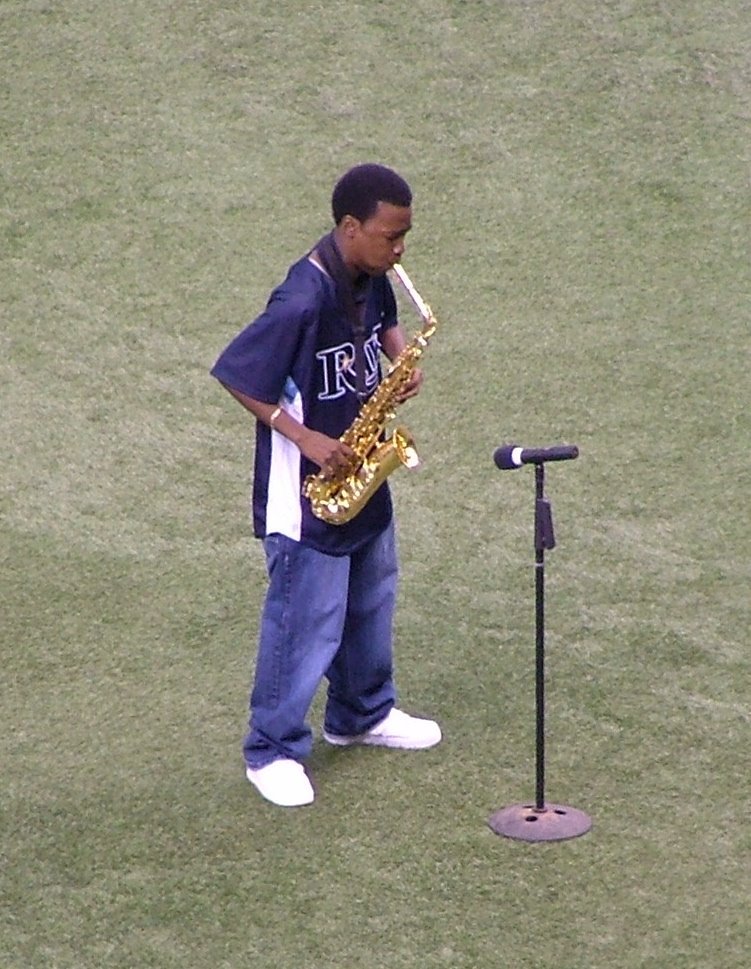
Normally I am impressed by the performance of the national anthem before ball games, but not moved. Yesterday was different. The song was performed by a 17 year old local jazz saxophonist and before it was over, I had chills. This kid was amazing. Here he is doing it at a game earlier in the season.
Apparently I was not the only one moved. Here is what Rays outfielder Carl Crawford had to say about it:
“It didn’t hit us until we actually got out on the field and saw the crowd, heard the screaming and hollering, hit the national anthem. You know the little saxophone kid killed it and that really just put us over the top. So our emotions were flowing everywhere. And now we’re in the dugout and can’t sit down. And it went from there.”
Technorati Tags: Baseball
A quick report is due on the first game of the American League Division Series between the Rays and the White Sox, a game which the Rays fortunately won. Attending was exciting and fun and left me with several enduring impressions.
First, there is a phenomenal camaraderie formed between complete strangers in situations like this. We all acted like we’d known each other since middle school. At one point, I’m high fiving the lady next to me and bumping fists with the guy in front. Our friend Keith is not a touchy feely guy, but the drunk, I mean fan, next to him hugged him after a home run. Pretty interesting.
Secondly, in the needle-in-a-haystack department, we were blessed before the game to have a friend and church member Hannah descend from the seats above us to say “hi”. She had spotted me coming back with two $4 sips of Pepsi, and rushed down to see us. (Weren’t you supposed to be in class, Hannah?) Later, between innings, I ran into a fellow pastor and friend Dave Harding. It is no surprise that I would KNOW two people out of the 35,000 plus in attendance. But that I would see them? That’s odd.
Thirdly, if there was any debate remaining about Evan Longoria deserving rookie of the year, he crushed any doubt with his first two at bats.
I have a fourth impression, but that deserves a post of its own.
Right now, we are celebrating that the Tampa Bay Rays are the only team in major league history to be undefeated in every one of their post season games.
Technorati Tags: Baseball
The Rays clearly saw that for an organization to improve, it is not sufficient to further strengthen strengths. It is important rather to know the weaknesses, and astutely allocate resources to address the weaknesses. That is what they did. And they have been remarkably successful
I mentioned earlier that church growth, while clearly a work of God, requires that the leaders, as good farmers, become astute in the factors that produce the best environment for growth. Growth is the work of God, but we are called to understand and address those principles which are characteristic of a healthy body, into which God builds growth.
This is really what the Rays have done, identifying what is necessary for success – pitching, fielding, teamwork, clubhouse chemistry, etc. – and addressing the areas where they were the weakest. When we can see our weaknesses (a painful thing) we are in the best position to grow beyond where we are. Progress in the weakest area may cue significant change in the whole.
In baseball, identifying the attributes which contribute to success is fairly easy. Finding the personnel to improve those areas is not. In the church, identifying the principles which provide the environment for growth is hard, and admitting our weakness in those areas can be tough. But God provides the gifted people through whom to build on the weaknesses.
The good news is that small steps in the weakest area can have a significant impact.
The Rays are not perfect in every area. They still have weak spots and areas for growth. We cannot as a church expect to perfect every aspect of church life. But we can, if we have the heart to do so, compare our ministries to those factors which encourage growth. Small improvement at the point of weakness can significantly improve the whole.
You see then the question around which I am dancing. What factors which must be present for a church to be healthy? If there are, say, ten key factors which every church must evidence, what are they? Knowing what they are can provide the assessment grid with which we can assess the areas in any church which need the greatest attention.
So, what are those factors? I’m all ears.

Some of you may be hoping to see the baseball season come to an end so that I will just stop obsessing about it. I can only ask that you bear with me. I confess to the obsessive part of this.
I began yesterday to ponder why the Rays have been successful, suggesting the strange thesis that the church can learn something from them. So first, why the Rays success?
I’m no expert and I’ve not played baseball since little league. But there are some obvious things that can be noted. Clearly they did not improve by following the lead of their rivals, spending bunches of money on big name hitters and pitchers. (Funny to me how in small churches we assume that growth depends upon being able to act like the bigger, wealthier churches. I don’t think that is the case. But I get ahead of myself.)
Rather In looking at the stats, some trends emerge. First, the stats reveal that the change did NOT occur in their offense. Here is how they finished the year statistically in hitting (out of 14 AL teams):
Curiously, these statistics are not very different from those posted in 2007. The Rays offense is average, as it was last year. Growth is not dependent upon an organization, like a church, perfecting every aspect of its ministry. The Rays do not excel in hitting, as some churches do not excel in preaching or worship or depth of relationships. But their hitting is not sick either. It is good, just not great.
Where the change for the Rays has occurred is in defense and pitching. Hear is where they finished in 2008.
In each of these categories in 2007 they were 14th. Dead last.
The same trend can be seen in their defensive stats (though I don’t have a clue how these are calculated):
Again, in 2007, the Rays were 13th in fielding percentage and 14th in defensive efficiency. The improvement is startling.
Even in spite of these particular numbers, in most other statistical categories, they are in the middle of the pack. The important revelation is that they are at the bottom of NO category except losses.
What has made the difference for the Rays is that they looked for those areas where they were weakest, and strengthened those areas. They did not need to become perfect in every area. Their improvement began by their addressing the missing aspects to their team health.
I think it is important to note that their dramatic return, from worst to first, is unusual, and is not something to be expected in any organization. But one could say that had they simply improved their fielding and pitching from 14th to, say, 8th, they could have had a mid pack, perhaps .500 season, and we’d still be happy.
And I think it is reasonable to suggest that an organization, say, a church in seeking to know how it might strengthen its ministry does not need to perfect that which it does well. A small church will not have the resources to do so. But what a church rather needs to do is to examine the neglected areas.
More to come….

In the car yesterday, I heard an Obama campaign spot stating that John McCain has ‘stood in the way’ of stem cell research. The ad was set in such a way that it implied, of course, that McCain did not care if little girls were afflicted with diabetes. Cruel hearted man.
The fact is that the ad was a lie. And researching that led me to a very helpful resource: FactCheck.org. Think Consumer Reports analyzing the claims of political candidates, and you get the picture.
As to the stem cell question, this issue is at the top of this web site. Here you can hear the audio of the spot and then read what the candidate’s stated positions actually are.
In fairness, we should note that McCain-Palin takes it on the chin as well.
Amazing – a source for actual reality without spin. Very helpful. Useful for political cynics of whatever persuasion.
Technorati Tags: Politics

On the eve of the Tampa Bay Rays first ever playoff game (at which I. Barb, and two friends will be seated in section 309, Row C, seats 9-12 – look for us!) it seemed appropriate to begin to share some thoughts which were stimulated by the Rays’ success (along with some books I’ve been reading – more on that later).
My thoughts will be posted over several days and the conclusion is that there are fascinating realities revealed by the success of the Rays which can inform how we think about the health and growth of a church.
I’m serious, so stop laughing!
First, the history.
Here is a team that has never had a winning season, sporting last year the worst won-lost record in all of baseball. That they would lose baseball games and end up last is what we all expected of them. When a church assumes such an expectation regarding its own contribution to the kingdom, it is deadly to the life and health and happiness of the church. It is easy, though, for small churches to embrace such negative expectations.
This year, to the surprise of most everyone, the former worst team in baseball has the second best record in the American league. They won the AL Eastern Division, the toughest division in baseball, winning 97 games, one more than they lost last year. They hold this record despite an AL second-lowest payroll of $45 million (1/5 the payroll of the Yankees and 1/3 that of the Red Sox, teams against whom they compete in the AL East).
I’ve pondered how this turn around has occurred. I alluded to one reason yesterday, but that is not all.
I wonder, baseball geeks, what you think has contributed to the Rays sudden success? I’ll tip my hand tomorrow.

A couple days ago, I was sitting near the manager of my most frequented Starbucks as she began to orient a brand new employee to her store. She began to talk to her about the ‘culture of Starbucks’.
I spoke with this manager yesterday about that, because it is true that what makes Starbucks is a certain culture, a certain attitude of shared commitments and attitudes of the employees. They seem to like working there, and the pleasure they take passes on to the customer.
The culture of a place in this sense are the shared attitudes and values and commitments that give to the thing its personality. And the culture of a place is something often unspoken and unexamined, but which is quickly picked up by those who come in contact with that place.
There is a culture which Starbucks seeks to cultivate.
 There apparently is a unique culture to the Tampa Bay Rays, and this unique culture has contributed to their winning ways. I am planning a longer post on why they are winning, but this article says a lot about what has made them successful. Joe Maddon, the manager, has built a culture there where guys respect and love one another, and have a freedom to be who they are regardless of their accomplishments. Amazing.
There is a culture at Starbucks, with the Rays, And there is a culture in churches. It can be free, or stifling. It can be grim or it can be joyful. And whatever that culture is, people pick up on it and respond to it.
The church I pastor has undergone some changes in recent years. One might see those as cosmetic changes – different instruments, different schedule, whatever. But at heart has been a desire to change the culture of the church. That will have far more effect upon the effectiveness of a church than we might imagine.
What Carlos Pena says about the Rays should be said about the church, don’t you think?
“Everyone here feels comfortable, free to be themselves,” Peña said. “They’re respected. They are very appreciated. To come out and feel you’re at home when you walk through the door makes a huge difference as opposed of coming in and you’re like, ‘I feel out of place here. I can’t really talk. I got to watch what I say. I got to make sure I do this right.’ That’s not cool. That’s not the way it’s supposed to be.”
I’d like to be in a church like that!
So I’m curious: what do you see as important in the ‘culture’ of a church?
Technorati Tags: Church
Within my circle of friends and loved ones is one who has the ability to say things which at first sound ridiculous, possessing that quality that makes hearers think, “I can’t believe she just said that.” Upon any serious reflection we find that what she has spoken without reserve what the rest of us hold deeply covered in our heart.
The classic for this was uttered a couple of years ago. She said, with all sincerity:
“I’m not prejudice toward those that matter.”
Yes, of course it is contradictory. But it sheds light on a dark truth of my own heart, if I think about it.
And then yesterday, she said this:
“I don’t mind rules, as long as they don’t keep me from doing what I want to do.”
Yes, of course, that is the problem with rules, isn’t it. She may be more astute than we give her credit for.
Technorati Tags: Christian Life

The Shack by William Young has been this year’s Prayer of Jabez. It is showing up everywhere, and some otherwise rational folk have made the astounding comparison of this book to Pilgrim’s Progress. Whoa, there, Sally. That’s a bit of a tall order.
Others, however, have pretty much concluded that the thing wafted up on an updraft from Hell.
So, anything generating such conflicting reviews and such popularity (#1 seller at Amazon.com) demands some attention. Fortunately, HPC’s associate pastor Geoff Henderson has read it and posted his thoughts.
You can read his review here.
Technorati Tags: Books
Powered by WordPress & Theme by Anders Norén