Randy Greenwald

Concerning Life as It Is Supposed to Be

Site updated

Thanks to all of you who so kindly expressed your opinion about a format change for this blog. I was fascinated by the comments about how certain colors better fit the blog’s title ‘Somber and Dull’. It’s as if some forget that the title is meant to be, uh, ironic. But more on that later.

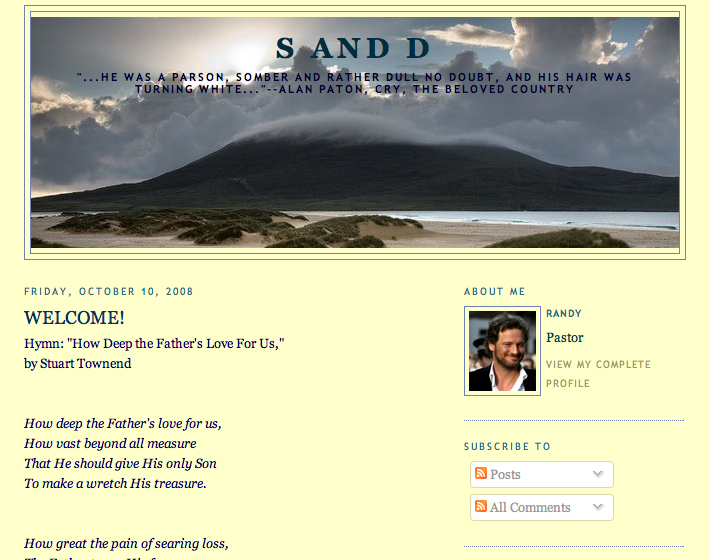
Fiona kindly invested some time in showing me what could be done with one of the formats, in terms of color and such – things I did not know were possible. Her sample is pictured here. (Thank you, Fiona. Where’d you find that picture of me?) So, taking her lead, I’ve modified one of the provided templates.

I hope you all like it. If it is hard to read, please let me know!

And, I hope the colors are somber and dull enough for you.

I had to stay up and watch the Phillies – Dodgers game to get this done. But, hey, some sacrifices just have to be made.

Geoff Hits a Home Run


Geoff Henderson, the associate pastor of Hope Presbyterian Church, has had a good season at the plate. He has consistently hit the ball out of the infield, often for extra bases.

But with his recent blog series on nostalgia (here and here), he has hit a home run. Very insightful.

Geoff submitted an article based upon the same themes to the local newspaper for publication, and it was published yesterday, but in a severely edited form. You can download the full, unedited article here.

Good work, Geoff!

[PS for Geoff, if you read this, well, about the picture – I couldn’t resist!]

Heaviness and Heaven

Now and then we forget that our forefathers in various ways referred to this life as a veil of tears. I suppose they forgot to take the positive thinking seminar when it was in town. Or perhaps they were observant and therefore honest men and women who saw and sympathized with the sorrows around them.

Recently I’ve been accosted to the point of numbness with reports of struggle and sorrow, of death and alienation, of marital struggle and parental pain. There is a heaviness about into which I’d like a saint from old to speak.

Most of those who call themselves Calvinist have never read a thing by John Calvin. That’s a shame. When they do, they discover not a man who is polemically committed to a ‘floral’ theological system, though committed he is. They rather find a man who is passionate about helping others grasp a big picture of God so that their weak knees might be strengthened and their hope lifted up.

He is a great friend to have nearby. You really should come to know him.

May these words bring encouragement to you, and may they, perhaps, as well, encourage you to read Calvin on your own. The numerical references refer to the book/chapter/section of The Institutes of the Christian Religion in which they are found.

*****

‘For whomever the Lord has adopted and deemed worthy of his fellowship ought to prepare themselves for a hard, toilsome, and unquiet life, crammed with very many and various kinds of evil. It is the Heavenly Father’s will thus to exercise them so as to put his own children to a definite test.’ [3.8.1]

*****

“…the Lord instructs his followers in the vanity of the present life by continual proof of its miseries. Therefore, that they may not promise themselves a deep and secure peace in it, he permits them often to be troubled and plagued either with wars or tumults, or robberies, or other injuries. That they may not pant with too great eagerness after fleeting and transient riches, or repose in those which they possess, he sometimes by exile, sometimes by barrenness of the earth, sometimes by fire, sometimes by other means, reduces them to poverty, or at least confines them to a moderate station. That they may not too complacently take delight in the goods of marriage, he either causes them to be troubled by the depravity of their wives or humbles them by evil offspring, or afflicts them with bereavement. But if, in all these matters, he is more indulgent toward them, yet, that they may not either be puffed up with vainglory or exult in self-assurance, he sets before their eyes, through diseases, and perils, how unstable and fleeting are all the goods that are subject to mortality.

”Then only do we rightly advance by the discipline of the cross, when we learn that this life, judged in itself, is troubled, turbulent, unhappy in countless ways, and in no respect clearly happy; that all those things which are judged to be its goods are uncertain, fleeting, vain, and vitiated by many intermingled evils. From this, at the same time, we conclude that in this life we are to seek and hope for nothing but struggle; when we think of our crown, we are to raise our eyes to heaven. For this we must believe: that the mind is never seriously aroused to desire and ponder the life to come unless it be previously imbued with contempt for the present life.“ [3.9.1]

*****

”…that no one has made progress in the school of Christ who does not joyfully await the day of death and final resurrection. Let us then, take hold of a sounder view, and even though the blind and stupid desire of the flesh resists, let us not hesitate to await the Lord’s coming, not only with longing, but also with groaning and sighs, as the happiest thing of all. He will come to us as Redeemer, and rescuing us from this boundless abyss of all evils and miseries, he will lead us into that blessed inheritance of his life and glory.“ [3.9.5]

Calvin of Geneva, of course, had learned much from Saul of Tarsus:

”For the grace of God has appeared for the salvation of all men, training us to renounce irreligion and worldly passions, and to live sober, upright, and godly lives in this world, awaiting our blessed hope, the appearing of the glory of our great God and Savior Jesus Christ, who gave himself for us to redeem us from all iniquity and to purify for himself a people of his own who are zealous for good deeds.“ (Titus 2:11-14)

Technorati Tags: ,

Sunday Preparation


Satan loves to have our hearts distracted when we go to worship, and he delights in our demeaning of the value of the preached Word. There is a battle in our hearts to treat the Word as that which is more valuable than rubies. The Puritan preacher and scholar Thomas Watson new that battle, and challenges us to look with seriousness upon that treasure which is the Word preached. Says Watson,

“Do we prize it [the preached Word] in our judgments? Do we receive in into our hearts? Do we fear the loss of the Word preached more than the loss of peace and trade? Is it the removal of the ark that troubles us? Again, do we attend to the Word with reverential devotion? When the judge is giving the charge on the bench, all attend. When the Word is preached, the great God is giving us his charge. Do we listen to it as to a matter of life and death? This is a good sign that we love the Word.

I trust that these sentiments will soften our hearts as we prepare to hear the Word this Lord’s day.

———-

I’m sorry that I can’t reference the exact source of that quote. It was sent to me from a good friend in Toronto who picked it up from this on-line source. If anyone knows its actual source in Watson’s writings, I’d love to know.

Technorati Tags:

Vote for a New Layout

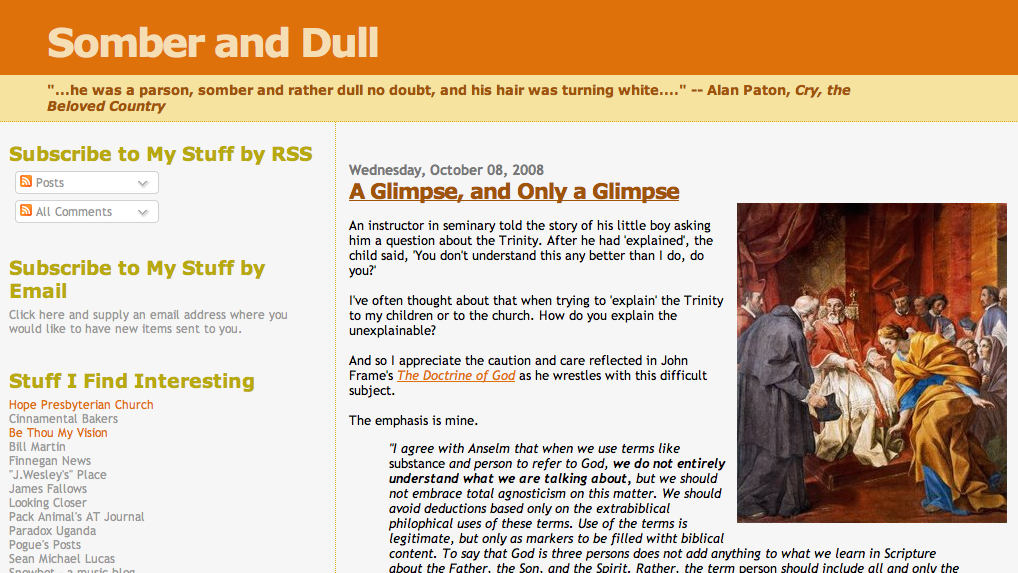
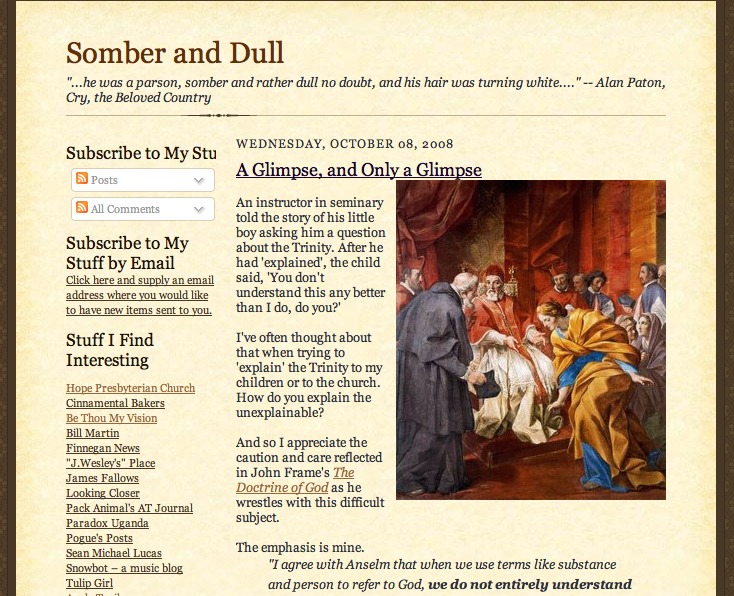
I chose the title and layout for this blog some time back when I was just playing around and not sure I even wanted to blog. The more now that I stare at the orange banner, the more I want to change.

I’m limited, I think, to the standard layout templates Blogger provides, so mine will still look like a kazillion others out there. But within those confines I’ve chosen several to preview. I need your input. Check out each of the previews below, and vote for the one you prefer I use.

Feel free to tell me to ditch all four and go back to the drawing board, if that is your opinion.

The polls are now open…

Thanks!

#1 (the current configuration)

#2

#3

#4

Paris, je t’aime


One of my absolute favorite movies which I’ve seen ever, and one which bears watching over and over again is Paris, je t’aime.

Eighteen gifted and experienced filmmakers create 18 shorts all set in differing regions of Paris and all bearing the theme of love. Some are sweet, some are puzzling, but the whole is well worth watching.

The clip I am linking here is a must see. It paints a picture that is a sermon I want to preach to any man or woman who decides that he or she is no longer in love.

Enjoy it, and then rent or buy the whole movie, sit with someone you love, watch it and let me know what you think. You will laugh and you may cry, but every minute will be worth your time.

UPDATE: Just noted – I’ve not seen Prince Caspian, waiting rather to rent it, but those who have will recognize the husband in this piece, Sergio Castellitto, as King Miraz from that film.

Technorati Tags: ,

A Glimpse, and Only a Glimpse


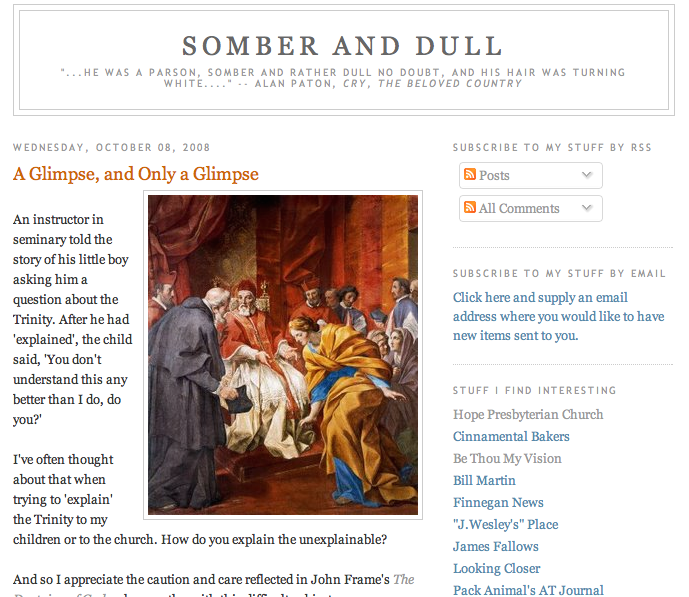
An instructor in seminary told the story of his little boy asking him a question about the Trinity. After he had ‘explained’, the child said, ‘You don’t understand this any better than I do, do you?’

I’ve often thought about that when trying to ‘explain’ the Trinity to my children or to the church. How do you explain the unexplainable?

And so I appreciate the caution and care reflected in John Frame’s The Doctrine of God as he wrestles with this difficult subject.

The emphasis is mine.

“I agree with Anselm that when we use terms like substance and person to refer to God, we do not entirely understand what we are talking about, but we should not embrace total agnosticism on this matter. We should avoid deductions based only on the extrabiblical philophical uses of these terms. Use of the terms is legitimate, but only as markers to be filled witht biblical content. To say that God is three persons does not add anything to what we learn in Scripture about the Father, the Son, and the Spirit. Rather, the term person should include all and only the content of the biblical teachings. Person is simply a label for the ways in which the Father, the Son, and the Spirit are alike, in distinction from the Godhead as a whole.” – page 699

“Again, we must acknowledge our ignorance of the precise distinction between substance and person in God and of the precise interactions between these. God has given us, in Scripture, a glimpse into his inner life, but only a glimpse. The Trinity is not an irrational doctrine, but it is highly mysterious. It is not contradictory, but we do not always see clearly how apparent contradictions can be resuloved.” – page 705

Technorati Tags:

My ‘Post’ Office

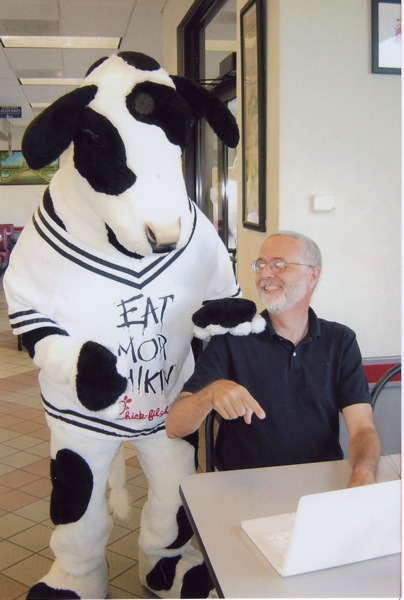
So, you wonder where I write up posts for this blog? Where I find my inspiration? The picture tells all.

Here I am getting some advice from an expert.

Why the Rays Won and What the Church Can Learn, Part 5


What Schwarz is attempting to measure and to analyze is church health, the quality of the church’s life and ministry, with the assumption that churches which function at a certain level of quality in his perceived eight areas have a better chance of seeing growth. He contends that a church does not have to excel in these eight areas, but all eight realities need to be in place for a church to grow.

Obviously, to me, there may be other principles he’s overlooked, or he may be focusing on those which are of no consequence. But the idea that church quality is to be assessed based upon more than a spiffy worship service or a proliferation of programs is somewhat refreshing and encouraging.

I appreciate his insistence that we not simply look at how other churches (teams!) operate and assume we can operate the same way that they do – or did. We look at large churches across town or churches with a national reputation – or we look at the church of our childhood or the one in the town we were saved in – and we isolate one thing about that church and figure that if we do that one thing we will grow. That is a fallacy.

His view is much more organic and situation specific. He says we need to look at our setting and evaluate ourselves upon the measure of these eight items. Progress can be made if we simply identify the weak point in our ministry and shore it up, without making any changes anywhere else.

His criteria of essential elements for health and quality are perhaps valid, perhaps not. But they can serve at least as a helpful place to begin, as we look at our own ministries. This analysis can help us perhaps find the area of the greatest need and begin to address it with the goal that our church might function as a greater organic whole, and be more effective in her ministry for the things to which God has called us.

Technorati Tags: ,

Why the Rays Won and What the Church Can Learn, Part 4


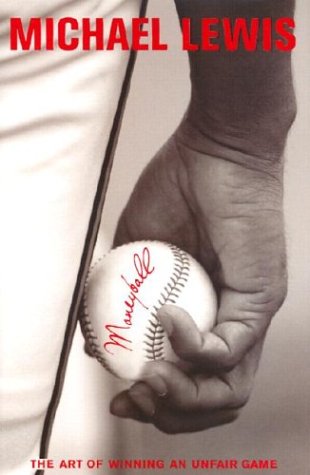
Two books lie behind my recent posts on the Rays and church growth (here, here, and here). They are wildly different. The first is a book on how major league teams in underfunded markets have succeeded called Moneyball, from which I have quoted before.

The second is one called Natural Church Development. The thesis of this book is what tied together for me the similarities between baseball success and church growth.

NCD is a book by a church analyst named Christian Schwarz. I’m not sure how widely the book has been read, but apart from some quibbles, I found the book helpful. Like Moneyball with baseball, this author wants to question commonly received assumptions about what makes churches grow in order to look beneath the surface to see the actual principles at work which contribute to real growth.

The author here is a bit tedious, and one must always be suspect of statistical analysis, upon which he depends heavily. It must be more difficult to statistically analyze, say, dynamic spirituality than it is to measure baseball’s on-base-percentage. And it seems to me that the author’s starting point is not the Bible per se but his own intuition. He seems to me to draw in the Bible and theology almost tangentially, but certainly not as his starting point.

He dispels the common idea that if we just did THIS ONE THING our woes would pass (whether it is change our worship, change our pastor, change our evangelism, or whatever). The church is an organic whole of many functioning parts all of which need to be functioning in some way in order for growth to occur.

The eight principles that must be functioning in any healthy congregation, according to Schwarz, are as follows. I am curious if you would add/subract any.

1. On-base-percentage
2. Walks/hits allowed per inning pitched
3.

oops… wrong list. Ahem:

1. Empowered leadership
2. Gift oriented ministry
3. Passionate spirituality
4. Functional structures
5. Inspiring worship services
6. Holistic small groups
7. Need-oriented evangelism
8. Loving relationships

Technorati Tags: ,

Page 119 of 142

Powered by WordPress & Theme by Anders Norén