Randy Greenwald

Concerning Life as It Is Supposed to Be

Bracket Update


When the dust settled after the second round, I didn’t do too badly in my picks. Of the sixteen teams still standing, I picked thirteen. That’s pretty good for me, who does no research and merely guesses. That was why (blush) I had Clemson playing Cinderella and making it to the Sweet Sixteen. I don’t think I can be faulted too badly, though, for expecting Illinois and West Virginia to make it further than they did.

At least my beloved Spartans are still in it. If anything stands them in a good position it is the depth of their bench. GO GREEN!

Jesus and our Message and Practice

“Jesus’s teaching consistently attracted the irreligious while offending the Bible-believing, religious people of his day. However, in the main, our churches today do not have this effect. The kind of outsiders Jesus attracted are not attracted to contemporary churches, even our most avant-garde ones. We tend to draw conservative, buttoned-down, moralistic people. The licentious and liberated or the broken and marginal avoid church. That can only mean one thing. If the preaching of our ministers and the practice of our parishioners do not have the same effect on people that Jesus had, then we must not be declaring the same message that Jesus did. If our churches aren’t appealing to younger brothers, they must be more full of elder brothers than we’d like to think.”

Tim Keller, The Prodigal God, pages 16-16

The Most Unfortunate Boy That Ever Lived


The following, offered without comment, comes from C. S. Lewis, The Horse and His Boy.

“I do think, ” said Shasta, “that I must be the most unfortunate boy that ever lived in the whole world. Everything goes right for everyone except me. Those Narnian lords and ladies got safe away from Tashbaan; I was left behind. Aravis and Bree and Hwin are all as snug as anything with that old Hermit; of course I was the one who was sent on. King Lune and his people must have got safely into the castle and shut the gates long before Rabadash arrived, but I get left out.”

And being very tired and having nothing inside him, he felt so sorry for himself that the tears rolled down his cheeks.

What put a stop to all this was a sudden fright. Shasta discovered that someone or somebody was walking beside him.

“Who are you?” he said, scarcely above a whisper.

“One who has waited long for you to speak,” said the Thing. Its voice was not loud, but very large and deep.

“Who are you?” asked Shasta.

“Myself,” said the Voice, very deep and low so that the earth shook; and again “Myself,” loud and clear and gay; and then the third time “Myself,” whispered so softly you could hardly hear it, and yet it seemed to come from all round you as if the leaves rustled with it.

Shasta was no longer afraid that the Voice belonged to something that would eat him, nor that it was the voice of a ghost. But a new and different sort of trembling came over him. Yet he felt glad too.

Wrecked Bracket

Ah, March. Gentle breezes, new life, departing snow birds, and basketball.

I should report that officially, one half way into the first round, my bracket is wrecked. Among other surprises, which Big Ten team does anyone expect to win its first round match – Illinois or Michigan? I got that one backwards.

Maybe I’ll do better today, but I’m sure glad that no wagers were riding on this.

For the record, I was 10-6 on the first day. Pretty poor. Anyone do worse?

In a long post about what is really important, Jeffrey Overstreet raises some very good questions. This one line, for us information freaks, is quite convicting:

Confession: I know more about the upcoming Wolverine movie than I do about what’s going on in my brother’s life right now. How sad is that?

The Value of a Team


There is a further thought that arises from yesterday’s accounting of the conflict between Paul Hume and President Truman.

For the bulk of his seven plus years in office, Harry Truman had the same press secretary. This man, Charlie Ross, had been a childhood friend of Truman’s, and had become a respected reporter for the St. Louis Post-Dispatch. The importance of this appointment went beyond the ability of the man to handle the press. He was also able to handle Truman.

Just a few days before this controversy broke, Charlie Ross died in his chair at the White House from a sudden and massive heart attack. He was 65 years old.

Those who knew the relationship between Ross and Truman suspect this: that if Ross had been alive, the moment he saw Hume’s review of Margaret’s performance, he would have known what Truman’s response would be. He would have intervened and the letter would never have left the White House. He would have been able to have calmed Truman and brought sense to the matter.

In other words, Charlie Ross made Harry Truman a better man. That is a truism. Others make us better. In fact, to be all that we are capable of being demands having the right people around us.

Over the years, God has brought people into my life who have made me a better man. They are not the ones who agree with me necessarily. But they are the ones who know me, who stand with me, and when necessary, those who correct me.

Few men have all the gifts necessary for doing all that is expected of them. I know this is true in pastoral ministry. The greatest blessing for anyone in ministry is to be a part of a team of people who complement one another, who make each other stronger, and who can then be so much more useful for the kingdom.

(This is, by the way, the strongest argument for multi-staff ministry where that can be accomplished.)

Vision beyond Emotion


In David McCullough’s biography of Harry Truman, there is an intriguing minor character named Paul Hume.

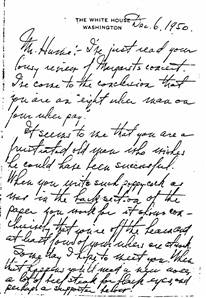
Hume was a music critic for the Washington Post during Truman’s White House years. Truman’s daughter, Margaret, was an aspiring singer.

Margaret Truman’s career took off not because of her vocal gifts but because of the novelty of being the president’s daughter. Reviews tended to be soft and reserved out of respect for that relationship.

Generally, that was true. But then there were the honest ones.

During Truman’s second term, Margaret performed in Washington to an audience consisting of her parents, the British Prime Minister, and 3500 others. Afterward, some gave the performance its expected praises. Author John Hersey remarked privately, however, that “she was really pretty bad that night”.

Paul Hume said so publicly. After speaking positively of her stage presence and her personality, Hume said, “Yet Miss Truman cannot sing very well.”

Miss Truman’s father responded in a very un-presidential way, writing a scathing letter the next day after reading Hume’s review. Among other ‘pleasantries’, Truman said, “Some day I hope to meet you. When that happens you’ll need a new nose, a lot of beefsteak for black eyes, and perhaps a supporter below!”

This created quite a controversy and was in the end an embarrassment to the president. But this is not what intrigues me.

Shortly thereafter Truman took a huge political risk and recalled General Douglas MacArthur from Korea. MacArthur’s popularity was very high, and this move, while history has shown it was warranted, was universally criticized when it happened. Few, very few, people in the country supported Truman. But among those was Paul Hume who sent to the president a letter expressing his support.

To be able to speak clearly and honestly without being swayed by admiration or disdain for the person is an admirable trait. It is the ability to have clear vision in spite of emotion. I’m impressed by Mr. Hume.

Years later, Hume was in Kansas City to review a concert of Maria Callas, and decided to drive out to see the newly established Truman library in Independence, Missouri. Truman was there, and seems to have forgotten all the bodily harm he had once pledge to deliver. Hume reported that the two had a wonderful visit.

My heart yearns for reconciliation among men. Our emotion too easily clouds our vision. That’s sad. I’m touched by the model of Mr. Hume.


Being Missional

Geoff and I continue to write articles for the local newspaper, articles we assume are read mostly by a church-attending population, which dictates our approach. This was my month. What I say in this article is nothing new to those of you who hang around HPC, but it is, I trust, important.

Photoshop Thinnification

I’ve occasionally railed against Barbie Dolls because of what they do to girls’, ordinary girls’, self acceptance.

Not it appears that it is Photoshop that is the culprit in many a false image.

Sara Zarr is an author of young adult fiction, and I appreciate her candor and courage in this post about a photo shoot for her third novel. It’s a fascinating account, to me. But more importantly I appreciate her willingness to admit the struggle involved in looking good, maintaining good health, and accepting ourselves as God made us.

She says,

I am just really tired of and sad about my friends and random women and girls being so unhappy with themselves because they don’t look like women they see in magazines, who are uber-retouched, limbs lengthened, flesh carved away, etc. And tired of men thinking that’s how women look.

There is a bit of language here. But, hey – she was a bit upset.

Calvinism Is Hip Again

Time Magazine sees Calvinism as a <gasp> culture shaping movement. Wow!

This is actually quite a good summary.

Page 103 of 142

Powered by WordPress & Theme by Anders Norén