Randy Greenwald

Concerning Life as It Is Supposed to Be

New Header

(We have been requested to post the following warning.)

WARNING: DO NOT READ UNLESS YOU’VE HAD BREAKFAST!

+ + + + +

I’ve been hungrily changing header pictures recently taken from pictures of the Cinnamental cinnamon and pecan sticky buns. The newest one is from a new format of the cinnamon roll which is half the size of the traditional bun. Here’s the whole bun, for those of you (mostly family) who are interested in the evolution of the Cinnamental bun:


NOTE: Clicking on the picture may have some ‘enlarging’ results.

Get Local Culture – Friday and Saturday

This Friday and Saturday night, Hope Church in Bradenton, the church I pastor, will metamorphose into an art gallery and coffee house. We’ve done this for four straight years, and each year it gets bigger and improves.

Our heart here is to build bridges into the community by providing a venue for local artists and musicians to display their work. A number of local artists and local musicians will be displaying their art and performing their music in a coffee house atmosphere that we think is absolutely unique in the Manatee / Sarasota County community.

Here is our flyer for the event (click for a larger image):


We guarantee that the quality of what is displayed and performed will be top notch. Since TulipGirl has listed links to some of the artists and musicians, I will direct you there for more info.

This is not a strictly ‘Christian’ event. Some of the art is by artists who are Christians, and some of the music, but not exclusively so. Our desire here is to simply say to artists of all stripes that we care about what they do and to provide them a venue to display and play.

That’s where you come in. You can help show your appreciation for local art and music by coming. The atmosphere will be relaxed. Come, sit on a couch, stroll among the art, listen to the music, sip on some Starbucks Coffee (graciously provided by our nearby SB), and snack on some fine pastries. It’s a great date night.

We (and the artists/musicians) would love to see you both nights.

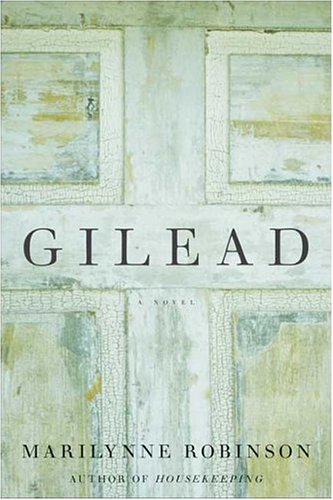
Gilead

I am not a novelist and imagine being so in only the briefest of delusional fantasies. However, those who write say that one writes best about what one knows best. So, Marjorie Kinnan Rawlings set The Yearling in the central Florida setting of her childhood. Success, acclaim, and the Pulitzer Prize followed.

So if I were to write some kind of novel, what do I know best? I’ve been a pastor for 23+ years. I suppose the story would have to center on a pastor’s life, but how would one make such a story captivating?

I don’t have to worry about it. The book has already been written, by a woman, by one who has never been a pastor, by one whose father was not a pastor, but by one who has so inhabited a pastor’s skin that this pastor was captivated.

I’m speaking of a novel called Gilead, written by Marilynne Robinson, which was published in 2004 and received not only the Pulitzer Prize but also the deep affection of readers from diverse backgrounds.

It is the story of family and pastoral life in small town Iowa from the time of the civil war to the mid-1950s. However, it is not the plot which dominates, as it might be in many novels. The story is told through a series of letters written from an aged pastor to his seven year old son, a son born to him late in life, a son he knows he will never get to see into adulthood. And so we eavesdrop as he tells family stories and shares reflections and thoughts with his son as he would expect a father to do, but which he knows he will not be able to do. We hear him struggle to come to grips with apostasy, suffering, family division, and the prospect of death and the hope of heaven.

Rare is the cultural product which paints pastors sympathetically, but that is what Robinson has given us here. John Ames is a man of character and devotion. He is a man who struggles with what he should think and how he should respond to others. And when he struggles, he prays. He is a man whose beliefs are sincere and deep and whose love for others is genuine and not feigned. Time and again in reading the book I felt that this woman had spent time in my head listening to my thoughts and puzzlements and exultations. And in her writing she shows an acquaintance with the Bible that is natural and of the depth that one would expect of a pastor. It was hard to imagine that this was NOT being written by an aged pastor.

The story unfolds in a non-linear fashion, which can be disconcerting for some readers. I’m a sucker for the Tom Clancy novel where action barrels ahead with unrelenting momentum. I’m always in a hurry to finish what I start. This book did not let me. It forced me to slow down and ponder what I read. (That this is difficult for some of us is a fault in us the reader, not in the book or its author.)

I finished reading the book today as I lay in my bed recovering from a 24-hour virus. I feel like I’ve bid farewell to some friends. If I were to open up the newspaper and read that the Rev. John Ames of Gilead, Iowa had died, I would be sad. But he never lived. At the same time, he has lived and lives in churches large and small throughout this world.

I’ll need to visit Gilead again someday.

Doubt, Downfall, and Down Under

Barb and I had a pretty intense weekend of movie watching. Makes us long for another dose of Mama Mia!

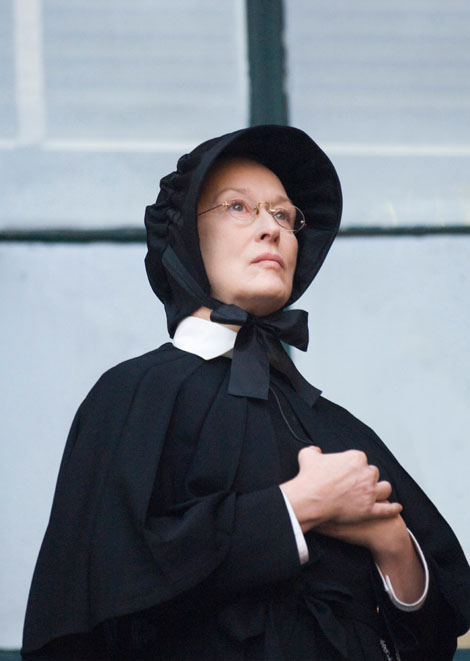
On Friday we watched Doubt, a film that was awarded five academy award nominations. It is about some relationships within a Catholic church and school and the conflict between a strict nun and a personable priest, with a naïve nun caught in the middle. Most reviewers have commented that though the plot leaves too many unanswered questions it is carried along by its superb cast. I would agree, but it seems to me that that is the point. Ultimately the film is not about the story itself, but it is about the ambiguity that we cannot seem to handle, the ambiguity we want our stories to remove for us. Don’t look for anything to be neatly tied up. The film raises questions about doubt, but gives no answers, and certainly no heroes. Does the film maker mean for us to have certainty about nothing and no one? I wonder.

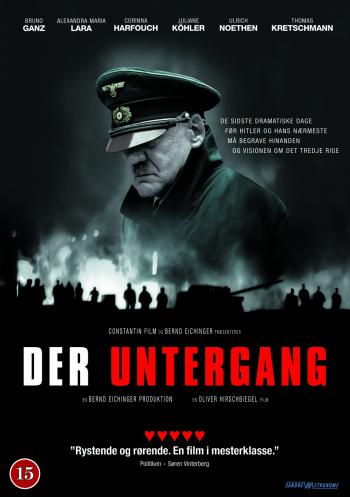
On Saturday night, we hunkered down to a German film with the English title Downfall. This movie is based upon the memoirs of Adolf Hitler’s personal secretary, a woman who was in her early 20s and spent the last days of the war in Hitler’s Berlin bunker as, well, as men and women committed suicide around her. She and a few others escaped, although Hitler had given her a capsule of poison to take. Yessir, this makes for cheery viewing – 2 1/2 hours of delight. Though the film was highly recommended to me by a good friend with tastes that often match mine, and though it was nominated for an Academy Award as best foreign language film of 2004, and though even now it resides at a lofty #79 on IMDB’s Top 250 films, I just didn’t get it. It documented a significant portion of history from a point of view we don’t often see, and I have to admit that the acting and the set design was stunning. But it was all so hopeless. I left with was this: that people look for a king. They look for someone who promises to lead them to a promised land, and if that person can successfully persuade them of their power and intention to do so, they will follow him with intense and possibly blind loyalty. When the person so followed is as evil as Hitler, that is scary. But oh to be able to successfully point people to Christ, a wise and worthy king.

Finally, also on Friday, we watched Out of Africa, 2. Well, not exactly. The title on the screen said Australia. But the movie was Out of Africa. The similarities were so many that I wondered how a film maker could take pride in a work that is so much a rip off of something that has already been done. Wealthy English woman ventures to wild and exotic foreign land following her man, but loses the man and is forced to manage an agricultural enterprise on her own against staggering odds. In the process she meets a wanderer, a man who supports her, loves her, but is too independent and free spirited to stay. He comes and goes and she endures it. We could go on with the similarities, down to a native man who repeatedly is filmed standing at a distance, keeping guard over the woman, and the fact that the woman becomes the first woman allowed in a local men’s drinking establishment. Between the two, go for Streep and Redford over Kidman and Jackman. Both are nearly three hours long, but the former is based upon a true story, and has a memorable soundtrack (and won seven oscars). Australia does have, however, the cutest child actor to appear on screen ever, a kid of aboriginal descent who has the biggest and most expressive eyes.

We intend on lightening up next weekend!

That Troublesome Book

[This post is part 2 in my response to Robert Wright’s article “One World, Under God” from the April, 2009 Atlantic. My intention is summarized in part 1.]

+++++++

When I was a college freshman, a pastor of the church I was then attending offered me some counsel that I will never forget. I was struggling over the ethical implications of certain passages in one of the epistles of Paul. This pastor sounded wise when he challenged me to learn to distinguish in Paul’s letters between when God is speaking and when Paul is speaking.

My first thought was, “Wow. That’s profound.” My second thought was, “What?” Who has the wisdom to make such distinctions? And do such distinctions exist?

Robert Wright seems to solve the dilemma by simply making the assumption that all Scripture instead of being God-breathed (to use the language of 2 Timothy), is simply man-penned. God never really speaks. He is only represented as speaking.

Scripture, and scriptural truth, is a malleable body of teachings open to modification when the need requires, and such a need arose in the early centuries of the church. The growing cosmopolitan character of the Roman empire, the soil in which Christianity took root and blossomed, demanded such revision and modification, so that the newly founded Christian franchise could prosper.

Such is the assumption which underlies this article. The premise, that the Christian message was shaped to fit the needs of an increasingly globalized world, is made possible by this assumption.

This assumption makes this article tedious going for Christians (1) who see the books of the Bible as a canonical whole, conveying one story from beginning to end. It is a story of creation, fall, redemption, and restoration. Every part of it adds to and develops these overarching and unified themes.

To assert and believe such is to believe that the Bible has a transcendent source. Many, Mr. Wright included, prefer to emphasize the human origin of Scripture, and argue therefore as if the Bible is a disparate, though at times artful, collection of human documents, at times purporting to be reflecting God’s word to men, but in no way able to substantiate that claim. In fact, in this light, the scriptures become something quite useful to those developing and furthering particular causes. And in the hands of the Apostle Paul, the malleability of Scripture became a pragmatic tool upon which to found a Christian franchise. So Mr. Wright concludes:

“But even for nonbelievers, the scriptures carry a modestly reassuring message, at least when read in light of the social and political circumstances that shaped them: people are capable of expanding tolerance and understanding in response to facts on the ground; and even mandates from heaven can change in response.”

If this is true, then my college counselor was asking way too much of me. There is no real need to distinguish between God and Paul speaking. God is silenced as an independent, self-existent, self-revealing entity. Only Paul is left to speak, as the needs dictate.

It is important for us to see that it is a fundamentally radical view of scripture which informs this article, a view which many thinking Christians (not an oxymoron), and yes, scholars (2), eschew.

+++++

[Blogs do not allow for footnotes, so this will have to do:

1 When I say ‘Christians’, I mean no disrespect to those who claim the title but differ with my assertions. I simply mean Christian in terms of those who believe in the historic Christian faith, certainly founded on the Bible, and articulated in the great ecumenical creeds and confessions. Christianity has an historical substance and content and it is from this basis I will argue for what is Christian.

2 Men and women who believe in the fundamental integrity and ultimately divine origin of Scripture are often denied the title ‘scholars’. But there are many who bear scholarly credentials who would assent to the historic Christian view of the scriptures.]

Oops

I’m the master of ‘oops’. Any who have heard me preach or who have read this blog know that I frequently make blunders which for some reason I do not catch.

But some ‘oops’ are bigger than others.

My wife told me this morning that a few days ago, the local newspaper ran an obituary of a young man who, the paper reported, “went home to be with the Lord unrepentantly”.

Wow. Apart from the theological musings which that raises, that is a harsh thing to put into an obituary. But there it was.

Apparently it was an ‘oops’. A whopping big ‘oops’.

This morning the same obit ran. The same, but different. Today we read that ‘he went home to be with the Lord unexpectedly’.

Like I said. Oops.

Mark Fidrych (1954-2009)


While a student at Michigan State, I was not one to pay much attention to the Detroit Tigers. In those days, a kid from Cincinnati didn’t pay any attention to the American League except for one night in July and for a week in October.

However, one could not ignore a phenomenon which was arising in Tiger Stadium. Mark Fidrych was nothing if not a character. He was one of baseball’s great all-time personalities.

I just had no idea what a servant he was.

Servanthood is giving self for others without seeking return. Most of us are no good at it. “The Bird” apparently excelled.

Listen to this tribute from NPR’s Scott Simon, and you will see what I mean.

One who commented on this story on the NPR site said this:

In 2002, I produced an event at Comerica Park for the Make-A-Wish Foundation. At that event, were a half dozen or so Old-Timer, Tiger players, including Mark Fydrich. It was expected that these Former Greats spend some time in the stands with the Wish Kids and their families. Mark Fidrych was the ONLY former player that stayed with the kids for the ENTIRE game, despite the hot sun and available amennities in the General Motor’s suite. I will never forget this GRAND goofy duck. He lived life from his heart. God Bless Him!!

The world is poorer without people like this. Perhaps God would make us moreso to take his place.

[The photo comes from this excellent tribute.]

A Routine Morning

It should come as a surprise to no one who knows me that I have a pretty regular routine every morning.

The alarm goes off at 4:50. I rise, hit snooze, and then generally wake up fully before the full ten minute grace period has elapsed. I sit on the edge of the bed, in the dark bedroom, and feel the night stand for my glasses. My wife has normally not come to bed before midnight, so I try to do as much in the dark, or with minimal light, as possible.

I head out into the family room/kitchen in order to heat up some tea. On the way this morning, I stopped to read a note that my wife had left. I also sat briefly at the kitchen table, where my laptop summoned me, to see if any interesting email messages had arrived over night, and to see if the Rays had managed a win (remarkably, they had).

Oddly, I could not see the screen very well. My eyes were watering, it seemed, and this was making my vision a bit blurred. Or so I thought. I started the tea and headed out to the driveway to get the newspaper.

When the tea was done – tea I had made yesterday and simply needed to warm – I sat on the couch to have my quiet time. No need for glasses there. I’m quite nearsighted, thank you.

It wasn’t until I put my glasses on after my quiet time (so that I could prepare my Raisin Bran and Piece of Toast breakfast) that I noticed the reason my sight was still blurry. The left lens of my glasses was missing. At least, I noted, the screw was still there.

I was able to manage breakfast without my glasses. (A man must have his priorities!) After that, the search began. And as this process advanced, I realized the irony of one who cannot see trying to find by sight the very object designed to help him see. There is a spiritual application to this somewhere, but I was not prepared to develop it.

My first step was to feel on and around my nightstand (my fancy name for the TV tray set up next to my side of the bed which holds books and glasses). This accomplished nothing. So, I thought perhaps when I sat at my computer the lens had fallen out. I looked and felt around the kitchen table. Nothing.

With a flash of brilliance, I headed into the bedroom with a flashlight, hoping that I would catch a glint of light reflected from the lens if only I could shine the light in the right direction. I searched the whole bedroom to no avail. So, I took my shower and dressed.

The next step was to retrace my steps from when I got up to when I first noticed blurry vision. But I was beginning to worry, and to be glad that I was looking for a full size lens and not a contact lens.

I thought of the note that I read from my wife. To read it, I probably would have removed my glasses. The note was on a counter. Below the counter was a laundry basket with some clothes in it. I shined the light down, and there, on top of the clothes, was a reflection. My lens.

Now began another search. Somewhere in the deep recesses of my wife’s purse she keeps a glasses repair kit. I’ll never make fun of what a woman carries in her purse again. I found it.

I picked up the glasses to begin the repair, and heard the tiniest ‘plop’ which was, of course, the crumb-sized screw falling out and hitting the floor and bouncing, I assumed, underneath the kitchen table, joining other crumb-sized things, like the crumbs from last night’s supper. I was back on my knees with the flashlight, still blind, searching for the screw. It was the third crumb next to my son’s chair.

The final stage in the saga was taking this crumb and dropping it into the hole in the frame, using an alarmingly large thumb and finger. I didn’t think they were abnormally large, until I tried this maneuver. After about the eighth try, I succeeded. I’m happy to report that I’m typing this with clear vision.

So much for routine. I wonder what the rest of the day has in store.

Magical Mystery Present

On my birthday, my two at-home daughters (H and J) presented me with a magical birthday present – an Amazon.com gift certificate.

They know the way to this dad’s heart.

I dropped this piece of paper into the magical hat, and drew out three ‘rabbits’ of a very special nature.

* * * * *

First, I drew out a book called Gilead by Marilynne Robinson. This book had been recently very highly recommended to me, and so it was an easy choice for me. It is a fictional collection of letters written by an aged pastor to his seven-year-old son. In the letters he recounts his life, including insights into his life as a pastor of a church in the small Iowa town of Gilead. As a pastor (not aged, thank you!) I’m intrigued. The book won the author a Pulitzer prize, but more interesting to me is that the book was suggested to the one who commended it to me by two people of nearly opposite ideological worlds. I’m digging into it now. I’ll have more to say when I finish it.

* * * * *
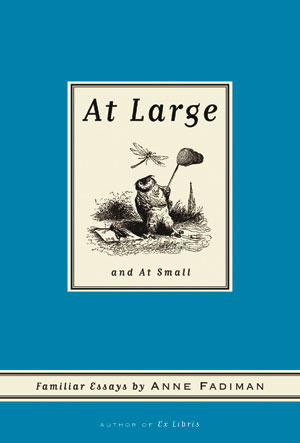
Secondly, my magical piece of paper became a small book of collected essays called At Large and at Small by a woman named Anne Fadiman. Ms. Fadiman is the champion of a genre known as the ‘familiar essay’ of which this book is a small collection. In her words:

“The familiar essayist didn’t speak to the millions; he spoke to one reader, as if the two of them were sitting side by side in front of a crakling fire with their cravats loosened, their facorite stimulants at hand, and a long evening of conversation stretching before them. His viewpoint was subjecteive, his frame of reference concrete, his style digressive, his eccentricities conspicuous, and his laughter usually at his own epense. And though he wrote about himself, he also wrote about a subject, something with which he was so familiar, and about which he was often so enthusiastic, that his words were suffussed with a lover’s intimacy…. Today’s readers encounter plenty of critical essays (more brain than heart) and plenty of personal — very personal — essays (more heart than brain), but not many familiar essays (equal measures of both).”

In short, the familiar essay is something I would love to learn to write.

* * * * *

And finally (cue the theme music), a DVD special edition of one of the greatest movies ever made: Sergio Leone‘s classic ‘spaghetti westernThe Good, the Bad, and the Ugly. What can one say about a 179 minute classic (with 18 minutes of restored footage) which has no line of dialogue until ten or twelve minutes of time have elapsed, and which ends with a shootout so well choreographed with its music that one thinks of it as a dance more than a showdown with deadly force. What a great film.

A great film in which my wife can find no merit whatsoever, even with the close-ups of a young Clint Eastwood, the unnamed hero of the film. So, since we normally watch movies together, I have a problem.

Fortunately, my daughter is very pregnant. At some point in the very near future my wife will feel the motherly impulse to spend some extended time with my daughter and soon to be born grandchild. What shall I do with time alone? I’m not sure, but nearly three hours of it will be spent with Clint and Co. Perhaps six if I also watch it with the commentary turned on.

Problem solved.

* * * * *

I loved all the presents I received for my birthday. (If my daughter holds out, then I will enjoy Barb’s gift to me on Thursday – a baking class at a local cooking school, which we will take together.) But to be given free reign at the world’s largest store – that was fun. Thanks H and J.

Didn’t Know That

From the ‘I didn’t know that’ department:


Barb and I just finished watching Audrey Hepburn in Roman Holiday, a very good movie, by the way. I assumed, and have always assumed, that Audrey Hepburn was Katharine Hepburn‘s daughter.

Nope. They are not related.

I didn’t know that.

Page 100 of 142

Powered by WordPress & Theme by Anders Norén