Concerning Life as It Is Supposed to Be

Category: Uncategorized Page 9 of 71

A Biblical Apologetic for Fishing

Christian fisher-persons looking for yet another route by which they might justify their obsession might find an ally in the Reverend Bruce Milne, who penned a commentary on the gospel of John for the The Bible Speaks Today series.

In commenting on their Galilean fishing trip recorded in John 21, he notes that the disciples of Jesus have taken it on the chin over the centuries for their decision to go fishing so soon after the resurrected Jesus had commissioned them to be sent as he had been sent (John 20:21).

Milne is sympathetic, which causes me to picture him with his own pole in his hand:

“It has also to be said that in terms of their psychological and emotional well-being a fishing expedition back in the old familiar surroundings of the Sea of Galilee was therapeutically ideal. The last few days had been an emotional roller-coaster. In a matter of a week they had been lifted up to the giddy heights of Palm Sunday, sent spiraling down into the utter depths of despair on Good Friday, and then been swept up again to the heavens by the glory of the resurrection. A good night’s fishing was probably just what a doctor would have ordered.” (310)

There you go. Biblical support for therapeutic fishing.

Starbucks Miles?

Given the promise of a dollar off my next visit, I agreed to complete a short, online, Starbucks “Customer Experience Survey”. I had to chuckle when I came to this screen:

StarbucksSurvey

I visit my local Starbucks “occasionally”. So, I sent it to a friend who “occasionally” is there as well and asked her how she thought I should answer the question. Her suggested answers were worth repeating, and will be appreciated by others who “occasionally” frequent their local Starbucks.

A. Lost track

B. You should know because my card is registered.

C. Lets just say I could circle the globe with my ” Starbucks Miles”

D. People thought they were on “Cheers” because everyone called out my name when I entered.

E. Check your manual. My picture is on the front.

Thanks, Holly!

Really Cool Grace

A casting call has been issued for replacement vocabulary for all the Christian hymns dependent upon ‘amazing’ for their power. We’re talking some biggies here. “And Can It Be” ponders God’s “amazing” love, as does “When I Survey the Wondrous Cross”. And of course, there is (or was?) “Amazing Grace”.

All of them need to be fixed.

According to the arbiters at Lake Superior State University (home of the appropriately named ‘Lakers’) “Amazing” is one of the words which should be banished from use, along with “Baby Bump”, “Occupy”, “Man Cave”, and “Ginormous”. LSSU receives nominations for its annual banished word list throughout the year, and this year the greatest number of nominations mentioned “Amazing”.

Say the judges,

Many nominators mentioned over-use on television when they sent their entries, mentioning “reality” TV, Martha Stewart and Anderson Cooper. It seemed to bother people everywhere, as nominations were sent from around the US and Canada and some from overseas, including Israel, England and Scotland. A Facebook page – “Overuse of the Word Amazing” – threatened to change its title to “Occupy LSSU” if ‘amazing’ escaped banishment this year…

Pretty intense.

So what are we to do? Send Wesly, Watts, Newton, and Co. back to the drawing board, I guess.

Awesome grace, how sweet the sound…

Love so mind-blowing, so divine…

Stupefying love, how can it be.

Hmmm. This presents a potentially ginormous problem.

—–

As a footnote, let me praise the folks at LSSU. I am generally in total agreement with their judgment. Last year’s list included “epic”, “fail”, “man-up”, “viral”, and my personal dis-favorite, “the American people”.

For Understanding

This is from novelist Ian McEwan’s piece on his relationship with Christopher Hitchens.

THE place where Christopher Hitchens spent his last few weeks was hardly bookish, but he made it his own. Close to downtown Houston is the Medical Center, a cluster of high-rises like La Défense of Paris, or London’s City, a financial district of a sort, where the common currency is illness.

This complex is one of the world’s great concentrations of medical expertise and technology. Its highest building denies the possibility of a benevolent god — a neon sign proclaims from its roof a cancer hospital for children. This “clean-sliced cliff,” as Larkin puts it in his poem about a tower-block hospital, was right across the way from Christopher’s place — which was not quite as high, and adults only.

The highlighting is mine.

That sentence is a call to arms for every apologetic cell in a Christian’s body. But for a moment, let’s just listen.

This is also a very clear, and very poignant, insight into how many think about God. If we have been enabled to reconcile the benevolence of God with a children’s cancer hospital, then let us be grateful to God, but let us as well be sympathetic to those yet to make peace with one of the hardest realities in a broken and fallen world.

And let us pray that we all, especially at Christmas, may have a clear vision of a benevolent God’s breaking into this broken world through a Child.

Two Front Teeth, and a Couple Other Things: An Instant Read Thermometer

While I’m in a kitchen kind of mood, I would like to recommend one more critical piece of kitchen equipment for this Christmas season.

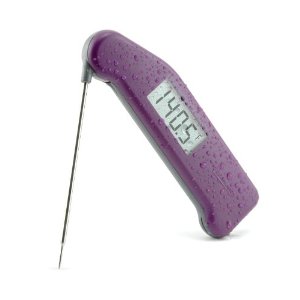
Though I like cooking and baking, my repertoire of kitchen creations is rather limited. More often than not I will be grilling something or baking rolls. And before I discovered the wonders of the Thermapen instant read thermometer, my burgers would be burnt, my chicken pink, and my rolls fallen. All was not good. But the Thermapen has rescued me from all that.Thermapen

This gadget is a slick piece of design which can measure the internal temperature of meat, breads, and even, because we’ve tried, swimming pools. It is accurate and very, very fast. Within seconds, you can have an accurate read on your food’s internal temperature and know whether to shove it back in the oven or get it off the grill.

The usefulness of this thermometer is pretty obvious when it comes to meats. The ability to measure the internal temperature of a piece of chicken quickly on a hot grill keeps me from over and under cooking chicken, which I did frequently before. An undercooked turkey can be a frustration on Thanksgiving or Christmas, as some may have recently discovered.

But the real value of the Thermapen for me has been in baking. Breads are not necessarily done when the outside is brown. The rapidity of browning varies based upon the moisture content of the bread and the proximity of the heating elements. Bread is only done when its internal temperature is in the 180-210°F range, depending upon the bread. The ability to test this quickly without losing oven heat is so, so helpful to impatient types like me. A tray of rolls whose center temperature is only 160°F may look fine in the oven. But when pulled out and allowed to cool, the center will sag and underneath the beautiful brown crust will be a gooey mess of undercooked dough. Ugh.

The Thermapen is pricey. It can be purchased from the manufacturer’s web site for $89.00. I suppose one would want to rescue a whole lot of rolls for that price. And I have. We’ve used ours for a few years now and should this one break, which it shouldn’t, I’d buy a replacement without hesitation.

So would, apparently, a host of reviewers more celebrated than I, including, according to the Thermapen web site, Alton Brown. But, hey, why trust anecdotal preferences when you can turn to the guys over at Cooking for Engineers dot com (yes, that is a real site) to run a series of tests on it? The Thermapen won the day there, and has persuaded me here. Perhaps there are less expensive options out there, but I can’t see trusting my rolls to another.

Two Front Teeth, and a Couple Other Things: A Kitchen Scale

Black Friday had come and gone, and so perhaps many of you already have your Christmas shopping complete. For those of you who don’t, let me recommend an item for those who love to hang out in the kitchen. In my thinking, right up there with ‘oven’ and ‘refrigerator’ in the pantheon of indispensable kitchen things is the digital kitchen scale.

Why?

First, accuracy. It is notoriously difficult to measure flour with consistent accuracy. Various methods are used, but only one is consistent: weighing the flour. One cup of flour weighs 120 grams. If you try to scoop the flour, you compress it. If the flour has been sifted, it is fluffy and full of air. One cup of compressed flour does not equal one cup of fluffy flour. But 120 grams is always 120 grams. With a scale, there is no guesswork.

Secondly, it is so much easier and cleaner to measure ingredients by weight. We make our own sloppy joes. The sauce is composed of a cup of this and three tablespoons of that. When done, the counter is littered with a variety of measuring tools all of which need to be cleaned. With the scale, I put a bowl on the scale, and proceed to add the ketchup, the mustard, the vinegar, the sugar, and so on, by weight to the single bowl. I need not dirty a single measuring tool. When all the ingredients are added, I mix them in the bowl and add them to the fried hamburger. Simple and made so much simpler by the scale.

Third, for the borderline OCD like myself, I love knowing that ALL my hamburger patties are within a fraction of a precise 5 ounces. It’s a beautiful thing.

And finally, conversion. I have my own pancake recipe which the family is fond of. I mix the dry ingredients ahead of time and store them so that when we want pancakes, all I need to do is to mix the liquid ingredients, drop in the right amount of dry ingredients, mix, and fry. One day I was preparing to make a batch of the dry mix only to discover that instead of the necessary 960 grams of flour (i.e. 8 cups) I only had 690 grams. That is, I only had 72% of what I needed.

Now, if one was measuring in cups and tablespoons, how quickly could you calculate and then measure 72% of the necessary 6 teaspoons of baking soda? With a scale, all it takes is a calculator. 35 grams instead of 48 grams. Piece of (pan)cake.

We’ve had a couple scales over the years, but the one which has served us well is the Escali. Accurate, easy to use, durable, and cheap. And the pink one made my daughter-in-law especially happy.

So, I’m happy here to pass your way a very good and very special pancake recipe. But, alas, as you will see, there is a catch.

Enjoy!

Flour – 135g
Baking Soda – 7g
Sugar – 29g
Salt – 2g
Egg 1
Oil (or butter) – 28g
Buttermilk – 240g

Makes about 8 decent sized pancakes.

Soul Doctor

Prone to self-pity, I told my wife the other day that I must like despair like some like ice cream since I indulge so often. But though our thoughts may be trained to flow down well-worn channels, we are never meant to stay there.

My Bible reading plan for the other morning had me reading the book of Lamentations. This is by no means the first place I’d go to or recommend going to when one is feeling the weight of life, and I had little hope of the morning’s reading bringing much comfort.

But the prophet Jeremiah, the book’s reluctant author, has been nicknamed ‘the weeping prophet’ not because he curled up in a useless puddle in the face of the affairs of life, but because he gave expression to the frustrations that life brought to him. He took those frustrations to the One whom he believed to be the source of life.

He wrote as the city of Jerusalem fell apart around him under a Babylonian siege. That siege, Jeremiah had repeatedly pointed out, was the judgment of God upon the squishy, superficial spirituality of Israel. God had had enough and was bringing his promised judgment.

As I sat in “Dr. Jeremiah’s” couch, he showed me that affliction and sin all mixed up and confounded can drag one from freedom to bondage.

“She who was a princess among the provinces has become a slave.” (1:1)

He showed me as well that it is okay to trace this to its source.

“…because the LORD has afflicted her for the multitude of her transgressions.” (1:5)

The cause may be my sin, but the source of the affliction is and always will be God. It does not help to try to sidestep God’s sovereignty when we are suffering. In fact, it is appropriate to give full vent to how this makes us feel.

“The Lord has swallowed up without mercy all the habitations of Jacob….” (2:2)

It seems wrong to accuse God of acting “without mercy”, but when that is the way it feels, that is what we need to say. But in Jeremiah I see as well one who, giving vent to bitter honesty, cannot remain at the place of bitter honesty. That is the case with any who truly know God. Yes speaking with such honesty is good, but we must at some point emerge elsewhere.

“The steadfast love of the LORD never ceases; his mercies never come to an end; they are new every morning; great is your faithfulness.” (3:22, 23)

I want to live in that verse, but I often don’t. I think that one of the reasons public worship is so important is that being with God’s people under the ministry of God’s word is a place where, if even for a brief moment, God can move us from the despair of 2:2 to the affirmation of 3:22, 23.

But we want to be there always, not just for a brief moment, we protest from Dr. Jeremiah’s couch. He knows that. But he also knows that in God’s wisdom there is ordained a time for everything under heaven, and for some times we must wait.

“The LORD is good to those who wait for him, to the soul who seeks him. It is good that one should wait quietly for the salvation of the LORD.” (3:25, 26)

Waiting is something foreign to me and to many others. Waiting is not what spoiled and soft children are prone to practice. But waiting, nevertheless, is what God demands.

It does not take one long to realize that the afflictions facing the Israelites and observed and experienced by Jeremiah were far worse than those faced by the readers of this blog (both of us). Nevertheless, ours FEEL as real and as painful and the hard place for all of us is to wait quietly. Quiet waiting is a far better place than quiet (or noisy) desperation.

And so Dr. Jeremiah dismisses us from his office with a prayer purged of complaint and focused as it ought to be.

“Restore us to yourself, O LORD, that we may be restored! Renew our days as of old….” (5:21)

The ellipses can be used to hide things to make the text say what I want it to say. Many writers hide behind abbreviated texts. Here note that I have dropped an important qualifier from the text.

“…unless you have utterly rejected us, and you remain exceedingly angry with us.’

What Jeremiah could only sense is what we know to be fact – that we may trust in one who was utterly rejected for us, so that we might know that God would never remain exceedingly angry with us.

With that hope we leave our appointment with this soul doctor. And the good thing is that his consultation was free.

158 and Counting

When I get an idea for a blog post, I scribble it down and eventually sketch out a few thoughts as a draft in MarsEdit, a wonderful piece of blogging software. The draft is written with the hope that I’ll eventually flesh it out and get it online. Sadly, though, that often does not happen. Since moving 1½ years ago, time to update the blog has been something rare leading to a substantial backlog.

As it now stands, there are 158 such drafts, dating back to June, 2009, most of which will never ever see the light of day. They address everything this blog was intended to cover – a pastor-eyed view of all of life. Buried there are some real duds which would be better off deleted (give thanks you never had to wade through them!). Some are time related comments whose time has passed. Some though are important thoughts (to me) which may or may not ever be resurrected. In addition to these 158 are several series of posts (on marriage, on knowing God, on the Christian sacraments, on adoption and parenting) which exist elsewhere, some only in my mind.

I may lose readers over the course of time, but this is for sure: I’ll never run out of things to write about.

Whether I have anything worth saying will be for others to judge.

Seeing Blindness

Questions for a Monday morning:

As I was driving to my Monday morning office, I was pondering this question: What is justice? Apart from its meaning as just retribution for wrong, what is its meaning for the Christian wanting to act in a way true to his God in a world filled with inequality, oppression, and want? What is justice?

When I got to my ‘office’, I had a long and fruitful conversation with a colleague which raised a number of related questions, the crux of which was this:

As Christians in 2011, what are our blind spots? Pundits around us expect us to be exercised about abortion, homosexuality, and economic and political freedom. But what are our blind spots? What should concern us that we are not seeing?

The white church in the antebellum south was blind to the horrors of human bondage. The white evangelical church of the mid-twentieth century did not take the lead in the further fight for the civil rights of all people. They were blind to the oppression around them. From an historical vantage point, we can see THEIR blind spots.

What then are ours?

That is a real, and not a rhetorical, question. Comments are open for charitable contributions!

Lies, Damned Epistemological Crisis, and Statistics

I began this post on January 28, 2011. It joined my queue of other begun and never completed posts which is at this point quite lengthy. I penned the title in a fit of inspiration which may have been more fit than inspiration, but there it is, and I’m not going to change it. It is taken, many will note, from the quote often attributed to Mark Twain but which, it seems, really originated from the British prime minister Benjamin Disraeli. He is reported to have remarked that there are three kinds of lies: Lies, damned lies, and statistics. I’m not sure what role statistics played as a shaper of human opinion and decision making in the 19th century, but he could not have imagined how influential his third category of lies would become in our own. And since this subject has been bouncing around my head for years, this post will be, apologetically, abnormally long.

What spawned the post was originally this article in the Atlantic Monthly with the curiously familiar title “Lies, Damned Lies, and Medical Science”. The article is a fascinating profile of a Greek medical researcher whose labor is aimed at debunking the claims of other medical researchers. He is not bitter nor one motivated by some high level rejection. Rather, his concern for the work of medicine drives him to hold researchers to a high standard of accuracy.

That he does NOT find that high level of accuracy in medical research disturbed me greatly. Researchers, like many of us, are measured by their results. Funding flows to promise. There exists an immense pressure upon researchers to demonstrate positive results in order to keep their positions and their funding. Such pressure can skew findings, can tilt the table so that we find what we are looking for. Hence, my epistemological crisis: whom do I believe? The one who says that eating eggs is bad for me or the one who says that it has no discernible effect in shortening my life? Do I believe the research that says at my age I should get a PSA test, or the one that says that this test has led to much unnecessary treatment?

So goes medicine, and so, sadly, goes religion. Churches have drunk deeply of the statistical Kool-aid in recent years. Recently, I’ve been approached by several people with stats in hand proving that the church is failing young people who are, supposedly, abandoning the church in droves. Some statistics become so dispersed that they attain something of an unquestionable canonical status. Is it not absolutely true that there is no discernible difference in the divorce rates between secular and Christian people? Common thinking, fed by certain popularized studies, says so. But is it true? No.

Years ago, wanting to not be left at the station as a pastor, I began to pay attention to the epicenter of contemporary evangelical statistical research: The Barna Group headed by George Barna. Barna’s name in evangelical culture is synonymous with polling data and his surveys are quoted widely with great authority. “Barna says…” is a powerful rhetorical weapon.

As I received my periodic reports from The Barna Group, I began to notice the disturbing trend that every report ended with something like this, “You can read more about this important study in George Barna’s new book….” Everything led to a book. (He has 28 of them on sale on his web site.)

And what sells books? Controversy and panic. Nearly everything he published had the air of alarm about it. The church was failing here; young people were being lost there; beliefs were eroding, people departing. I grow tired of the doomsayers.

I sense great similarities between the alarmists among us and the medical researchers desperate attempt to achieve publishable results.

Planned Parenthood needs to elevate the pro-life threat into a frightening frenzy to generate its support (I know – I was once on their mailing list, though I don’t know how). The same approach is adopted by Evangelical alarmist groups – be it Focus on the Family or the American Family Association or any number of other groups dependent upon fundraising. The greater the alarm, the greater the threat, the better the flow of money. And that disturbs me. So, I shut down and mistrust all alarmist rhetoric.

But that flows from my bias. I could never back up my resistance to Barna and other alarmists. Recently, though, some well placed Christian scholars have publicly taken issue with Barna and his methodology and results. Reflecting on one study in 2010, Calvin College philosophy professor Jamie Smith was quoted by Justin Taylor with this criticism of Barna:

This is not social scientific data that would ever pass muster in the scholarly field of sociology of religion (as represented, for instance, by work done in the Society for the Scientific Study of Religion). Indeed, I find it hard not to find this almost laughable in its methodological naivete and anecdotal nature.

Recently Taylor pointed out another public rebuff of Barna by Baylor University sociologists Rodney Stark and Byron Johnson in the Wall Street Journal.

As for media-hyped studies about religion, one should always beware of bad news bearers.

Stark loves the role of myth buster, and one could write this off as a bitter feud among those who get attention and those who don’t. But my experience tells me that it is quite easy to make statistics do what we want them to do. And the result is that the church becomes an alarmist place, with God’s people, serving the one in whom is all authority in heaven and earth, in a body against which the gates of hell will not prevail, cowering in fear and apprehension.

I agree with Stark and Johnson: Beware the bad news bearers. Check and double check all statistical claims. Use a source other than one whose work is used to sell books. And let us become more known for the good news we proclaim than the bad news we fear.

Page 9 of 71

Powered by WordPress & Theme by Anders Norén