
“Two streams converged in a wood,
(with apologies to Robert Frost)
And I was swept away,
and that has made all the difference.”
❦
This is not a story of a wood or of literal streams. But it is the story of a convergence that captured my heart and ( once again) launched me into writing a book. While working with the content of the first book, a friend put me in touch with David Mills, a former executive editor of the journal First Things. A part of the wise counsel he kindly gave to this unknown pastor from Florida was this challenge:
“I’d also urge you to set yourself to write a regular column of some sort with too low a word limit for what you want to do. A weekly article for your bulletin or web site would do. Try to exposit each clause of the Nicene Creed in 250 words or predestination and the historical debates over it in three 300 word articles. Anything that forces you to cut and cut.”
To reduce forces a writer to come to grips with what he wants to say and to make sure he says it in the clearest possible way. E. B. White’s “omit unnecessary words” captures this.
This challenge from David Mills is the first stream.
❦
The second stream has been a part of my life for some time. I pastor within a tradition whose theological standards are three related documents from the first third of the 17th century. Among the three is a little gem called the “Westminster Shorter Catechism.” Its 107 questions and answers, containing just over four thousand words, are a comprehensive and devotional survey of historic and reformed theology and practice.
The first question and answer is well known (“Man’s chief end is to glorify God and enjoy him forever.”) having made recent guest appearances in writers as different as John Piper and Rick Warren. But the supporting cast, while as insightful and rich, remains largely unknown.
And that is a loss.
The only resource that has been available to help people come to know, appreciate, and understand the Catechism has been a work that was written in the early seventies. It has served the church well but is dated. I have long urged others, some well known and others not, to write a new and fresh introduction and exposition of the Catechism. But none has been crazy enough to try.
❦
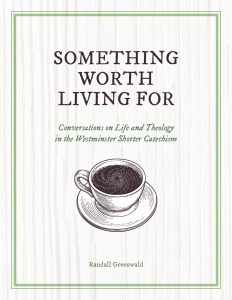
These two streams, the Mills challenge and the need for a fresh introduction to the Catechism collided and led to my commitment to write short (five or six hundred words) entries on each of the seventy topics touched upon by the Catechism. My envisioned readers are the many thoughtful and curious people who want to understand historic reformed Christianity but who find the standard introductions too weighty and daunting. The work’s title, Something Worth Living For, captures its goal, that readers might find a rootedness here.
The work, about two-thirds complete has generated some good initial encouragement.
“Pastor Greenwald’s Something Worth Living For is a fine exposition of the Westminster Shorter Catechism. His work is theologically accurate, and he never forgets that he is addressing real people.”
Theologian John Frame
“Finally a book of theology and the Reformed faith that won’t bore the reader to death.”
Pastor and teacher Steve Brown
“This is a project that requires writing chops, theological acumen and a pastor’s heart. Randy’s got them all.”
Former Warsaw Bureau Chief for Bloomberg News Nate Espino
Very kind, these words. But kind words don’t sell books. And though I care deeply about this work and want to make it accessible, that will take a great deal of work, a good dose of luck (see my conversation about Q/A 11 in the forthcoming book), and perhaps the engagement and help of a lot of friends.
The two streams converged to produce the book. Here’s hoping for a third, that of a publisher eager to invest in such a work.