Concerning Life as It Is Supposed to Be

Month: December 2018

To Be Blessed

My cardiologist told me the other day, “It is a privilege to spend time with those who are dying.”

I didn’t think my heart was that bad.

Turns out it isn’t. She was speaking generally about the privilege that she, along with others like nurses and pastors, have in walking with people through some of their darkest times.

It is a privilege. But I get to do more. I get to bless.

At the end of every worship service, I stand in some liturgically significant place and with hands lifted over the congregation, speak words, frequently these:
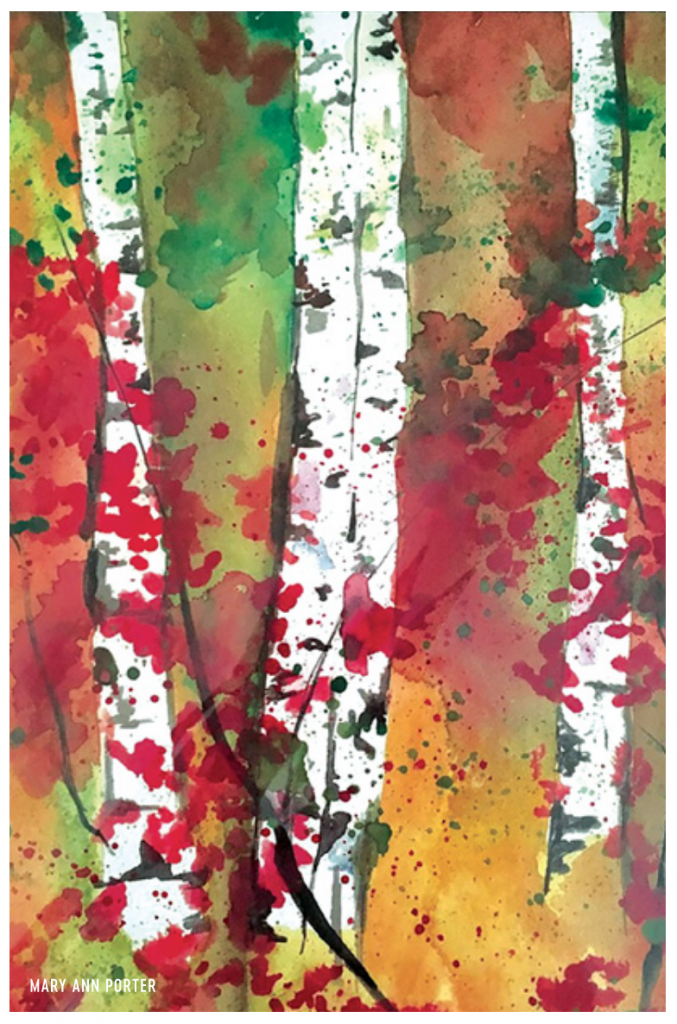
Artwork by Mary Ann Porter. Used by permission.

The LORD bless you and keep you;
the LORD make his face to shine upon you and be gracious to you;
the LORD lift up his countenance upon you and give you peace.

If we are lucky, we’ve heard these words (taken from Numbers 6) so often that they are like warm bread to us: comforting, familiar, and certain. They have become a part of who we are.

God gave these words to Aaron to be spoken over his people. “Thus you shall bless the people of Israel,” God said. This people, weary of traveling and not yet receiving the things promised them, needed assurances. And so God gave them words of blessing.

But they are not mere words. All the goodness and intention of God lies behind them. When spoken from God to us we are drawn into a reality that is not yet but is nevertheless certain. Our impatience with life invites despair. Things are not the way we long for them to be. We long for life to get better, for the pain to disappear, for the conflict to pass. We grow desperate, perhaps despondent.

And then I or some other pastor stands and speaks these words into our darkness because God blesses his people.

Years ago my wife and I, with a toddler and an infant, sat in a state of desperation. We had moved everything to St. Louis to follow our sense of God’s call to seminary. But I had no job, and we were out of money. We put the kids to bed, sat on the edge of the bed in our apartment and sang a hymn.

“Jesus, I am resting, resting in the joy of what thou art….”

With this hymn we affirmed that we knew

“…thy certainty of promise and have made it mine.”

And we wept.

Yes, we knew the promise, and we wanted to believe its certainty, but we were having trouble making it our own.

Words of blessing like the ones we are here considering are necessary in such times. They serve as a bridge between what we know and yet struggle to make our own. They take the certainty of God’s promise and declare it to be real that we may rest now in what is yet future.

There is power in these words when spoken over the people of God gathered in worship that cannot be fully appreciated in a blog post, or twenty. Nevertheless, I’d like to spend some time teasing out some of this particular benediction’s richness in posts that will appear here every other week so that we might better know the certainty of his promise and make it our own.

Especially in those dark times through which we are each called to walk.

To Paint or Not To Paint, That Is the (Preacher’s) Question

On a recent Monday, several church members were at the church painting the nursery. When I went to get my lunch from the kitchen, one spied me and said, “Hey! Are you coming to join us?”

I mumbled some kind of answer, appealing to being busy, and the like. The essence of my answer was clear: “No.”

He accepted my answer.

“That’s okay,” he said. “I was half-joking.”

Half?

I will begin preaching through the book of Ephesians in January. To prepare for this, I’ve spent the past few Monday mornings coming to know Ephesians as best I can. It’s been a rich time in which I easily lose myself.

But some could easily argue that spending time with church members and youth slopping paint around the nursery might be time better spent. It makes sense. There is no better way to build relationships than working side by side with others. And yet, I spent the day in Ephesians. Why?

First, I genuinely believe there is power in the preached word. When Paul in Romans says that “…faith comes from hearing, and hearing through the word of Christ” (Romans 10:17) he is not suggesting that the Romans download a Bible app that will read the word to them on their daily commute. The word of Christ read and explained in worship promises faith to its hearers. The power is not in me or in any skill I might claim or possess. There is power in the Spirit of God taking the word and doing his work with it. That is not something to trifle with.

But if that is true, then, I must make sure that it is in fact the word of Christ that I preach. I fear, as I think I ought, the prospect of preaching untruth. I approach preaching with James’ caution in mind, that “Not many of you should become teachers…for you know that we who teach will be judged with greater strictness” (James 3:1)

It is annoying to think that people don’t listen to my preaching. But it is frightening to think that they do.

To work carefully to ensure that the sermons I preach conform to the word I’m seeking to expound takes time and care. I’ll stumble and I’ll fall and I’ll say foolish and ill-advised things. But I labor against that to speak what is the word of God.

These things together give me hope that the word preached might effect change. John Stott, a British pastor and theologian of the last century, was moved deeply by the powerful picture of a united Christian community that he found in the book of Ephesians. “At the same time,” he lamented, “the realities of lovelessness and sin in so many churches are enough to make one weep, for they dishonour Christ, contradict the nature of the church, and deprive the Christian witness of integrity.” (God’s New Society1979, page 10)

It was by preaching that he hoped to bring to pass the lofty vision of the Bible among a weak and struggling humanity. The word preached has the power to accomplish the change we hope to see in the lives of God’s people.

I believe these things. And so I and many others study when we could paint.

Whether my friend was ‘half’ or ‘fully’ joking, I can’t say. I think it is the latter.

Regardless, I can say with certainty that he and those like him are generally unaware of the important contribution they make to the preaching of the word. When they take up the brush, their pastors can study. And that promises blessing beyond measure.

The Five (The Pilot Episode)

1.

Some who publish blogs are so together that they are able on a regular basis, like weekly, to post a rundown of their more interesting discoveries. They will point to essays they’ve read, or make quick notice of books they’ve enjoyed or interesting facts they’ve learned.

This sounds fun.

If only I were one of those ‘together’ bloggers.

So, as an alternative, I’m introducing “The Five.” My intention is for this to be a periodic feature in which I’ll post five interesting things I’ve run across in the past week or month or 37 days. That is, whenever I collect five interesting things, I’ll post.

These will be random because I am random. My interests often run toward the odd and eccentric. But I hope some will find a thread of interest.

The name (“The Five”) is a nod to my favorite recipe item at a Florida based breakfast and lunch chain, Maple Street Biscuit Company. It’s an odd pile of things (biscuit, cheese, chicken breast, bacon, and sausage gravy) that amazingly work well together.

This is the ‘pilot.’ If it goes well, we may pick it up for a full season starting in January.


2.

Which came first – the doctor or the freshwater worm?

I recently read The Scarlet Letter (for the first time!). I was struck by how casually Hawthorne refers to the doctor as ‘the leech.’ I suspect that if I called my cardiologist a ‘leech’ she might take offense. So, I wondered, was Hawthorne being intentionally offensive?

Turns out, no.

Webster’s not only lists ‘leech’ as a (now archaic) name for a doctor or a surgeon, the word itself is derived from a German word meaning ‘physician.’ In fact, and this is where it gets weird, the worm is named because it was used by physicians.


3.

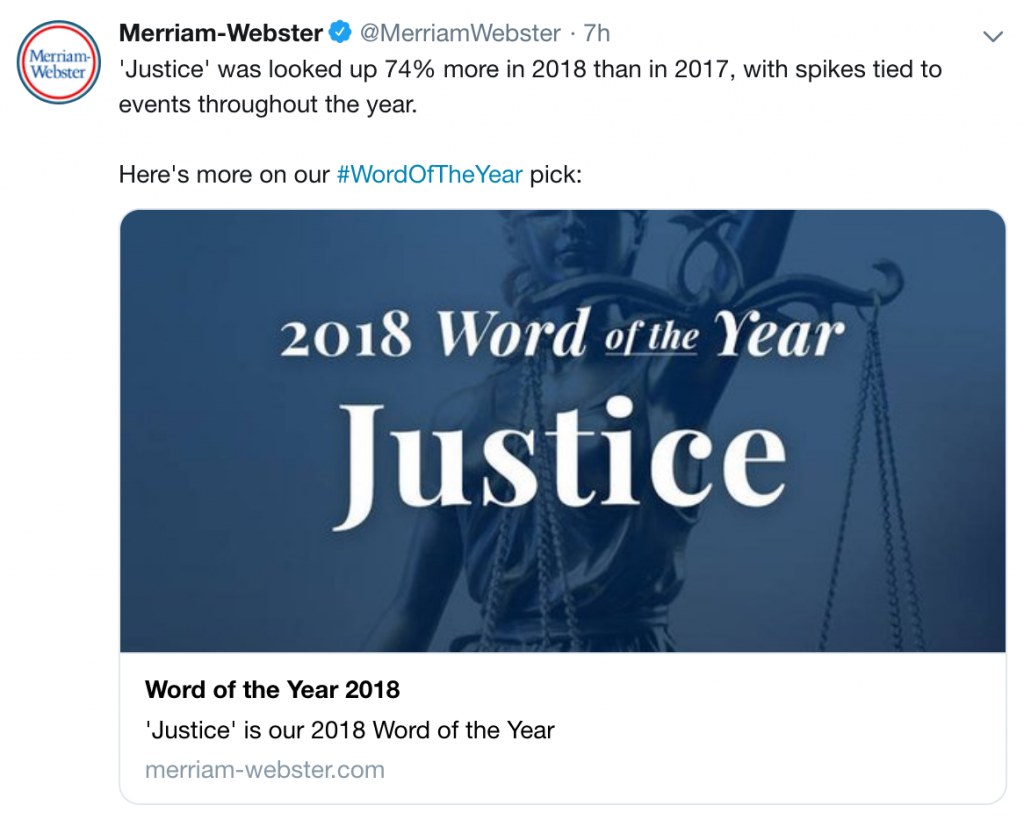
Related to the above, one of the most interesting twitter accounts I follow is Websters, which just revealed that it’s word of the year is ‘justice,’ a word whose look up rate is up 74% this year.

Dictionary nerds can be fun as well as informative. You can follow them at @MerriamWebster.

https://t.co/kyB9swUkQp

4.

A fascinating essay by Andrew Sullivan (New York Magazine / “America’s New Religions”) in which he makes the case that  all people have a religion.

“Our modern world tries extremely hard to protect us from the sort of existential moments experienced by Mill and Russell. Netflix, air-conditioning, sex apps, Alexa, kale, Pilates, Spotify, Twitter … they’re all designed to create a world in which we rarely get a second to confront ultimate meaning — until a tragedy occurs, a death happens, or a diagnosis strike”

5.

Finally, this interview with Anna Goff, the founder of Dove’s Nest, provides some very helpful and practical suggestions regarding how churches can be safe places for the survivors of sexual abuse.

As she says,

“Churches are places of high trust and therefore also places of high risk.”

They Are People

Recently, tear gas canisters were launched at people near the U.S. border with Mexico. The targets were those fleeing Central American instability to seek asylum in the United States. They were and are people.

And some of them were children.

No decent person wants to gas children, of course. But I wonder to what degree the language of our arguments, to the degree that it dehumanizes others, allows some to take such action which leaves children in the crossfire. That is, ‘migrants’ or ‘refugees’ might be met with a degree of sympathy and compassion. ‘Criminals,’ ‘threats,’ ‘rapists,’ and ‘terrorists’ (all terms at one point used to reference those heading for the border), on the other hand, are more readily cannon (or tear gas) fodder. The more successfully our language moves a group from the category of ‘human’, the easier it becomes to justify violence against them.

To counter this tendency, we need to read more books.

Edwidge Danticat

At the 2018 Festival of Faith and Writing my wife discovered the books of Haitian writer Edwidge Danticat. With her encouragement I eventually read two of them, both set in Danicat’s native Haiti. I’ve never been to Haiti and I benefited from her rich and unsentimental portrait of a people shaped by their land and history to be so different from me and yet, by our shared humanity, to be so similar. Months later, the flavor of that land, its richness and earthiness, and of that people, their luminescence, joy, and sadness, is still with me.

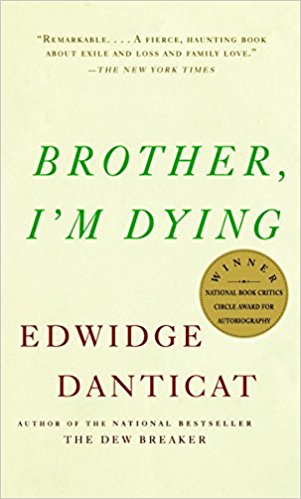
The urge to leave such a place for greater opportunity or safety is developed in Danticat’s moving memoir of her father and uncle, Brother, I’m Dying. When Danticat was a child of two her father immigrated to the US, followed shortly thereafter by her mother, leaving Edwidge to be raised by her aunt and uncle. Such was the family-separating immigration policy of the time.

When at age twelve her parents were able to bring Edwidge to the U.S. to be with them, she was forced to leave the only land she had known and the uncle who, through disability and poverty, had cared for her. It was painful, as such things always are for people. People, and these are people, after all, like us, never make such decisions lightly.

In time, her uncle, then an old man suffering from a debilitating but treatable disease, fell under the disfavor of a violent gang. He was forced to flee Haiti seeking safety and asylum in the U.S. Danticat’s well-researched and well-documented account of her uncle’s experience with U.S. immigration authorities is agonizing to read and illustrative of a system that is and has long been broken and in need of repair.

It is a system that dehumanizes and eventually lofts tear gas across border walls.

Will reading Danticat, or authors like her, shape or change, a reader’s convictions regarding immigration policy? I can’t say. What I can say is that our convictions will be better formed when we form them around the fact that the subjects of these convictions are people. Not problems, not enemies, not threats, but people.

They are all people. And that matters.

Powered by WordPress & Theme by Anders Norén