Concerning Life as It Is Supposed to Be

Month: November 2013

Safe Doubt

Rob Edenfield preached a helpful sermon on doubt this past Sunday at the church I pastor. The reaction to the sermon has shown that many are fearful of sharing their doubts and others (happily) surprised to find out they were not the only ones struggling with doubt. Doubt is real, and real to all honest Christians. Tim Keller has noted that “a faith without some doubts is like a human body without any antibodies in it.” (The Reason for God, page xvi) It’s good to be aware of and to admit our doubts.

But often we do not express our doubts because we are fearful of how others will receive us if they know we are struggling. To ponder how to respond to those giving honest expression to their doubt is a helpful exercise. To that end, I shared with our community group this anecdote from Susan Schaeffer Macaulay, the daughter of noted apologist for the Christian faith, Francis Schaeffer. This story has always been immensely helpful to me. I share it here hoping it will be the same for all of us as we welcome doubt among us.

I started the process of thinking through my beliefs almost accidentally, when I was eleven years old, growing up in Switzerland. What touched it off was a squabble with my two sisters, Debby and Priscilla. We had nearly finished weeding the family vegetable garden, and we were hot, tired, and crabby. As I grew more and more obnoxious in my side of our argument, one of my sisters piped up and said that I wasn’t being a very good Christian example to any villagers passing by.

Without thinking, I said the most shocking thing that came into my head — pretty shocking, at least, when your father is a minister. “Well, I’m not a Christian anyway!” I yelled. “I don’t believe any of it!”
I was received with the dramatic reaction I’d wanted: shocked silence.

As we picked up our hoes and walked down the mountain path toward our home, I suddenly felt a tingle of fear creep up my spine. Inside, I had the dizzy sensation of standing on the edge of a dangerous cliff. I had said that I wasn’t a Christian because I’d wanted to shock Debby and Priscilla. But now I wondered: Did I really believe in God? Was the Bible true? Did I have reasons to think so, or had I just blindly accepted what my parents had told me?

The more I thought about it, the worse I felt. I had loved this God of the Bible since I had been tiny. Now all that I’d heard about his teachings and his love seemed to be turning to ashes in my hand.

At the supper table, Priscilla announced, “Susan says she isn’t a Christian.”

By then I didn’t feel like denying her words, even though I could see that my mother looked sad. I was sad, too, for I felt as if I had lost God and his love. I wasn’t sure that there even was a God.

But I was also determined. I couldn’t believe in fairy tales! I had to grow up.

That easily could have been my last day of knowing God was there, and that I was safe in the order he had provided. It could have been the death of my faith.

Or it could have been the end of my progress into thinking as an adult. All it would have taken was a comment like, “Of course you’re a Christian, Susan,” or, “You’re only eleven; you don’t know what you’re saying,” or, “Don’t be foolish — it’s obvious that the Bible is true.’

But something else happened instead. That night when I was ready for bed, alone and quiet in my room, my father came in.

“Let’s talk, Susan,” he said seriously. “Tell me why you said you are no longer a Christian.”

I confessed that I’d first said the words because I was mad. “But as soon as I said it, I was scared,” I explained. “I can’t call myself a Christian! All this time, I’ve only believed it because you and mother told me about it. Now I’ll have to wait and see if it’s true or not. Maybe the other religions are true. Or maybe there isn’t even a God at all!”

There was a moment of silence. I still remember the quiet, friendly companionship in the atmosphere when my dad finally answered me. “Susan,” he said, “those are good questions. I’m glad you’ve asked them.”

What a relief! That dizzy, lonely feeling left me. It was OK to ask questions! It was important for me to find out for myself if what I’d believed was true.

As we talked that night, I discovered that my dad had asked these same questions about God in his own search for answers. Dad opened the door for me into a new adventure. He said that I didn’t have to go through life with a blindfold on my mind to believe in God, merely clinging to hopes and feelings. Neither did I have to throw my beliefs out the window.

If something is true, he explained, you can look at it hard, and think about it, and compare it with other beliefs, and it will stand. It will be reliable.

I decided to do just that.

[From How to Be Your Own Selfish Pig, pages 15-17.]

The full sermon will be found here when posted.
Feeling Rotten?

When we feel rotten, we want to avoid happy people. Laughing hyenas travel in packs; the depressed ones probably travel alone. Sometimes we just want to be alone and church is not a place where that is easily accomplished.

Often those who feel the worst avoid worship because they are convinced that everyone else is happy and no one knows the misery they are experiencing. No one who is struggling wants to hang out with people who are going to inevitably ask, “How are you?” Maybe they care, maybe they don’t, but when we are upset, we don’t want to be asked.

And so, we stay home. We go to the beach. We watch TV. We feign illness. And we void the very thing that God has created for hurting people.

Hearts that are chewed up and in trouble provide fertile soil for the gospel. Overturned earth is most ready for the seed. Sorrow breaks the hardness of our hearts and brings the possibility of healing most in view. And our Enemy does not want us to find that healing. So he whispers insistently, if not persuasively, “Stay home; you don’t want to be there. Not with THEM.”

When you feel rotten is, in fact, when you most need to be in worship. Go. Be there. And pray that the renewing dew will fall upon your broken heart.

Nostalgia and the Kingdom

To get me to ignore your message, frame it in crisis terms. I’ve become immune to any appeal suggesting that avoiding this movement or embracing that practice is ushering in the collapse of all the we (generally white Americans) find culturally precious. The claims may be accurate. The sky may be falling. But I’ve grown immune to the screaming.

We see cultural collapse when we are gripped with an unhealthy sense of nostalgia. We are persuaded that the 1950s was the height of safe Christian culture (or, for me for a time, 1860) – conclusions which for obvious reasons will be shared by white men far more than others.

Nostalgia links to our sense of shalom. We long for shalom, and sentiment for a time lost is easier to embrace than hope for a time yet unforeseen. Anything which seems to threaten that nostalgic longing is a portent of imminent social collapse. And for many, the harbinger and possible cause of this collapse is pop culture (rivaled only by, and often seen hand in hand with, the ‘other’ political party). The movies and music and media of our day are eroding our national strength and if not stopped or countered will lead to inevitable loss. So goes the argument meant to make me feel guilty if I don’t buy a ticket to Fireproof.

To argue the case one way or the other seems a bit fruitless to me. Lives are won or lost one at a time through old fashioned love and discipleship. Micro-ministry holds greater hope for the kingdom of God than macro-movements.

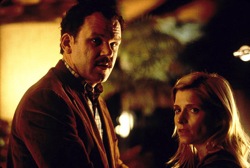
That said, pop culture does play a role, but it is not universally negative as some too easily assume.Magnolia melora walters john c reilly Signs that pop-culture can SERVE the kingdom and not degrade it are not hard to find. The 1999 movie Magnolia could be seen as evidence of our cultural fall with its sex and drug use and gay lead character. But the biblical themes of judgment are rich and the Christian character is the only one who is not coming undone. There is much positive here.
In 2005 Steven Spielberg directed a version of the H. G. Wells classic War of the Worlds. It was not a particularly good movie, but that’s not what matters here. In an interview Spielberg compared this movie with his earlier Close Encounters of the Third Kind. Both involved families. Both involved aliens. The difference, he lamented, was that in his earlier movie, crisis tore families apart. In this newer movie, crisis took families which were apart and pulled them back together.

Progression toward shalom, and not away from it, should be celebrated. Not all ‘progress’ is retrograde.

Nostalgia can fix our eyes on the past and blind us to the progress of God’s work in the present. Perhaps it is better to fix our eyes on the kingdom and celebrate it wherever we see its fingerprints, in the present, in the past, and especially in our hopes for the future.

Mysteries

Here are a few of life’s unanswerable questions, mysteries to which I have no insight. I’m sure you can add to the list. In fact, I wish you would.

1. How do they get the candy coating on the M&M?
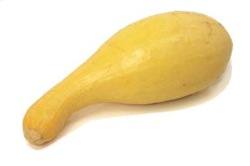
2. Why is it called squash?Squash yellowcrookneck
3. What is “fat-free half and half” half and half of?
4. Do giraffes get hit by lightning with greater frequency than other animals?
5. Do they form the butter into a stick before wrapping it?
6. Why do highly paid professional basketball players ever miss a foul shot?
7. Why is there an expiration date on sour cream?
8. Why are hot dogs always shorter than the bun?
9. For that matter, why do hot dogs come ten to the pack, and buns 8 to the pack?
10. Why does the Virginia Polytechnic Institute go by the initials VT instead of VPI?
11. When does a flashlight ever ‘flash’?
12. Why are smoke detectors pre-programmed to signal dead batteries only at 3:00 AM?
13. Why does someone who believes in the goodness and sovereignty of God worry?

On Significance

Insignificance is the human nightmare. Being nothing and mattering to no one is our existential terror. My recurring fear is imagining myself a researcher who has invested 25 years in her lab following a once promising hypothesis only to lock the lab on a final day realizing that the pursuit was a dead end, her life work irrelevant. Others share such fears.

Florida has spectacular clouds. Towering and billowing and showy and beautiful, they ultimately leave no evidence of ever having been. We shudder to apply that as a metaphor to our lives. We want to matter for more than appearance. We want to leave something of substance in our wake. We fear we never will.

My son confronted extreme difficulty the other day and when I went to him, his first words out of his mouth were not “do you forgive me?” but rather “are you disappointed in me?” The ache of any child’s heart is to hear that he matters, that his daddy is proud of him. It’s the desire of all our hearts, really. If I could hear that, I think the fear of insignificance would simply drift away.

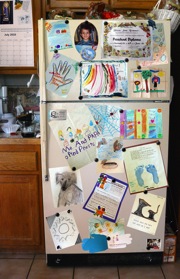
Parents who want to give that message to their children boast of their work. A child sketches and scribbles a picture on a piece of notebook paper, and the parent immediately pins it on the refrigerator. Judged by a purely objective standard, the picture lacks the quality of great art. But the child has significance as she is loved, and as her parent shows his pride in what he considers her well done works.Fridge

The word I long to hear from God is not “I forgive you.” I hear that every Sunday and know it to be true. The word I long to hear is “Well done.” The works I do, judged by a purely objective standard, certainly lack the quality of great works. But my significance lies not in the works, but in the love of my father. I like to think that he has pinned my works on his refrigerator door. He is a good father, proud of me, his son.

All we do we do under the watchful eye of a loving and understanding father. Our works are weak and our production spotty. But this heavenly Father loves us. He puts our pictures on his refrigerator. There is no insignificant child of God.

Powered by WordPress & Theme by Anders Norén