Randy Greenwald

Concerning Life as It Is Supposed to Be

Is It the Weather or the Water?

In Manatee and Sarasota Counties on the west coast of the Florida peninsula, there are five Presbyterian Church in America (PCA) churches. Each is quite different from the others in size and style, but one of the things they share in common, odd as it might seem, is the longevity of the pastoral tenure in each church.

Though I am leaving, I have been at Hope Presbyterian Church for nearly 25 years. Larry Edison, has been pastor at Covenant Life Presbyterian Church for 30 years. Dave Sturkey has pastored Cornerstone of Lakewood Ranch since its founding 18 years ago. John Grady became the pastor at Faith Presbyterian shortly after I came here, through a merger with the congregation that he pastored for a few years before that, so his total is 30. And Dwight Dolby, of Auburn Road Presbyterian in Venice, has nearly 20 years behind him.

No matter how one slices it, this shatters the average tenure (about 7-8 years) of most protestant churches. Not sure why this is. Is it the water we drink or the weather we enjoy? I guess we’ll never know.

For Dads of Pretty Daughters

Seeing this morning that there is a Facebook group called “Guns don’t kill people. Dads with pretty daughters do”, I was reminded of this poem, found many places on the internet (and clipped from here).

As the dad of three pretty daughters, two of whom are single, I understand ‘dreams infanticiddle’.

Song To Be Sung By The Father Of Infant Female Children

by Ogden Nash

My heart leaps up when I behold
A rainbow in the sky;
Contrariwise, my blood runs cold
When little boys go by.
For little boys as little boys,
No special hate I carry,
But now and then they grow to men,
And when they do, they marry.
No matter how they tarry,
Eventually they marry.
And, swine among the pearls,
They marry little girls.

Oh, somewhere, somewhere, an infant plays,
With parents who feed and clothe him.
Their lips are sticky with pride and praise,
But I have begun to loathe him.
Yes, I loathe with loathing shameless
This child who to me is nameless.
This bachelor child in his carriage
Gives never a thought to marriage,
But a person can hardly say knife
Before he will hunt him a wife.

I never see an infant (male),
A-sleeping in the sun,
Without I turn a trifle pale
And think is he the one?
Oh, first he’ll want to crop his curls,
And then he’ll want a pony,
And then he’ll think of pretty girls,
And ho ly matrimony.
A cat without a mouse
Is he without a spouse.

Oh, somewhere he bubbles bubbles of milk,
And quietly sucks his thumbs.
His cheeks are roses painted on silk,
And his teeth are tucked in his gums.
But alas the teeth will begin to grow,
And the bubbles will cease to bubble;
Given a score of years or so,
The roses will turn to stubble.
He’ll sell a bond, or he’ll write a book,
And his eyes will get that acquisitive look,
And raging and ravenous for the kill,
He’ll boldly ask for the hand of Jill.
This infant whose middle
Is diapered still
Will want to marry My daughter Jill.

Oh sweet be his slumber and moist his middle!
My dreams, I fear, are infanticiddle.
A fig for embryo Lohengrins!
I’ll open all his safety pins,
I’ll pepper his powder, and salt his bottle,
And give him readings from Aristotle.
Sand for his spinach I’ll gladly bring,
And Tabasco sauce for his teething ring.
Then perhaps he’ll struggle though fir e and water
To marry somebody else’s daughter.

Salvation by Starbucks

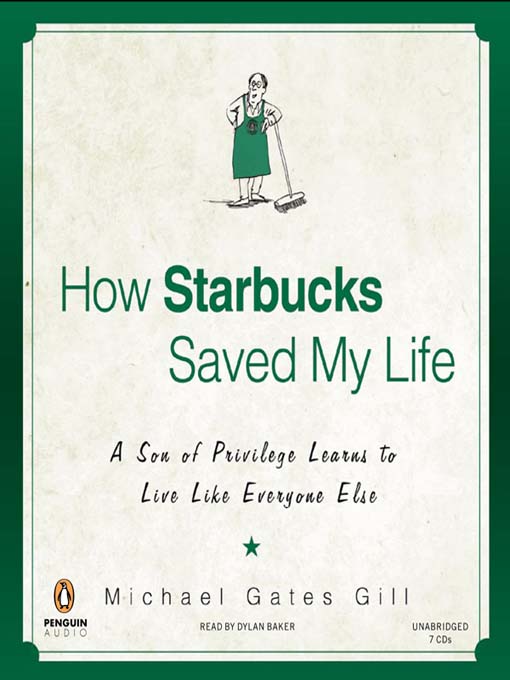
Needing a break from the fairly heavy reading of A Distant Mirror and The History of the Ancient World, I was glad to receive for my birthday from my son and daughter-in-law the book How Starbucks Saved My Life by Michael Gates Gill.

A friend had been recommending this book to me for some time. It is a book that could be enjoyed and tossed aside without much of a thought. However, there is more here of value than one might at first imagine.

The book’s subtitle rightly casts Michael Gates Gill as a son of privilege. His father was a writer for the New Yorker, his Yale education was a matter of course, and his rise to prominence in a major New York advertising firm partially due to the connections his background afforded him.

But at around age 60, it all fell apart. He was fired from his job (younger men were cheaper and just as capable) and he lost his marriage (due to an affair he now sees as foolish) and, in due time, his fortune. Trying still to maintain some semblance of success, he was sipping a latte at a New York Starbucks one day when the African-American manager offered him a job.

Being desperate he took the job. The story unfolds from there. He who in his previous life would argue against the expectations of affirmative action found himself working for a black woman whose mother had been a drug dealer, and alongside of men and women he would have barely noticed much less trusted before. And it all morphs into the happiest time of his life.

Starbucks was the context for Gill’s transformation, and much about the Starbucks culture contributed to his transformation, but the points at which his transformation occurred transcend Starbucks and expose tendencies many of us need to examine. One example will suffice.

Gill is honest about his elitist and arrogant treatment of those unlike him. He was a man who had in his life met the likes of Ernest Hemingway and Jackie Kennedy and was used to treating underlings as capital to be spent and cast aside. At Starbucks, however, he began to see those who were once ‘invisible’ and ‘dispensable’ as real human beings.

One night, he was closing the store with two African-American partners, Charlie and Kestor. When their work was done, they got ready to head to the subway together.

“Kester and Charlie were changing into their street clothes: do-rags, big caps, baggy pants, and boots. They were completely transformed from the smiling Partners in green aprons. They both had earphones dangling down their chests. When I went back upstairs, I was accompanied by two guys who I would have at one point typed as hip-hop artists or gangsters—probably both. But now I knew when I saw guys like these, they might be something else, too. They had lives and loves that were as full or fuller than mine.”

Gill had to fall to see what many of us do not see yet. We look at people and type them: gay, atheist, bitter, happy, homeless, buddhist, liberal, Republican. Once we type them, we fail to see them as real people. They are merely categories about whom we form blanket opinions.

It was no coincidence that I was reading this alongside my study of John 4, where Jesus crosses gender, lifestyle, racial, and religious barriers to do what no one else was doing: treating a sinful Samaritan woman as a real person. May his grace so infiltrate our souls so that we might do the same, see others as people having “lives and loves that [are] as full or fuller than” our own.

The Sojourner

I’m preparing a sermon on Psalm 94 for this Sunday and noticed that God’s concern for the weak and oppressed and under-served finds expression in verse 6 as the psalmist expresses anger that the wicked “kill the widow and the sojourner, and murder the fatherless.”

The lexiconsays that the word translated here as sojourner “…is a man who (alone or with his family) leaves village and tribe because of war, famine, epidemic, blood guilt etc. and seeks shelter and residence at another place, where his right of landed property, marriage and taking part in jurisdiction, cult and war has been curtailed.”

It is clear that God has a heart for the widow, the orphan, and the sojourner, and it is clear that he reserves judgment for those who misuse their power over such.

To apply Scripture to life requires considering how biblical categories translate into modern situations. In our case, the widow may be the literal widow, or the single mom. The orphan may be the child bounced around in foster care, or the unborn child in the womb.

Who in our day would correspond to the sojourner?

Alfred Gore

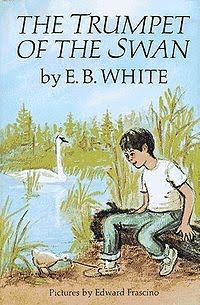
My son and I just finished listening to a wonderful recorded version of E. B. White’s The Trumpet of the Swan.

This story of the trumpeter swan, Louis (as in Louis Armstrong), born without a voice and who learns to play a stolen trumpet and must earn money to pay off his debt and win his love is one of the sweetest in the catalog. The recorded version is special as it is read by the author. Mr. White reads with a certain New England ambience that adds real character to the story. I commend this edition to anyone.

The author introduces a character who makes an appearance on the streets of Billings, Montana, with a name that is strangely familiar: Alfred Gore. Though it is not quite right, even Google can’t tell the difference. Search for Alfred Gore and the top hit is former VP Al Gore’s Wikipedia page.

What’s funny is that poor Alfred Gore, created by Mr. White when the future Vice President was a mere 20 year old still hitting the bars with Harvard roommate Tommy Lee Jones, is presented as a character with little environmental knowledge or concern. I smile.

I introduce you here to Mr. Alfred Gore:

[A storekeeper who has just decided to donate money to the Audubon Society is speaking.]

“The Audubon Society is kind to birds. I want this money to be used to help birds. Some birds are in real trouble. They face extinction.”

“What’s extinction?” asked Alfred Gore. “Does is mean they stink?”

Fair

I know that the topic of immigration, legal or otherwise, is a highly charged and emotional issue. I know that people feel very strongly about the matter for many deeply seated personal reasons. I understand that, and do not want anyone to take personally anything I might say about the matter. My concern in this case is not the immigration issue itself. That is a complex issue that politicians tend to avoid because it has no simple answers. My concern is that when those who possess power wield that power in ways that isolate the powerless, the potential for injustice is so great that we should take notice and ponder carefully the implications.

Megan McCardle, a libertarian commentator for the Atlantic Monthly makes the point I want to make very well here. A sample:

If, however, this law could not possibly be passed if it affected the majority, because it’s far too intrusive and would result in a lot of people passing unhappy hours in jail or waiting by the side of the road while the police checked their ID with immigration . . . well, then, it’s probably not something we should be doing to other people, either.

But I encourage the reading of the whole. It’s short.

A Minor Sadness

As much as I love major league baseball, there is something very special about minor league ball. I’ve posted before about the fun that can be. Generally, men playing in the minors are pursuing their dreams with little immediate gratification other than the dream itself.

As we get ready to leave the town we’ve lived in for nearly 25 years, this town decides to get its very own minor league team! The Bradenton Marauders, a high A affiliate of the Pittsburgh Pirates are playing their inaugural season in what is arguably the sweetest ball park in all of Florida.

My wife, son, and I took in the inaugural game a few weeks ago, and loved every minute of it. I could easily see me following this team regularly. I mean, they play less than ten minutes from my house. We could… oh, yes, that’s right: we’re moving.

Every move has its share of excitement and sadness. We are excited about the move. But ‘twould have been nice had the Pirates installed this team a couple decades ago!

+ + + + +

One could hope, however, if Arizona does not repeal it’s awful new immigration law, that some major league teams will choose to relocate their spring training programs to Florida. If any major league GMs are reading this, I know of 16 prime acres in Oviedo, Florida for sale. Call me.

My Friend, the Root Canal

Last week I compared change to visiting the dentist. We never want to visit, but we are always glad that we have.

As if to add emphasis to that thought, at the end of last week I had to see my friend the dentist. He determined that it would be a good idea to meet his friend the endodontist. My new friend the endodontist liked me so much that tomorrow morning he has invited me back to meet his friend the root canal.

I’ve met enough friends this week.

J. R. R. Greenwald

To write a book about God, if your name is not John Frame, requires you to author it not as ‘Bob’ or ‘Jim’ or whatever your name is, but to author it with initials. Note these:

The Holiness of God, R. C. Sproul.
Knowledge of the Holy One, A. W. Tozer.
And the all-time best Knowing God, J. I. Packer.

I long ago concluded that I could not write such a book for, among other more formidable deficiencies is the simple fact that I am, simply, Randy. I am Randall to the IRS and to the phone company, but Randy to everyone else.

I ruled out many years ago using my initials. “R. R. Greenwald” sounds like a car trying to start with a nearly dead battery. It lacks the pop of a ‘J. I. Packer’. So the book will remain unwritten.

It has occurred to me recently however that ‘R. R.’ does have some precedent not in theology directly, but in literature. If I could get someone to loan me a ‘J’, ‘J. R. R. Greenwald’ doesn’t sound half bad.

Meet and Eat

My son and I have been watching when we can the Discovery Life series. It is beautifully photographed, so beautiful that I wonder if James Cameron has gotten involved. Somehow, though, this series is not as captivating as the previous Planet Earth series.

Perhaps others have formed a different opinion, but the series seems to predominantly explore who eats whom (which we watch in graphic detail) and how various creatures copulate. I guess there’s not much else going on out there in nature.

Admittedly, I’ve seen but two of the ten. To early to form a solid opinion.

Page 68 of 142

Powered by WordPress & Theme by Anders Norén