Randy Greenwald

Concerning Life as It Is Supposed to Be

“What can these anxious cares avail thee?”

Rx for anxiety induced sleeplessness:

Psalm 147:5 Great is our Lord, and abundant in power; his understanding is beyond measure.
6 The LORD lifts up the humble; he casts the wicked to the ground.
7 Sing to the LORD with thanksgiving; make melody to our God on the lyre!
8 He covers the heavens with clouds; he prepares rain for the earth; he makes grass grow on the hills.
9 He gives to the beasts their food, and to the young ravens that cry.
10 His delight is not in the strength of the horse, nor his pleasure in the legs of a man,
11 but the LORD takes pleasure in those who fear him, in those who hope in his steadfast love.

Job 40:8 Will you even put me in the wrong? Will you condemn me that you may be in the right?
9 Have you an arm like God, and can you thunder with a voice like his?
10 “Adorn yourself with majesty and dignity; clothe yourself with glory and splendor.
11 Pour out the overflowings of your anger, and look on everyone who is proud and abase him.
12 Look on everyone who is proud and bring him low and tread down the wicked where they stand.
13 Hide them all in the dust together; bind their faces in the world below.
14 Then will I also acknowledge to you that your own right hand can save you.

Taste deeply and call me in the morning.

This may help as well, but it’ll take longer! (You may need to follow the link to download, if you like. I’m not sure the embedded player below will work as planned.)

Jonathan Edwards Dating Service

It is a little known fact* that the ‘e’ in ‘eHarmony’ stands for ‘Edwards’. Jonathan Edwards, to the surprise of many, is a great companion for young women seeking a worthy life partner. He should be, of course. He had a slew of daughters himself (one named Jerusha, just like a ‘famed’ 21st century Bradenton pastor I know).

I have told my daughters that all men are liars. I exempt none. My particular sample here is, of course, men who are seeking a girl. They will so present themselves so as to be acceptable to the women they seek. In so doing, they will present themselves in ways that may be wildly tangent to reality. We will, as guys, shade and construct the truth in order to make ourselves acceptable. Guys just cannot be trusted.

You can argue with my cynicism if you like, but that is not the main point here.

A Christian women will want, or at least will express her intention to want, a Christian guy. If she is particularly attractive, and her standards become known, there will be a veritable revival in Christian profession among men occurring like a wake around her. Suddenly guys who have not seen the inside of a church in a decade are professing a dear acquaintance with Christianity.

Revivals, we all know, can have spurious ‘converts’. So, when a young lady is faced with a most certainly Christian young man, according to his own profession, how will she, and her father with her, determine the genuine nature, or hypocrisy, of his faith?

Exactly the question Jonathan Edwards sought out to answer in his treatise on the Religious Affections. Okay, maybe not with dating in mind. But the application works nonetheless.

So, as a community service, and to assist all the searching and eligible, but vulnerable young women out there, (and as the last entry in my posts on this book) I direct all to whom this applies to my posts (summarized here). If you don’t have the time, or the patience, for all of that (though telling some guys that you can’t come with him to the movies because you are reading Jonathan Edwards could have quite an alluring impact), I give this one simple assessment of the whole.

The clearest evidence of whether a guy is telling you the truth regarding his ‘profession’ of Christianity will be in his practice, not his words. The genuine guy will seek as a rule to conform his practice to Scripture, and this conformity will be the rule of his life over time. He will not simply be a ‘good man’ who is ‘good to me’. he will be a man whose desire it will be obey Jesus.

Such men are, sadly, rare. (And those that there are are also remarkably blind, overlooking a slew of good, godly, beautiful, available Christian girls. That is the subject for another day.)

So, ladies, look through the veneer of a supposed ‘profession’ of faith, which may be no more than a profession of desire. Listen closely to Mr. Edwards, and you will be in the end a much happier woman.
———-
*because I just made it up.

Randy Sends a Text Message

Prepare to be underwhelmed.

I am generally adept at most things technical, but one skill I’ve never mastered is texting. So, on Monday, with my daughter at Starbucks, I was given a lesson in the finer points. I had taken a picture Sunday, which I knew that I could send to some folks from my phone, but tried with no success. So, in about 4.5 nanoseconds, J showed me how.

Amazing.

Technically, I don’t ‘have’ texting on my phone. That is, we pay for each text sent and received. So, don’t send me a text. But this one indulgence was enough to show me that it could be very addictive.

Now, get this: on my OWN I figured out how to send the picture to my own email inbox! Whoa.

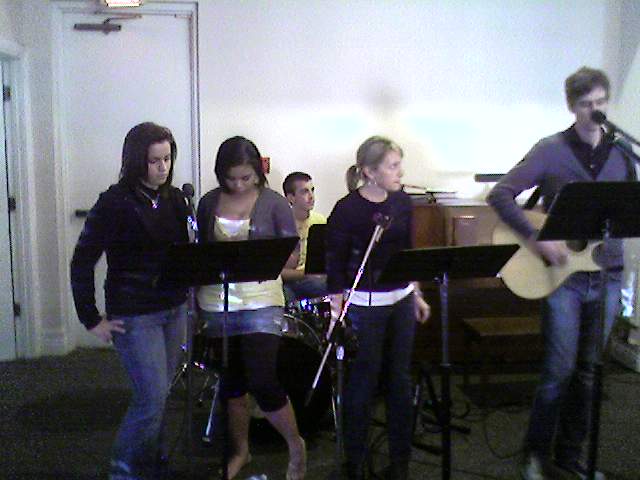
Anyway, here is the picture. It is of our musicians rehearsing for our worship and prayer time Sunday night.

Rovings 12/8/2008

Since the monumental discovery of the Rock, Paper, Scissors Society last week, discovery has been pretty tepid.

That said, I was quite excited to find this free Christmas song from Sixpence None the Richer. It’s beautiful, and free, and as much as I like beautiful, I really like free. (Some thoughts on a recent concert appearance, and an explanation of their name here.) “…so kiss me…”

And thanks to one of the esteemed faculty members of Covenant Theological Seminary, I learned that my preppy name is “Rucker Garrison Vanleer the Fifth”, but that most people know me as “Topper”. I have NO idea what lies behind this.

God Unkind?

“If God were unkind enough to answer some of our prayers at once, and in our way, we should be very impoverished Christians.” (D. Martyn Lloyd-Jones, From Fear to Faith: Studies in the Book of Habakkuk – and the Problem of History, page 24)

It is, it seems to me, a far greater test of the depth and legitimacy of faith, to believe this statement as true, than it is to believe that God answers every rightly prayed prayer.

Forgetting What Lies Behind, We Press On


When I was teaching my youngest son to ride his bike, he would fall often. When he would fall, he would at times look at me and say, “I’m sorry” and act in such a way that made me certain that he thought I was displeased with him. I wasn’t. I was trying to help him ride without falling but he was too busy trying to please me.

It is clear that God wants us to ride without falling. His call is to holy living and fruitful character change. But we fall so often that we wonder if what we are called to do is at all possible.

Then we are told, rightly, that change is God’s business, that ‘sanctification’ is a work of God’s Spirit. What a wonderful truth that is!

But then, we puzzle, why is it that some seem to change more radically than others? And we struggle with why change seems such a dim reality for us. Further, we puzzle over the passages of scripture which tell us to do certain things, and we wonder if there is a role for us in the matter of sanctification after all.

These are the puzzles brought to me by a correspondent last year which I have been trying, in my own way and from my own wrestling to answer. I trust this has been helpful. (If they have been, tell a publisher. Okay, just kidding.)

I have suggested that there are things which a Christian ought to ‘do’, but not what we ordinarily think of doing. Many falsely assume that the path to change is to, well, just change. Scripture and experience suggest that change, real heart change, is not within our reach. Only God can change us at the level we need change.

So what can we do? I suggest five interlocking actions. Click on each and you will be taken to the post where that has been previously discussed.

1. Know who you are

2. Seek the work of God’s grace to change you

3. Put yourself in the way of grace

4. Mortify sin

But even after all of this, we will fall. And when we fall, we will look up at our heavenly father, and say, “I’m sorry” and wonder if he is yet pleased with us. He is. And that is the truth which must be kept before us. So a critical part of our sanctification is one that seems to have nothing and everything to do with it:

5. Rejoice in the gospel

God has done a most amazing thing. While I was a sinner and before I evidenced any desire to be delivered from that sin, he became a man, incarnate in the person of Jesus Christ. Knowing the darkness that would define my heart, he gave his son, Jesus, to die in my place, to die the death that I deserved, to suffer the displeasure of God in HIS body, the displeasure that MY sin evoked. While I was far from him, and showing no inclination to serve him, he raised Jesus from the dead, pouring life into him which, in him, I am privileged to share. And while I was walking away from him, he sought me, profligate with blessings, he loves me when my sin would make me unlovable.

This is the gospel. (And if it is foreign to you, please make it a point to download and listen to the sermons listed under ‘gospel’ on this page.)

This is the gospel which tells us that no matter how many times we fail him, in Christ God is always pleased with us. He is not blind to our sin like some self-deceived wife who chooses to overlook her husband’s infidelity pretending that it does not exist. He is well aware of our failure, but does not count it against us since the full punishment of it has been born by his Son. His work is finished, and we have been made his forever.

The prophet Isaiah says that he ‘remembers our sin no more’. This does not mean that God has a faulty or altered memory. It means that because that sin has been fully dealt with by Jesus, he chooses not to bring it to bear against us. He cannot love us less than he does now.

Knowing these things (as poorly as I do) has two results. The first is that I am awed and struck with a wonder of great refreshment. I know at this point the ‘hug’ of God. At the same time, I am deeply sorrowful that I do not live up to what he has made me to be. His love for me is a far greater motivator to holiness than any threat of judgment or hint of displeasure.

So, what we must do in our struggle against sin is rejoice in this gospel of God’s grace to us. I pray often that God would restore to me the joy of His salvation. This is what David prayed after his failure with Bathsheba and it is what we should be praying. When I fail, I have to return to the cross and be reminded that Jesus died for that sin, as well as all I will commit. I need to be reminded that God loves me no less for that horrendous failure. I need to be reminded that God brings glory out of my weakness, and that I who have sinned have yet to see what wonder he will produce out of it and in me.

What you need to know and think deeply on when you fall down and look up to your father is that you name is ‘son’ not ‘exile’.

How do you do this? I don’t know how else other than to worship. We need to be in a community of believers who celebrate the gospel. We need to hear the gospel preached. We need to sing songs which emphasize the gospel.

Yes, Christian, there are things you can do. You can call to mind who you are. You can pray earnestly that God would change you. You can diligently put yourself in the way of grace and you can dutifully mortify sin. But your ultimate hope lies not in effort or act, but in the faithfulness of God displayed in the Gospel.

Rejoice in that gospel.

The Day the Earth Stood Still

December 12, the trailer says, is, ominously, The Day the Earth Stood Still. Actually, it is simply the date on which Scott Derrickson’s remake of the classic cold-war era sci fi feature will be released. I’m skeptical of remakes of classics, but Derrickson is a Christian whose The Exorcism of Emily Rose was very well done, so, I’m withholding judgment.

However, today I could use some earth standing still. I have a lot to do. My sermon needs more time to develop. I have some difficult tasks facing me this afternoon. There is just a lot on my plate.


So then, to my delight, I came into my study this morning to find that my wall clock is stopped at 12:39 AM. It has not moved since I came in. It shows that I got here VERY early, and that I’ve gotten quite a bit done since coming in and yet no time has yet elapsed.

My prayers are answered.

Sort of.

By Fruit You Will know

I finished Monday a project begun a long time ago (see here and here), the reading of Jonathan Edwards’ Treatise Concerning Religious Affections. Edwards is nothing if not thorough. And he is zealous to buttress his assertions with ample reference to Scripture. So, the work is wordy. But that wordiness is no slam against its worth. I’ve reflected extensively on this before, so no need here to repeat my thoughts.

I did not wish to leave the book without emphasizing the 12th sign of the work of God’s grace in the life of a professor of Christianity. His point here is that the major evidence for the reality of the work of God’s grace in our lives and others is the fruit of Christ-likeness we display subsequent to our profession of faith. It is our practice, the fruit, that reveals us and others for who we are.

Edwards says this:

“From what has been said it is manifest, that Christian practice or a holy life is a great and distinguishing sign of true and saving grace. But I may go further, and assert, that it is the chief of all the signs of grace, both as an evidence of the sincerity of professors unto others, and also to their own consciences.”

and this:

“Christ nowhere says, ye shall know the tree by its leaves or flowers, or ye shall know men by their talk, or ye shall know them by the good story they tell of their experiences, or ye shall know them by the manner and air of their speaking, and emphasis and pathos of expression, or by their speaking feelingly, or by making a very great show by abundance of talk, or by many tears and affectionate expressions, or by the affections ye feel in your hearts towards them: but by their fruits shall ye know them; the tree is known by its fruit; every tree is known by its own fruit.”

It is for these reasons that when I first hear of someone’s ‘conversion’, my rejoicing is tentative. I only believe what I hear when the fruit of what is expressed is revealed, and that takes time.

But what fruit do we look for? Is it perfect compliance to the law of God?

Hardly.

I read also this morning on ParadoxUganda of a man who during his marriage had pursued two affairs. Can we say that this man is truly saved? Given what is said here about his testimony before his church, we can believe he is:

“A primary school head teacher, who looked familiar to me but whom I do not really know, stood up front with his Bible, and proceeded to give the most beautiful testimony of repentance I have ever seen in any church. He began by saying that though he had become a Christian in 1992, he felt he was truly being born again today. He read several Scriptures to show that he needed to repent to God, to the church, to his children, and to his wife. Then instead of the vague “If I have done you any wrong please forgive me” kind of weak semi-repentance, he boldly told his story, saying that he had pursued two extra-marital sexual relationships over the last few years, and describing the terrible impact on his wife, and on his life. He actually got down on his knees, and his wife came up front, and when he asked for her forgiveness she granted it. The elders came forward and prayed for both of them, and their young child. Bhiwa hugged the man so hard he lifted him off his feet, and the women in the congregation were cheering they were so amazed. When it was all over the wife stayed up and asked if she could sing. She was too overcome to speak, but she stood in front of the church and sang solo a song about Jesus on the cross while a tear rolled down her cheek. Then in the prayer request time three other men stood up, none with specific repentances like this but all three asking the church to pray that they would be convicted by the Spirit and change as this man had!”

I want to see in a person a pursuit after godly behavior. But that pursuit will never be perfect. It must be conjoined with a regular repentance and a continual re-apprehension of grace.

That is the fruit of true conversion.

Awakenings

Rare is the movie I will watch twice in one weekend. But when one finds a good story, one wants others to discover it as well. So, a week or two ago, we were encouraged to watch a 1990 film Awakenings. Friday night, Barb and I watched it, and Sunday night, we watched it again, this time with many of our family members around.

This is not an original story. More incredibly, it is based on real events from the summer of 1969 in the life of a reclusive neurologist at a hospital for the chronically ill. But it is, as a story, more than that. At the end, Robin Williams, playing the neurologist, sums up the lessons of the summer, and says this:

“Another awakening took place. The human spirit is more powerful than any drug, and that is what needs to be nourished. Work, play, friendship, family. These are things that matter. This is what we’ve forgotten. The simplest things.”

The Flavor of Heaven


What will heaven taste like? It will be less like our ordinary Sunday services than we might imagine.

Our son and his wife recently moved into a neighborhood outside Miami, Florida, into a neighborhood which they describe in terms befitting the United Nations. They are white, their immediate neighbors are black, Cuban, and several other nationalities.

That is quite a bit more like what heaven will look like.

This past Thursday, Hope Presbyterian Church, the church I pastor, joined with St. Paul’s Missionary Baptist Church, pastored by my good friend James Roberts (pictured), for a joint Thanksgiving service. Pastor James brought with him their Young People’s Choir. You can hear a selection of their offering here. It was a wonderful service.

Is this what heaven might sound like?

It all suggests to me that heaven will not taste like anything familiar. But it also suggests to me that when we get to heaven, our taste for that which is not familiar but glorifying to God, will grow.

Page 112 of 142

Powered by WordPress & Theme by Anders Norén