Concerning Life as It Is Supposed to Be

Category: Uncategorized Page 52 of 71

The New Gadget

If you actually come to the blog page (as opposed to simply reading the posts through an RSS feed) you will notice a new gadget on the left hand side of the screen. If this works, it will calculate and keep updated the current ‘Magic Number’ for the Tampa Bay Rays. What this number represents is the necessary Rays wins and/or second place team’s losses for the Rays to clinch their division title.


I have watched magic numbers before. I grew up in Cincinnati watching the Big Red Machine, and lived in St. Louis during the heyday of Whiteyball. It is a happy diversion.

I wonder what playoff tickets cost?

Technorati Tags:

A Good Wife – Found!


Friday night is our date night. Standard operating procedure is for us to watch a movie at home, run to Starbucks for a drink and some conversation, and then return home for another movie. (We tend to be exhausted by Friday, and this is an inexpensive way for us to relax together doing things we both enjoy.)

The problem is that Friday nights will normally feature the Rays playing ball on TV. On most days, I set the DVR to record the game, and I watch it when (and if) I can that same night. (By the time I discover the score in the newspaper the next day, I’m no longer interested in watching.) But I studiously resist recording the Friday game, for obvious reasons.

So, on the way to Starbucks, we listened to a bit of Friday’s game, and we listened to it a bit more on the way home. We had a stop to make on the way home, and when we climbed back into the car and turned it on, the announcer was beside himself: “That’s Ben Zobrist’s first career grand slam home run.”

For a Rays fan, this is good news, and both Barb and I were pumped to hear it. So, this is how the conversation went from that point on.

Randy: And we could have been there. (I had earlier in the week suggested that we break tradition and go to a game, but we chose not to. This comment was dangerously close to an “I told you we should have gone”, which would have earned substantial ‘Bad Husband Points’.)

Barb: I know. Did you record it?

Randy: No. I didn’t think it would be a good idea to record and watch a game on our date night! (Note the stab at earning ‘Good Husband Points’.)

Barb: Well, at least we could have watched the grand slam.

Doesn’t the book of Proverbs say something like this: “A wife who wants to watch baseball, who can find. She is far more precious than jewels.”

Well, that’s close, anyway.

Technorati Tags: ,

Troublemakers


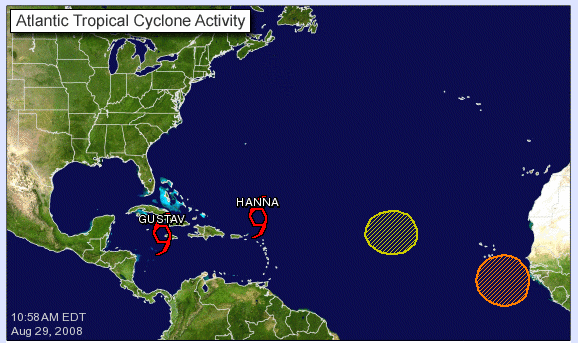
Our daughter Hannah and our friend Gus (short for Gustavo) share the same birthday, although something like sixty years apart. Now it appears they are causing trouble together as Tropical Storm Gustav and Tropical Storm Hanna. (We can’t help it if the weather people can’t spell.)

Way to go, guys.

Technorati Tags:

Mike Teevee

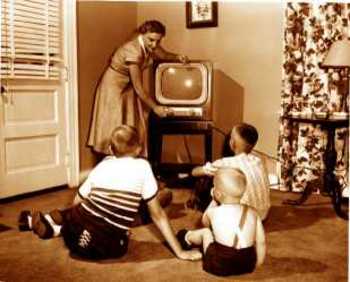
The simplest explanation for the lost passion for reading is to blame the television. My favorite presentation of this charge comes from Willie Wonka’s Oompa Loompas as they sing regarding the demise of poor Mike Teevee. This is especially fun to read to children. But there are plenty of us adults who might need to pay attention to it as well.

Enjoy!

The most important thing we’ve learned,
So far as children are concerned,
Is never, NEVER, NEVER let
Them near your television set —
Or better still, just don’t install
The idiotic thing at all.
In almost every house we’ve been,
We’ve watched them gaping at the screen.
They loll and slop and lounge about,
And stare until their eyes pop out.
(Last week in someone’s place we saw
A dozen eyeballs on the floor.)
They sit and stare and stare and sit
Until they’re hypnotised by it,
Until they’re absolutely drunk
With all that shocking ghastly junk.
Oh yes, we know it keeps them still,
They don’t climb out the window sill,
They never fight or kick or punch,
They leave you free to cook the lunch
And wash the dishes in the sink —
But did you ever stop to think,
To wonder just exactly what
This does to your beloved tot?
IT ROTS THE SENSE IN THE HEAD!
IT KILLS IMAGINATION DEAD!
IT CLOGS AND CLUTTERS UP THE MIND!
IT MAKES A CHILD SO DULL AND BLIND
HE CAN NO LONGER UNDERSTAND
A FANTASY, A FAIRYLAND!
HIS BRAIN BECOMES AS SOFT AS CHEESE!
HIS POWERS OF THINKING RUST AND FREEZE!
HE CANNOT THINK — HE ONLY SEES!
‘All right!’ you’ll cry. ‘All right!’ you’ll say,
‘But if we take the set away,
What shall we do to entertain
Our darling children? Please explain!’
We’ll answer this by asking you,
‘What used the darling ones to do?
‘How used they keep themselves contented
Before this monster was invented?’
Have you forgotten? Don’t you know?
We’ll say it very loud and slow:
THEY… USED… TO… READ! They’d READ and READ,
AND READ and READ, and then proceed
To READ some more. Great Scott! Gadzooks!
One half their lives was reading books!
The nursery shelves held books galore!
Books cluttered up the nursery floor!
And in the bedroom, by the bed,
More books were waiting to be read!
Such wondrous, fine, fantastic tales
Of dragons, gypsies, queens, and whales
And treasure isles, and distant shores
Where smugglers rowed with muffled oars,
And pirates wearing purple pants,
And sailing ships and elephants,
And cannibals crouching ’round the pot,
Stirring away at something hot.
(It smells so good, what can it be?
Good gracious, it’s Penelope.)
The younger ones had Beatrix Potter
With Mr. Tod, the dirty rotter,
And Squirrel Nutkin, Pigling Bland,
And Mrs. Tiggy-Winkle and-
Just How The Camel Got His Hump,
And How the Monkey Lost His Rump,
And Mr. Toad, and bless my soul,
There’s Mr. Rat and Mr. Mole-
Oh, books, what books they used to know,
Those children living long ago!
So please, oh please, we beg, we pray,
Go throw your TV set away,
And in its place you can install
A lovely bookshelf on the wall.
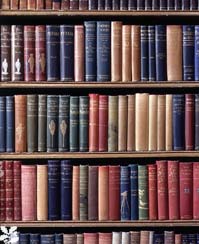
Then fill the shelves with lots of books,
Ignoring all the dirty looks,
The screams and yells, the bites and kicks,
And children hitting you with sticks-
Fear not, because we promise you
That, in about a week or two
Of having nothing else to do,
They’ll now begin to feel the need
Of having something to read.
And once they start — oh boy, oh boy!
You watch the slowly growing joy
That fills their hearts. They’ll grow so keen
They’ll wonder what they’d ever seen
In that ridiculous machine,
That nauseating, foul, unclean,
Repulsive television screen!
And later, each and every kid
Will love you more for what you did.


(With gratitude to Roald Dahl!)

Technorati Tags:

Where Have All the Readers Gone?

The commencement address of Pulitzer prize winning author David McCullough includes this passionately expressed exhortation:

“Make the love of learning central to your life…. You have had the great privilege of attending one of the finest colleges in the nation…. If what you have learned here makes you want to learn more, well that’s the point. Read. Read, read!”

One of the things that strikes me about this is that he made these comments to the graduates of, what he calls, “ONE of the FINEST colleges in the nation.” (The other is, of course, Michigan State University.) These graduates are the recipients of a top notch liberal arts education, and he is fearful that they will stop reading. That is amazing to me.

What, then, kills the love of reading? Or how have we failed to spark it?

I understand the typical explanations – television, video games, and the like. But there has to be something more basic. The child of mine who loves to read as much if not more as any of my children was the one who played the MOST video games and watched the MOST TV growing up. Something else is at work here.

The obituary for philosopher Mortimer Adler points out that he dropped out of school at age 15. Two years later, after reading Plato, he decided to become a philosopher. So, what was he doing after he dropped out of school? Reading Plato, apparently. What would have happened had he stayed in school?

Winston Churchill did not have grades good enough to enter Oxford or Cambridge, so he went to a military school and became an officer in the British army with a boring deployment to India. What did he do there? Began to read voraciously. The rest is, literally, history. But his passion to learn did not come in school.

For those of you reading this, please help me out: what was it that instilled a love for learning and for reading in you? Or, what killed it? I’d really like to know.

Technorati Tags:

Read, Read, Read

A number of thoughts have merged together recently on the subject of reading, so in several posts I will weave them together. I suspect that I am preaching to the choir, but so be it.

In response to my post about Where Writer’s Write and David McCullough’s wonderful garden writing shed, Staci left a challenging comment in which she made reference to Mr. McCullough’s commencement address to this year’s graduates of “Boston University”. (I searched fruitlessly for the whole address, stumped by my inability to successfully google this. Astute readers will spot the problem immediately. It’s Boston COLLEGE, not University. If that was a test, Staci, I failed.)

She quoted part of that address, a portion of which I reproduce here:

“Make the love of learning central to your life. What a difference it can mean. If your experience is anything like mine, the books that will mean the most to you, books that will change your life, are still to come. And remember, as someone said, even the oldest book is brand new for the reader who opens it for the first time. You have had the great privilege of attending one of the finest colleges in the nation, where dedication to classical learning and to the arts and sciences has long been manifest. If what you have learned here makes you want to learn more, well that’s the point. Read. Read, read! Read the classics of American literature that you’ve never opened. Read your country’s history. How can we profess to love our country and take no interest in its history? Read into the history of Greece and Rome. Read about the great turning points in the history ofscience and medicine and ideas.

”Read for pleasure, to be sure. I adore a good thriller or a first-rate murder mystery. But take seriously –read closely –books that have stood the test of time. Study a masterpiece, take it apart, study its architecture, its vocabulary, its intent. Underline, make notes in the margins, and after a few years, go back and read it again.“

In searching for this, I stumbled across the comments made by the commencement speaker to the 2003 graduating class of Hope Presbyterian School. Here is a curious excerpt:

Delight in all of life. Be curious. Pursue your loves and interests. And whatever you do, never be content with what you know.

This is a great big creation full of interest and God’s glory. Embrace it, come to know it, learn it. Hence, read, read, and read some more. Don’t let your brain turn into cottage cheese. Investigate, study… delight in life and in the world God has given….

The development of your curiosity, your love of learning, your passion for life… these things are more important than the degree you are receiving tonight.

I don’t suppose I could build a case for plagiarism, and to say ‘Great minds think alike’ would be unnecessarily degrading to Mr. McCullough. But it is something of an affirmation to hear someone of stature echo my own thoughts.

But why do such things – challenges to educated people to read – need to be said at all?

Technorati Tags:

Sign of the Week


I pulled up to a stoplight behind a motorcycle riding sheriff’s deputy this afternoon and for some reason looked at his license plate. Around his plate was a frame, and on the frame was written:

“Smile. I could be behind you.”

I smiled.

Technorati Tags:

An Online Notebook


My buddy Jeff (not to be confused with my colleague Geoff) told me the other day that he was glad to see that I was actively blogging again. ON Sunday I caught myself asking why I did this and trying to answer. Here is a more reflective answer to that question.

1. This is for me, an ‘online notebook’. It is a place to deposit my thoughts, observations, and reflections. There are things that I must get on ‘paper’. This helps. James Fallows says this about his blog for the Atlantic Monthly, “I undertook this long ago mainly as a notebook for myself. That is still my fundamental motivation, though like everyone in the writing business I am of course grateful to anyone who pays attention.” I, too, am grateful to all of you who pay attention.

2. It is as well a ‘discipleship tool’. As a pastor, I want to impress upon others what God has called us to be. My task as pastor is more than deliver a weekly theological address. I long to see people growing in their love for Christ and maturing in their Christian practice. A blog provides one more tool that I can use to encourage others to love and good works.

3. It is a place to write. Some people do everything possible to avoid writing. Writing for me is an outlet, often a refreshment and a delight. Tied in with this is a desire to delight, to entertain, to challenge, or to encourage others with my writing. I was told in college that those who want to write must write daily. To do so with instant readers was something this professor then could never have anticipated.

4. It is the refrigerator in which sermon leftovers are placed. In preparing a class or a message many more thoughts and ideas are suggested than can be used. So, I sometimes put here what I can’t use there. And sometimes I come here and grab out something that has marinated and is ready to be used there!

5. And, at least for now, it’s fun. And my buddy Jeff says, appreciatively, that this shows. I’m glad.

Technorati Tags:

Of Easels and Typewriters


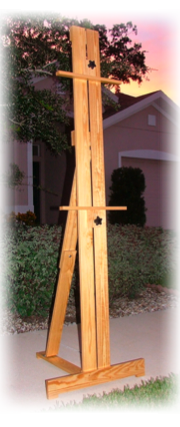
Recently I’ve been making a batch of artists’ easels. Ten of these will end up in a new studio which is being established here in Bradenton and the rest will be sold (hopefully!) by a local artists’ supply store. As I was working on them last Saturday, I was pondering their future. Some will be used, used hard, and eventually tossed into the garbage when their usefulness is gone. Some will be used initially with great enthusiasm, and then stored in a closet when the owner’s interests move elsewhere. Some may be used for a very long time and be a delight to their owners.

But it is possible that one, perhaps, will be used to hold a canvas on which an artist completely unknown to me may paint a great and celebrated work of art. And if it were to be, which easel would it be?

To imagine such a use for one of the easels is exciting, but that does not change the way I make any one of them. All of them are being made with the same attention and care.

As mentioned in a previous post, David McCullough writes in a shed with no computer, using only the same vintage Remington typewriter that he has used since the early 1960s. (That led Barb to wonder where one buys typewriter ribbon these days, but that is for someone else to figure out.) This means that one day long ago, there was a worker in a Remington factory making typewriters, each carefully assembled with pride (hopefully). Unknown to him, on one day, he assembled a typewriter which has been used to produce two Pulitzer prize winning works of history. Pretty cool. But the man who made the typewriter will never know that.

Pastors preach sermons, mothers nurse wounds, fathers give instruction, teachers motivate to excellence, and those who care do so with passion and heart and energy and concern. They are careful with and concerned for each person, child, or student which crosses their path. But maybe, somehow, unbeknownst to them, in time, on one of these children, students, or congregants, God will impress a work of greatness in which those who invested in that life will have a stake, but possibly no knowledge.

Perhaps it is convoluted logic, but I want to look upon the people we touch with that same wonder and fascination with which I look upon my easels. I may not know ever to what use God may put them, but the potential is always that he will do something great. With my easels, yes. But with my children, too. And with those to whom I preach.

And the fact that I will not see that should not change the love and concern with which my hands seek to mold and shape the tool while it is under my care. Or yours.

Technorati Tags: ,

Where Writers Write

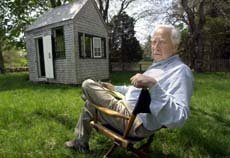
Included on the John Adams DVD is a special feature on the author of the book, David McCullough. (Fans of the old Ken Burns Civil War documentary have met him before as the voice of that feature’s narration.) McCullough has had phenomenal success as a writer of history. He likes to think of himself as a writer who writes about real people in the past. With two Pulitzers under his belt, I suppose we can say that he’s done a pretty good job of it.

A fascinating revelation in this was the description of where McCullough writes. Behind his house, through a gate in a fence, in a wooded garden there is a small building, no larger than a small shed. In that ‘shed’ is no computer, no telephone, no connection with the outside world, no distraction. There is a typewriter, a desk, a couple of file cabinets, and solitude. This is where his books have been written.

On each side of the gate there are posts. McCullough’s rule is that when he is working no one taller than those posts is allowed to pass through the gate to interrupt him. But if one is smaller than the height of those posts, he is free to come and go at will.

I’m reminded of what I have heard about 19th-century Princeton theologian Charles Hodge whose study was in his home on the seminary campus. Adults knew not to interrupt him when he was working. But little ones? He had the latch removed from the door which opened to the house so that the door would swing freely at the touch of little hands.

Those who want to write (whether it is books, theology, or sermons) need to guard their solitude. They need to build fences around their time and their space which are inviolable. But those fences need to have human sized gates which reflect a balance between isolation and humanity.

McCullough sounds like a guy I’d like to meet.

But not when he’s working.

Technorati Tags: ,

Page 52 of 71

Powered by WordPress & Theme by Anders Norén