
Concerning Life as It Is Supposed to Be

Month: June 2020

The Allure of Biblical Decency (Reprise)

At a political rally a Christian pastor proclaims,

“In a manly time of struggle one cannot get by with effeminate and sweet talk of peace.”

One can imagine his comments receiving a vigorous supportive response. Men, even Christian men, are to be marked by strength and aggression. We are to fight for our rights and never back down. Real men pack heat and and kick ass when called upon.

And I wonder if we’ve read our cultural biases into a Christian script and gotten off track somewhere. Perhaps way off. The Christian pastor spoke these words at a 1937 rally in Frankfort, Germany, in support of Adolph Hitler.

Christianity’s current determination to make sharp distinctions between masculinity and femininity is, while aimed at a good goal, wildly off the mark. Nostalgia leads us to imagine a time when men were men and women were women. We feed off that nostalgia, no matter how inaccurate, and then find in our Bibles verses that seem to anchor those claims in scripture. That’s a bad idea all around.

And yet the motive is a good one. Christian men are wondering how to shape their character and how to be obedient as a man to their Christian discipleship. It is good to give them direction. But the issue is not masculinity but decency. Let’s guide men toward decency.

But isn’t the word ‘decent’ too tepid? Isn’t it too broad? Perhaps. I know there are those who sense some of the same things I do who rightly prefer to speak of ‘godliness.’ I don’t quibble with that. To be godly is to be decent. But the language of decency speaks to a broader public and includes within its boundaries people of virtuous character who make no claim to Christianity. Christian men seeking to be godly men will be decent men, will be good men. That is language I think we can understand and live with.

Such decency will be for us defined by Scripture. It is modeled by Christ. It is outlined in the gospels and the epistles. It includes attributes we ordinarily attribute to masculinity – courage, for example, and integrity – and those we see as more feminine – compassion and gentleness. We should pursue these things not because we want to be men, but because we want to be like Jesus. And in our current context, to aim to be simply decent men will be to run against the tide, politically and culturally. It is an act of rebellion.

When the question is asked, “What kind of people do you associate with the church?” I want the answer to be, “Decent people.” There is a certain appeal to looking at a person, man or woman, and noting their fundamental decency and longing that more of us might evidence such character. My appeal as a pastor speaking to men who want to be men is simply this: let’s be decent men.

I could be drawn to a community, a church, a nation, and a world comprised of decent men. I’m not sure how to seed the world that it might sprout such men, but that would be the world in which I’d like to live.

Note: The quote with which this post begins appears on page 262 in Charles Marsh’s Strange Glory: A Life of Dietrich Bonhoeffer, a book I hope to review here soon. (Which I did here.)
The Myth of Biblical Masculinity (Reprise)

Standing in the serpentine line guiding us to our luggage after a cruise, my wife and I passed and re-passed a confident and athletic looking man wearing a t-shirt that broadcast his vision of masculinity. It said, “Cool story, Babe…now make me a sandwich.” He was not one to be pushed around, this one. He knew his place as a man and was going to assert it. Or, at least, he wanted others to THINK he knew.

We are told, though, that many men these days aren’t quite sure what their place is. And so books for “dudes” are written to guide them (with endorsements by real men like pro athletes). Charismatic pastors speak directly to men, using strong and colorful language, to shape their thinking of manliness. Defining what is called ‘Biblical Masculinity’ has become the rage and I’d like to make a modest plea that we stop trying to define what isn’t there.

My plea may arise from my not being very masculine. Yes, I can grow a beard, so there is that. And I like to hang out in my garage when I can. So far so good. But I don’t hunt. And if I do go fishing (once every decade, at least, just to keep the skills fresh), and if I were to catch anything (not likely), my wife is the one who would clean it. She likes that kind of thing. I do the grocery shopping in our family and have to be reminded how to start the lawn mower should my wife not be able to take care of the lawn some week. So perhaps my dismay over the search for biblical masculinity arises from my own confusion.

That may be so. But I like to think it arises from the fact that the Bible shows a complete lack of concern for such a thing. I don’t see Jesus or Paul or any of the gospel writers or apostles overtly concerned with teaching men how to be men. Yes, we are given some direction as husbands and fathers, but many fine men are neither.

I would plea that we simply get over trying to be men and replace that with a passion to be decent. How about we champion the admittedly rather bland and gender inclusive goal of biblical decency? We could stand for this, couldn’t we?

I don’t think the book on this has yet been written, but certainly it would include a chapter on kindness. And for sure there would be one on the courage to stand for the weak. Another would encourage integrity and fidelity. And it must include one on owning our wrong and making it right. It would cover all the essentials of what makes for a decent, if not ‘manly’, man. Compassion. Patience. And the meekness with which one will inherit the earth.

I’m open to correction here. Maybe ‘biblical masculinity’ is a genuine biblical thing. But even so, should not the pursuit of ‘biblical decency’ be an even more noble cause? To embrace that is my plea.

I’m sure my sons would have loved to have had a more manly dad. They had to have other guys show them how to fish and to take them hunting. I did go backpacking with the older two once, so maybe that counted for something. But as I recall, none of them ever sat me down and urged me to do more ‘manly’ things.

One, though, did sit me down and ask me to be more gentle. I think he wanted a dad who was a more decent man. And that is a good longing.

Go think about it, men, as you make your sandwich. Make one for your wife as well. It would be the decent thing to do.

Deliver Us from Manhood

Three and one-half years ago I wrote a series of posts questioning the whole idea of “Biblical Manhood.” My concern was to call men to quit worrying about being “manly,” whatever that might mean, and to embrace decency instead. “Biblical Decency” seems to me to be a far more defensible concept. To be a decent, trustworthy, and compassionate guy seems to me to be something more critical than exercising some dubious quality called masculinity.

Those posts bear reposting. We live in a moment that more than ever seems devoid of decency. Among the many examples that could be named (such as the macho chest pounding that passes as US foreign policy, and is cheered by some Christians) the primary one that leads me to revisit these posts is the one that has landed hard on my corner of the Christian world. In this corner, the one that birthed the idea of “Biblical Manhood,” there has been shown to be great rottenness. That brings shame on us all.

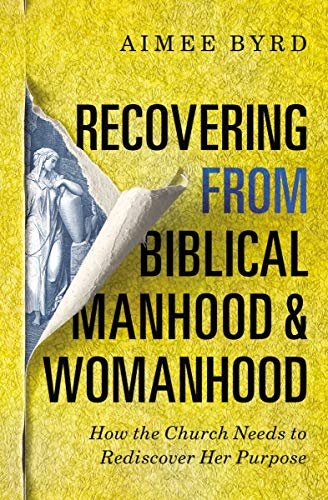
Aimee Byrd, a thoughtful and articulate woman, has written a book in which she challenges some of the assumptions and consequences of the Biblical Manhood movement. The response she has received has been ugly. “Biblical Men” can apparently be mean, which should cast a suspicious cloud over the whole business. The controversy has been well summarized by Ed Stetzer in Christianity Today and discussed by Byrd herself here and to some degree here. It seems that to some men what matters is not that she is thoughtful and articulate. What matters is that she is a woman. Frightened, I suppose, by a strong and courageous woman, they have launched ad hominen attacks on her character, her appearance, and her biblical faithfulness.

This is disheartening to me. (No doubt this is because I’m an effeminate softie.) But I would think it obvious to most that decent men or women do not demean the looks or reputations of others, whether those others be men or women. How can this be such a hard lesson to learn? Boys will be boys, some say, though even that is worth questioning. But men should be granted no pass to be cruel. We will be, of course. Occasionally we will say something mean or disparaging of another. But when called on it, decent men own it and seek forgiveness. So do women. It’s a part of being a Christian.

So, yes, for what it is worth, these things bear repeating and reposting. So, I will repost over the next several days. If you don’t want to wait, you can read them in their original setting here.

All Things Being (Un)Equal – the Prayer Edition

My wife and I were praying together after breakfast, as we do. It was her turn, and in a context I’ve since forgotten, she included this line in her prayer, “. . . it’s been a long time. . .” and for me all concentration was gone. Whatever spiritual demeanor I had worked up for that moment, drained away and was replaced with a series of queries, each leading to another.

“Where’s that line from?”

“Oh, right – from a Led Zeppelin song. What song?”

“I can’t remember. I need to look it up. Wait, I can’t do that right now. Okay. What are the other lines?”

“Wait. Barb’s still praying. Oh, she’s almost done. I’ll look it up then.”

There you have it. Insight into the mind and heart of a Deeply Spiritual Pastor.


I joke about being a Deeply Spiritual Pastor. But it is no joke that Christians condemn themselves without mercy for the state of their prayer lives. Perhaps we do need to pray more, or more often, or with more people. Others have addressed all those questions.

The question which few address is why it is hard for some of us to meet the goals others set for us. I would like to suggest that some of us are not wired to pray like everyone else. And to consider this can be greatly freeing.


I have never done well with private prayer. Sometimes that’s because I question its power or usefulness, issues of theology and faith whose solution lies elsewhere. I have something else in mind here.

Sometimes I struggle with prayer simply because it is profoundly difficult for me to sit still. I have a good system for prayer. I flip through names on cards and recite to God my concerns for each person, and this has value. But I quickly grow antsy.

I am fine with this until I read or hear someone say that we can assess the spiritual vitality of a person by his prayer life. We can know, it is said, what a man truly believes by the quality of his prayers. And suddenly, I feel like a spiritual hamster. I follow the rules for prayer, but as for Experiencing Awe and Intimacy with God, no, Tim, it ain’t happening that way for me.

Should I even be a pastor? What’s wrong with me?

I know others of you struggle as well and for you I want to offer a suggestion. What if we struggle not because there is anything wrong with us, but because who we are does not fit with the majority opinion on how prayer is to be done? What if some of us are cut out of different cloth?

The cloth from which I come is sufficiently ADHD that focus is a genuine problem. Create an environment in which I am to be alone with my thoughts and distractions come easy. Let a lyric from an old song cross my mind and I’ll chase that squirrel and cannot help myself. That should not reflect poorly on my or your spiritual vitality.

Maybe the way some of us are wired makes it fundamentally more difficult for us to pray privately than others. Maybe we are not like those spiritual giants whom we are told we are to emulate because we have, in fact, a more slippery hill to climb.


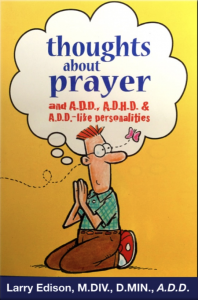
I posed these questions to my good friend and reluctant mentor Larry Edison, whose response was to write a book reflecting on the unique challenges that those with unique neurology face when sitting down (if they sit!) to pray. I know of no one else saying these things.

Notice the credentials following Larry’s name.

Larry does not want us to use diagnoses as an excuse for sin. At the same time he wants to liberate those whose minds work differently from the templates and paradigms laid down by those who write the standard books. The guilt for non-conformity and the shame of inability is already great in other ways for those with an a-typical mind. We would never tell a person with paralyzed legs that they must climb the stairs or the blind that they must admire a piece of an art. Why then do we insist that those incapable of focus should judge the quality of their spiritual lives by their conformity to a certain paradigm of mental focus?

It’s freeing to be told that perhaps prayer is more difficult because one’s brain is wired differently those who write the books and that is okay.

Always practical, Larry is honest about ways he has found to “pray without ceasing” that fit the way his ADHD brain works. You can judge the quality of a man by his prayers. But not if you force him to pray like everyone else.


The cover alone will encourage those of us with attention struggles. It was drawn for Larry by his good friend Tom Armstrong, creator of the syndicated comic strip Marvin.


Prayer will always be a struggle for Christians. It is, by nature, a declaration of dependence upon another, and our flesh will resist that. Let’s just make sure we are struggling with our flesh, and not with the expectations placed on us by well-intentioned but overzealous Christians. It’s encouraging to know that Right for me may be Different from the good people who write the books.


For those of you who have “read” this far, but not retained a word, I understand you completely. The information you are looking for is “Rock and Roll” released by Led Zeppelin in 1972.

Powered by WordPress & Theme by Anders Norén