Concerning Life as It Is Supposed to Be

Month: October 2017

Martin’s Slippery Slope

On October 31, 1517, Martin Luther took one small step for a man, one giant leap for mankind, onto the slippery slope.
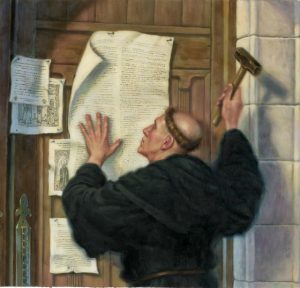
The slippery slope is, to many, a place no one committed to orthodoxy and historic Christian doctrine should ever be found. But Brother Martin never got that memo. So with a few quick strokes of the hammer, he ventured onto it. And yet we honor him five-hundred years later while we excoriate others who follow in his footsteps today.

Defenders of slippery slope alarmism will take issue with my suggestion. It is frequently suggested that this slope leads only to ruin. Therefore, Luther’s act was one of courage, not slippery-slopism. I don’t deny his courage. It is always courageous to take a step that puts one at odds with one’s peers. But to advocate for change when change is needed always puts one on a slippery slope, and that, as it was with Luther, is a good and necessary thing.

One concerned writer, in a lament over the descent into liberalism of a previously orthodox minister and as a caution to any who would venture onto the slippery slope that led him there, defines the slippery slope as “the unstoppable descent into liberalism and unbelief that begins when the authority of Scripture is compromised out of cultural accommodation.” He then maps the route to that slope: “In the late-20th century and early 21st century, the slippery slope has tended to begin over the issue of women’s ordination.” At this point of cultural accommodation, he suggests, the slippery slope begins. The slope, being slippery, inevitably sends one careening to the pit of ultimate unbelief. He jokingly (I think) presents his case as example number 4,742.

Would I win if I could produce 4,743 examples of those who took that step and did NOT descend into unbelief? Taking this issue of the ordination of women alone, often those who have embraced a change on this (I am not one of them, if that helps) have done so as a result of listening to the voices revealing skewed treatment of women in the church. They have revisited Scripture to see if somehow their previous reading had been wrong. One may not agree with their conclusions. But we must accept that there is a time when we need to be awakened to our mistaken views and have them corrected by scripture even if it means taking a stand against the ecclesiastical powers that surround us. I think Martin would agree.

We who celebrate the Reformation have a motto supporting this idea: Semper Reformanda. This motto calls us to be sufficiently humble regarding our convictions that we are willing to constantly submit them to the scrutiny of scripture. Yes, to face the possibility of error and to suggest possible correction is to step onto a slippery slope. That does not always lead to unbelief. It sometimes leads to necessary change.

The slippery slope is a dangerous place to be, for sure. But it is not always the wrong place to be. Far more dangerous is to refuse ‘being reformed according to the Word of God.

Let’s engage those on the slippery slope, let’s hear them, let’s learn from them, let’s examine the Scriptures with them. But let’s not dismiss them.

One of them might be named Martin.
I Am Woman, Hear Me

Some months ago, the controversy du jour involved Vice President Pence’s policy of not meeting women alone. Some found his policy appalling, some found it quaint, and some found it proper. I weighed in on it here because it touched a bit of my own history and struggle as a teacher and particularly as a pastor.

In response to my post I received a kind and insightful email from a young woman whom I had had the pleasure of coming to know ten years ago. She is an intelligent and sensitive follower of Jesus who, as a woman, has had a difficult time finding a home in the church. In her email she shared her experience as a woman in churches similar to the ones I have pastored. I think we need to hear her, and others like her. (She has given me permission to post her comments, though I have edited them for brevity and anonymity.)

Neither she nor I bring these thoughts with any kind of agenda. But understanding the experience of others can implicitly suggest necessary agenda. If it does, I’m glad.
I am grateful for her honesty.

When I first started to engage in Christianity, it was really clear to me that I would always be limited in some way as a woman. When [my male friends] had questions, they’d just go meet with the pastor. When I had questions, it was just not the same, even if that’s not an explicit rule. All the pastors were men and I’m a woman. So the natural supposition was to find a woman, but for many reasons that can be difficult.

To just know that’s not really an option when you have a male pastor, to engage as an individual and share your questions and concerns, subtly tells us “this is for men” and that women aren’t priorities here….

To be taught from a young age that my very biology is evil in some way, not because we’re all evil (total depravity!) but because I am a threat to men in some unknown way that I do not control, that I can be responsible for leading men astray, or that there’s a risk I’ll harm their reputation simply by being a woman, the internalizing of those messages is confusing and hard and leads to lots of feelings of self-hatred and questioning of yourself….

I had an experience of sexual abuse from a church leader as a child and so the argument that women are a risk to men is minimized when I know the opposite (that is, statistically more probable).

Going to church as a woman can sometimes be a heartbreaking experience. Every time I went to church with a male, whenever people would come over to say hi, he would be greeted first. He would be engaged in conversation. My presence there was in relation to the man next to me. There were a couple of times that I would try churches for weeks by myself and really wouldn’t make connections and then a guy would come with me and all of the sudden we’re welcomed. You can definitely make the case that the guys were just more outgoing and friendly, but it was definitely not every time.

Yes, these aren’t huge things. I’m not being stoned when I walk through the door or anything, but it is obviously discouraging to feel, even subtly, as if I don’t have a place because of my gender.

I invite others to reflect on this and to share similar, or contrasting, experiences.

Between the World and Me

An Education

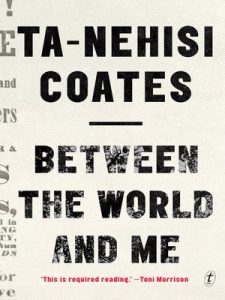
How should a white Christian like me read Ta-Nehisi Coates’ Between the World and Me, a book written by a black atheist? With ears open and a heart willing to learn. That is, we should come first as students.

When first exposed to a subject, whether chemistry or theology or, in this case, the experience of being black in America, initial forays into that subject feel foreign to the student. It feels as if she has landed among an exotic people speaking a foreign tongue. The words are all new, and the questions being asked and explored are ones she has never before considered. A good student’s response will be to listen, to be quiet, to learn the language, and to hear how the questions are being answered.

In Between the World and Me Coates speaks to his son but aims his words to we who listen in. As he traces his own awakening self-awareness as a black man from the streets of Baltimore, to a student at Howard University, to a writer in New York City, he provides an engagingly written assessment of life as he has seen it and the world as he has struggled to understand it. His assessment seems at times harsh, at times unfair, at times insightful, and at all times challenging.

Those new to this literature and to this world need to listen. His observations seem foreign, but such is the nature of learning. Some will be tempted to condemn, to judge, or to say he’s overstated his case. Maybe he has. Or maybe he has to. But we must labor to understand before we condemn. And sometimes, too often, if something threatens us, we don’t take the time to understand. He wants to unsettle the comfort and challenge the assumptions of “those who see themselves as white.”

And this does unsettle me. Is the world in fact arrayed in a way of violence toward the black body as he contends? It seems a plausible position, as cursory familiarity with history and the news suggests. As he writes to his son,

“The price of error is higher for you than it is for your countrymen, and so that America might justify itself, the story of a black body’s destruction must always begin with his or her error, real or imagined.” (96)

It was Trayvon Martin’s ‘error’ of walking through a white neighborhood in a hoodie, for example, that got him shot. The price of error is higher for the black man. That sounds right.

I have read and thought too little about the subjects he raises to be able to offer an informed critique of the book. I leave that to others. But we who live lives in an aura of safety and comfort are in need of this education, foreign though it may seem and feel. Our job may be in this case to be quiet and to listen. We need to allow new questions to form in our minds and be considered. This could be the beginning of our education.

[Note: I would not draw attention to Coates’ religious convictions except for the fact that he himself makes a point of his atheism. He laments that he cannot find the sort of perspective that faith has brought to many like him. This explains to some degree his emphasis upon the black ‘body’ and not ‘soul’ or ‘spirit’. I respect his honesty.]

Powered by WordPress & Theme by Anders Norén