Concerning Life as It Is Supposed to Be

Month: March 2017

Bookish Habits #6: Staci Thomas

[For an explanation of this series, see the post The (Book) Lives of the (Not So) Rich and (Marginally) Famous. I will be asking the same questions of all I interview, with a few followup questions as needed.]

The title of the originating post in this series makes mention of the rich and famous. My friend Staci is neither, if measured by dollars in the bank and widespread name recognition. She is, however, rich relationally, with a husband and four adopted daughters and friends scattered over many states and several continents. And to those who know her, she is famous for her passion for Jesus and for representing him with integrity by loving the world around her. She should be famous for being a consumer of books. Her volume of reading is such that it will take two posts just to keep up with her, and then we will have to stop and catch our breath. If you like to read or want to begin to read more widely, I commend Staci to you. To Staci I owe my introduction to some of my favorite books (Gilead and The Elegance of the Hedgehog, to name a notable two.) It is to be lamented that this homeschooling mom who also works as an engineer and as an advocate of adoption (currently Family Program Director with Chosen, and for some reason, long ago, gave up trying to find time to continue her blog (last updated in 2014). I’m happy to introduce you to Staci and her reading habits.

Randy: In the past year, approximately how many books did you read for ‘enjoyment’ (that is, books outside your direct professional interest)?

Staci: I read 42 books for enjoyment in 2016.

What motivates you to read books outside your profession?

Simply put, my life is better when I’m reading profusely. I’m a sharper employee, a more compassionate mother, a more connected wife, a better friend, and a kinder person. I would rather read than do anything else, so it’s not too much of an effort to make profuse reading occur.

How do you choose what books you will read?

The Sunday New York Times Book Review – I read it every Sunday and if there is a review of a book that sounds good, I add it to my TBR list, which I keep on a spreadsheet.

You sound like an engineer. The answer to every problem involves a spreadsheet. What other sources add to your spreadsheet?

What Should I Read Next Podcast – I listen to this podcast and read this website daily for book recommendations.

Book lists – I am obsessed with reading book lists, and if I see a title that repeatedly shows up on various lists, I add it to the spreadsheet. Every year I read the New York Times’ Top Ten Best Books of the Year, and then I’ll work through their top 100 picks for the year if I need something else to read. Last week I found a list that took all of the best of the year books and put the most frequented books on one list. All 20 of those books went on the spreadsheet.

Author Ryan Holiday sends out a monthly email of the best books he’s read each month; he recommends quality non-fiction titles.

Slate has some great book reviews and lists that I look at.
I do not read fluff; I know what I like and so it’s extremely easy for me to choose books that I know I’ll love. I rarely read something that I don’t like because I research pretty heavily.

How do you choose what books to read next?

I look at my spreadsheet and figure out how to read each book the most economically. Every day I look at Modern Mrs. Darcy Kindle Daily Deals. She does the hard work of putting together the quality titles that are on sale, and if I can get a book on my Kindle for $2.99, I’ll download it that day. If I have credits to use on my Audible account, I’ll download a book there that is on my spreadsheet. And if neither of those options are grabbing a book on the spreadsheet, I’ll reserve from the library. If the list at the library is too long, I’ll order it used from AbeBooks or used off of Amazon.

I always make sure that I have two fiction titles and at least one non-fiction title going at the same time. I despise reading only one book at a time unless it’s a classic, and then I have to only concentrate on the classic.

What book or books are you reading now? [Note: I asked this of Staci in December of 2016.]

The Association of Small Bombs by Karan Mahajan (on Kindle)

Evicted by Matthew Desmond (on Kindle)

The Nix by Nathan Hill (on Audible, so listening when exercising and in the car)

Emotional Agility by Susan David (hard cover)

The Secret Keepers by Trenton Lee Stewart (aloud to my kids)

Counter Culture by David Platt (aloud to my older teens)

What three or four books do you find you most often recommend to others?

Anything by Marilyn Robinson to people who like deep stuff and who want their lives to be changed – Home is my favorite

The Elegance of the Hedgehog by Muriel Barbery for people who want to laugh and like beautiful writing;

Anything by Stewart O’Nan for people looking for not so deep but quality writing;

Constellation of Vital Phenomena by Anthony Marra because life is too short to not read a book this good (note: R-rated material and very sad);

Bonus pick for Christians: The Grammar of God by Aviya Kushner because I LOVE this book and I think every studier of the Bible should read this as soon as possible. Get this one in hard cover because you will want to visit with it more than once.

Bonus kid pick: Mysterious Benedict Society series because this is a great series and a lot of parents don’t know about it.

A great list! Thanks, Staci. I will follow up soon with a question about finding the time to read.

The Great Motivation

Often discussions of what a church should be and do and look like are informed by references to the last few verses of Matthew’s gospel, a portion known as the “Great Commission.”

And Jesus came and said to them, “All authority in heaven and on earth has been given to me. Go therefore and make disciples of all nations, baptizing them in the name of the Father and of the Son and of the Holy Spirit, teaching them to observe all that I have commanded you. And behold, I am with you always, to the end of the age.” (Matthew 28:18-20)

This comes to us as a command to engage the non-Christian world with the truth of Him in whom all authority resides. It focuses the attention of disciples, to whom the commission is given, to reproduce themselves, to make more disciples. And it is so succinct that it is often extracted and made the priority for the church, with evangelism as its core. It easily resolves to a motivational slogan such as “His last command our first concern.”

Oddly, though, using these verses as motivation is apparently a modern innovation.

Anglican scholar Michael Green, in his book Evangelism in the Early Church, points out the (to our ears) oddity that these words of Jesus, influential though they were in other ways, were not invoked as a motivation for Christian outreach.

“In point of fact, it is quoted very little in the writings of the second century.” (239)

This was a time when the task of evangelism and of making disciples was fraught with serious difficulty.

“Wherever they went, Christians were opposed as anti-social, atheistic, and depraved. Their message proclaimed a crucified criminal, and nothing could have been less calculated than that to win them converts…. To Jew and Gentile alike Christians were offensive, on account both of the doctrines and the behaviour credited to them. All this they had to live down if they were going to win anybody at all for Jesus Christ.” (29)

If not Jesus’ ‘last command’ then what drove them to persevere against such odds? Green suggests it was rather love and gratitude. It was grace, not law, that moved them.

“They did it [evangelism] because of the overwhelming experience of the love of God which they had received through Jesus Christ.” (236)

People inevitably pursue, and point others to, what they love. The “Great Commission” is a great summary statement of the direction Jesus expects his church to move. What motivates the church to respond is never the command itself but the love of the one who issued it

It is the heart that is freed that is freed to follow, and to proclaim, the Liberator.

Long my imprisoned spirit lay
fast bound in sin and nature’s night;
thine eye diffused a quick’ning ray;
I woke, the dungeon flamed with light:
my chains fell off, my heart was free:
I rose, went forth, and followed thee.
Amazing love! How can it be
that thou, my God, shouldst die for me? (Charles Wesley)

When the church is misdirected or moribund what is needed are not more sermons detailing our Lord’s final command. Better would be more outlining and revealing his amazing love.

The Decently Religious

The other day my son shared with me a picture taken at his workplace. It showed two publicly posted pieces of Jehovah’s Witness literature which someone had defaced with a sharpie, marred with images and words ridiculing the content of the postings and those who posted them.

We seem to live in a day when no one group is immune from hate, nor one group alone capable of perpetrating it. Christians have shown themselves more than capable of defacing and ridiculing the positions of others and Christians receive ridicule in return. And in both directions, it is tiresome. It’s why I so long for recovering the virtue of decency as a fundamental Christian, if not human, virtue. If we are to be attacked, let it be for our righteousness. And if we are to attack, let it be with kindness.

In expressing that longing, though, I reveal that I have bought into the public perception that Christians are in fact “Hate Filled Hypocrites“, to borrow the ironic title of one provocative book. That Christians are not decent is such a prevalent image of Christians that we all come to accept and believe it.

Stephen King is a wonderful writer with often marvelous characters. His Christian characters, however, such as those in Under the Dome or Needful Things are cardboard cutout stereotypes of fanaticism and bluster. I’m currently reading Brandon Sanderson’s fantasy novel, Elantris. Sanderson’s gift is in world building not character development, but in his world the really obnoxious, plotting, cynical characters are the religiously fundamental. We assume that commitment to a religious faith by definition means annoying.

Current controversy does not quell that supposition, especially when news outlets would rather quote the provocative outbursts of a Franklin Graham rather than the thoughtful expressions of a Tim Keller.

Public representations of Christians as extreme and hateful will never go away, especially as we Christians play to type. But I wish I could introduce to the world the large numbers of Christians known to me who have been and are decent men and women, though unknown apart from the few people around them. These are those who face struggles and cares, and yet find joy in the midst of them. They look for ways to serve, and they stoop to pick up others when they fall. None are perfect and all fail in particular ways. But they are genuinely decent people. I have been blessed by such people. I wish more people could know them.

These are not those who are measured and calculating in their religious life and expression. They just live pouring out love for God and for one another. These are those spoken of by the prophet Malachi.

Then those who feared the LORD spoke with one another. The LORD paid attention and heard them, and a book of remembrance was written before him of those who feared the LORD and esteemed his name. (Malachi 3:16)

These are the quiet ones walking humbly with their God and, it follows, loving mercy. They are the decent ones, the truly religious, of whom God says,

They shall be mine…in the day when I make up my treasured possession. (Malachi 3:17)

They are the apple of God’s eye. I wish you could meet them. I think you’d like them.

A Very Unpleasant Person

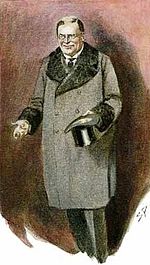
I suppose we all have people we don’t want to see or with whom we’d simply rather not have any kind of social intercourse. But few, if any, have the kind of impact on us that Charles Augustus Milverton had on Sherlock Holmes.

Illus from Wikipedia

“Do you feel a creeping, shrinking sensation, Watson, when you stand before the serpents in the Zoo, and see the slithery, gliding, venomous creatures, with their deadly eyes and wicked, flattened faces? Well, that’s how Milverton impresses me.”

I have read that sentence probably a dozen times over the past few days and it still strikes me with its vivid sense of revulsion. Those of us who would write something like “Sherlock did not like Milverton” can only dream of creating images like that.

🔍

The sentence sounds even better read out loud by a gifted performer, which is my real reason in bringing this to your attention. The Complete Stories of Sherlock Holmes is playing again in my Audible app and I could not be more delighted. A gifted reader reading Doyle’s great stories: what more could one ask to enliven long (or short) drives?

Bookish Habits #5: Dr. Steve Brown and Dr. Bryan Chapell

[For an explanation of this series, see the post The (Book) Lives of the (Not So) Rich and (Marginally) Famous. I will be asking the same questions of all I interview, with a few followup questions as needed.]

Steve Brown

Several weeks ago I sat down with noted authors and teachers Dr. Steve Brown, the founder and president of Key Life Network and Dr. Bryan Chapell, the senior pastor of Grace Presbyterian Church of Peoria, Illinois, to discuss their reading habits.

To be honest, I did not sit down with them. I emailed them. But I like to picture myself sitting with these two men, whose ministries have been so helpful to me,  discussing, among other things, the books we enjoy.

Bryan Chapell

Both men have lengthy careers in ministry and both have well-deserved reputations as being superb preachers. And both have written extensively. I direct you to their Amazon.com author pages (here and here) to sample their works. Personally, I’ve been helped by Steve’s A Scandalous Freedom and by Bryan’s Christ-Centered Preaching and Christ-Centered Worship.

Though I reproduce their answers to my questions with complete accuracy, I may have elaborated the dialog a bit. May have.

Randy (RG): Steve and Bryan, I’m thankful that you have both taken time from your busy schedules to meet with me this morning.

Bryan Chapell (BC): Happy to do so.

Steve Brown (SB): Same here. Mind if I smoke my pipe?

RG: No problem. As you know, we’ve been discussing the kinds of things people read when they simply chose to read for fun and enjoyment. So, in the past year, approximately how many books did each of you read for ‘enjoyment’ (that is, books outside your direct professional interest)?

SB: Forty to fifty, maybe more.

BC: Wow! That’s impressive, Steve. For me it would have been somewhere between twelve and fifteen.

RG: I find it all impressive. What motivates you to read books outside your profession?

BC: For me, really, it is something of a hobby. It enables me to pursue other interests, and honestly, I do it for the pure enjoyment of it.

SB: Similarly, for me, it is both escape and curiosity.

RG: How do you choose what books you will read?

SB: Mostly from friends… or authors with whom I’m familiar or friends who have written books. I also review and read books when someone wants me to write a blurb.

BC: I, too, depend upon the recommendation of friends, as well as book reviews, recommendations in magazine articles, or awareness of particular author emphasis.

RG: It seems that books reach readers like churches reach visitors: mostly through networks of friends. So what book or books are you reading right now?

BC: Those that I’m reading currently are all related to my role as a pastor.

Reformed Catholicity – Michael Allen and Scott Swain

No God but One – Nabeel Qureshi

Serving a Movement – Timothy Keller

The Day the Revolution Began – N. T. Wright

The Family Life of a Christian Leader – Ajith Fernando

RG: What about you, Steve?

SB: Currently I’m reading

The Fellowship: The Literary Life of the Inklings – Philip and Carol Zaleski

Father Brown Stories – G. K. Chesterton

Takedown (5th in The Scot Harvath Series) – Brad Thor

Truth Overruled: The Future of Marriage and Religion – Ryan T. Anderson

RG: The books that stick with us and are meaningful to us are the ones we will often recommend to others. What books do you find you most often recommend to others?

SB:

Anything by C. S. Lewis

Orthodoxy – G. K. Chesterton

BC:

The Discipline of Grace – Jerry Bridges

King’s Cross – Timothy Keller

Mere Christianity – C. S. Lewis

Sacred Marriage – Gary Thomas

RG: Thanks to both of you. This has all been very helpful.

BC: You’re welcome, Randy.

SB: Glad to do it.

Lenten Joy

That Christianity is a life of receiving and not a life of doing is at the heart of the gospel of grace. It also is at odds with our popular conception and experience. We cannot shake the idea that Christianity is at heart a life of doing, a confusion that sometimes is unnecessarily heightened during Lent.

Christians peering into the season of Lent anticipate a period of denial where they are challenged to self-examination and repentance. They take themselves low to root out sin lurking in the dark corners of their person. As much as this is a necessary thing bearing much promise many of us cannot help but see it as a time of rejecting delightful things just because, somehow, we are not supposed to do delightful things. We have bought the misconception that Christianity is a matter of what we do, and in order to help us stop doing we have Lent. This is not, of course, the formal framing of Lent, but that this is how some perceive it is sad.

James B. Torrance, a Scottish Presbyterian scholar whose little book Worship, Community, and the Triune God of Grace has recently been refreshment for me, reminds us what we lose when we make our faith primarily about what we do is joy. Repentance (of which much is said during Lent) is not an act we do in order to prompt God to forgive, but it is a reception by us of a forgiveness already given. Christianity is rooted in what God has done securing a forgiveness which we do not prompt but only receive.

We have a hard time with this because we can only think in legal terms. God is a judge before whom we stand confessing our sin. Our penitence, perhaps enhanced by a period of Lenten fasting, persuades God to forgive us and we go on our way. That all seems proper and right, but it is contrary to the spirit of the gospel of grace coming from our covenant keeping God who reveals himself as a Father. Repentance is not an act by which we persuade God to respond to our penitence with forgiveness. Repentance is rather our responding to his already secured and pronounced blessing of forgiveness.

Summarizing John Calvin, Torrance says,

“Repentance is our response to grace, not a condition of grace.”

On the cross of Christ the sacrifice has been offered and forgiveness pronounced, all prior to our confession and repentance.

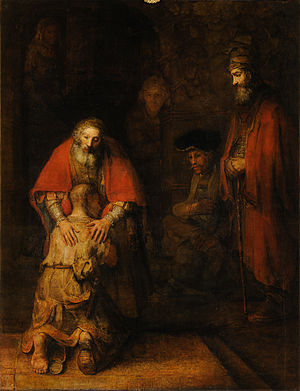
In Jesus’ parable of the prodigal son the father’s heart is gracious toward his son even when the son is in the pigsty. When the son repents and returns, he receives the father’s embrace, an embrace which the father was willing to give all along and which the father did not need to be persuaded to give.

Christians tend to enter Lent thinking they need to make themselves somehow more worthy of the Father’s embrace, that they, in some manner, need to act, to do, to urge him to be more forgiving. It is not that at all. Lent is a time for us to clear away the fog and see more clearly the vast measure of the Father’s kindness to us in Christ, that there is in fact no condemnation for we who come to the Father through the Son.

Yes, we are encouraged to take concrete action during Lent. We are encouraged to deny certain privileges, perhaps, or certain foods or other things ordinarily permissible. But we do so not to earn or curry the favor of God. We do so to clear away things that obscure our vision that we might more clearly and more joyfully receive the grace that is already there.

In this way, Lent is to be a joy. Let us with joyful anticipation enter in.

Powered by WordPress & Theme by Anders Norén