Concerning Life as It Is Supposed to Be

Month: February 2017

Bookish Habits #4: Jim Jones

[For an explanation of this series, see the post The (Book) Lives of the (Not So) Rich and (Marginally) Famous. I will be asking the same questions of all I interview, with a few followup questions as needed.]

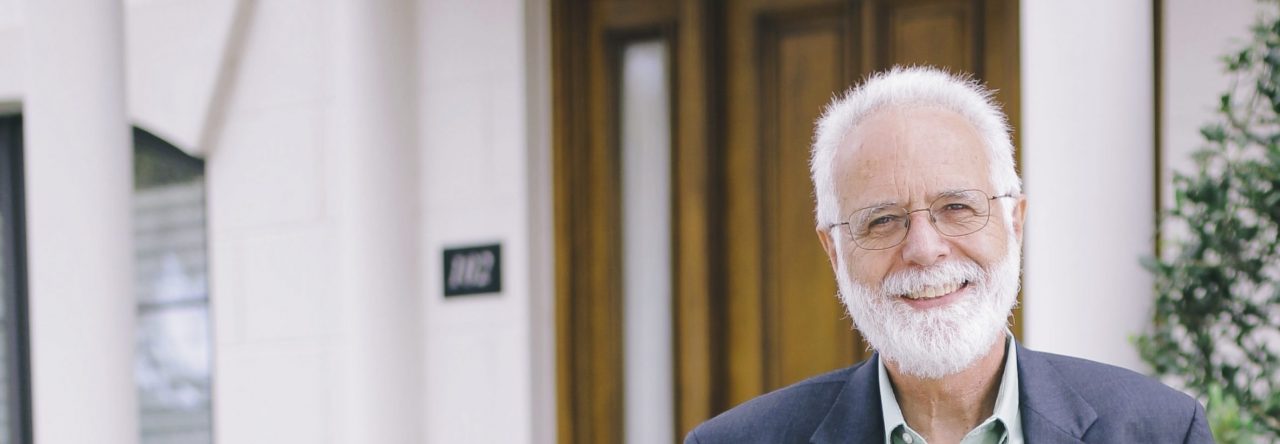
It took a hurricane to bring my friend Jim Jones and I together. Katrina, specifically. Jim was at the time the East County editor of the Bradenton (Florida) Herald. He lived near the church I pastored, and he had come to visit to see what a local pastor might have to say in the wake of that overwhelmingly devastating storm. Being one deeply committed to the best journalistic ethics, he introduced himself before the service (and I laughed at his auspicious name). He heard me preach and then did a wonderful job of summarizing my point for his article on Monday morning. From there developed a fruitful (for me, at least) friendship.

That friendship led to the formation of a book discussion group formed, Jim, my Muslim neighbor, a retired professor from Cornell’s college of architecture, and me. It was short-lived (we only got through two books) because of time, not interest. But through this I learned that Jim was a reader.

Jim served in Vietnam for 33 months between 1968 and 1971, and is a retired Army lieutenant colonel. Upon leaving active duty, Jim earned a BA from the University of South Florida. His entire journalism career has been in small Florida newspapers. His 2013 ‘retirement’ only lasted six months after which he returned to the Herald’s newsroom. He continues as a working journalist at age 70. In the interest of probing the reading habits of a committed journalist, I submitted my questions to Jim.

Randy: In the past year, approximately how many books did you read for ‘enjoyment’ (that is, books outside your direct professional interest)?

Jim: I am very much a sporadic, occasional reader because words are my business as a newspaper reporter/editor. My brain tells me reading is work. That said, there is usually a specific reason for me to pick up a book.

Recent examples include

Viet Thanh Nguyen, The Sympathizer and Nothing Ever Dies

Bruce Springsteen, Born to Run

Patricia Schultz, 1,000 Places to See Before You Die

What motivates you to read books outside your profession?

I have been working on a small manuscript for several years about my experiences in Vietnam and after the war. Several people have read it, invited to offer criticism, or rip it apart, to make it more interesting and readable. One of my readers asked, “Does the world  really need another book on Vietnam?” My response was that it depends on the story. The world is always ready for another Vietnam story as long as it’s an interesting read.

The Sympathizer won the Pulitzer Prize in 2016. That tells me that the world does need another book on Vietnam. I read Nguyen’s book because I was interested in what is Pulitzer worthy these days, and also because I was intrigued by the story of a Viet Cong agent who masquerades as a refugee. It is a story told from a minority viewpoint that will sometimes baffle and infuriate. Viet Thanh Nguyen’s parents were Vietnam refugees who settled in California after the war. He is now a college professor on the west coast. All of that makes it  interesting to me because of my own Vietnam history, including having a Vietnam war bride and returning to Vietnam several times after the war.

Nothing Ever Dies landed on my reading list because I wanted to see what else Nguyen had written.

How do you choose what books you will read?

Biographies and history are some of my favorite reads. Alexander Hamilton and Richard Nixon are among the bios in my little library, along with books on The Beatles, Ronnie Spector, Chuck Berry, Grace Slick, and Keith Richards.

I have just finished the Springsteen bio (for which he received a $10 million advance) and highly recommend it to anyone interested in popular culture. Springsteen is the rare clear-headed entertainer who eschewed drugs, and goes into details about his struggle for success, and the creative process involved in some of his best songs, including “Born to Run.” Although he never served in Vietnam, he talks about the significant impact that war had on him (seeing a pattern here?).

Keith Richard’s bio is amazing as well, given his well documented destructive lifestyle which he survived and remained a creative force. But I would have preferred to read more about Richard’s music and less about his substance abuse.

With Springsteen, there are personal connections we can make (dysfunctional family, struggle with playing the guitar, struggle, struggle, struggle), and things that are more mysterious, such as how one leaves a field of competitors and contemporaries and becomes a megastar.

What book or books are you reading now?

In front of me now is 1,000 Places to See Before You Die. I am planning a trip to Europe in the late spring-early summer. Practical tips on maximizing my time and making travel as efficient as possible are valuable.

What three or four books do you find you most often recommend to others?

Most recently I recommended the Springsteen book to a young reporter. She had been told by others that it wasn’t so good. I can only speak for myself and found that it was one of the best pop bios I have ever read. Springsteen is a surprisingly good writer.

Thanks, Jim. I hope your writing goes well, and that you land a Springsteen-like advance. I look forward to reading it.

Community for the Self-absorbed Millennial

My post on community generated a couple of offline queries both of which, for different reasons, were referring to the idea that the church is failing to reach Millennials, that supposedly self-absorbed and entitled generation that Gen-Xers have unleashed on the world under the benevolent and clueless gaze of Boomers like me.

And yes, I think too much is made of those supposed generational distinctions, but that is for another day. I’ve a different fish needing to be fried this morning.

When my correspondents mentioned Millennials leaving the church I went to the articles on which those concerns were based. I have a suspicion that arises whenever alarmist statistics are being tossed about in Christian circles. Somewhere in this will be the hand of Barna the Christian statistical guru. And my suspicions were confirmed.

Why I suspect this and why it is a concern I expressed now nearly 6 years ago. I encourage you to click through to that post and read it (although it is long).

The point of that post is that Barna’s work has credible critics which should cause us to hesitate in referencing him. Particularly concerning is his tendency to use data to fan into flame worries on which, coincidentally, he has written a book. When Barna’s sky is falling other more careful analysts see a rather sunny, or at most a partly cloudy, day. Baylor University’s Institute for Studies of Religion offers a calmer, more nuanced take on the data, normed over many more years and consequently more carefully nuanced.

Believe who you will. But I hope you share my concern that Christians especially should be anxious to speak the truth. We should be as cautious with what we say following “Statistics say…” as we are (or should be) when our sentence begins “The Bible says…”.

What does this have to do with community? Those who like to divide the world into Millennials vs. Gen-Xers vs. Boomers say that it is the Millennials who are longing for community and that in this the church is failing them. Whether this analysis is accurate or not I’ll leave for those more skilled in demographic research. I rather think, statistical research aside, that the demographic slice most looking for and longing for community are those humans created in the image of the Triune God. I think the church should seek to serve these people.

Fragile Community

One of the women helping us develop a new web site for our church (jokingly, I think) suggested this for a ‘tagline’:

COVENANT PRESBYTERIAN CHURCH
Trust us; you’re not too weird to fit in here.

There is a sense in which this works, or should work. Churches should be welcome places for those weary of trying to fit in a world that does not easily tolerate difference. No one should be too weird to fit in.

Our actual tagline is the far more sophisticated ‘Building Gospel Community.’ We believe that the church should be a community living out the truths of God’s kingdom in such a clear way that a world longing for shalom will be attracted to that kingdom and its King. Apparently we are not alone in this aspiration. Christine Pohl in her book Living into Community identified this as a trend.

For the past twenty-five years, scholars…have emphasized the importance of the church as a ‘contrast’ or alternative community, and have argued that Christians can challenge the beliefs and practices of the larger society by the beauty of their shared life. (8)

This, we are convinced, will have a far more long lasting and profound impact upon a struggling world than the failed attempt to shape culture by political power and verbal dominance. In a book tour for her book Absence of Mind, novelist Marilynne Robinson captures the hope for such intentional community:

Christianity should be itself. Christians acting like Christians would be the most effective possible evidence for the truth of what they profess.

A gospel community, a community where Christians, even weird ones, are being Christians, is what we are after, and what we think the world needs. The problem is that we may not be sure what such a community looks like. We know what ‘church’ looks like, but not such a clear-visioned intentional community. What will such community look like?

Should the church emulate monastic communities by sharing space and goods and vocation? Or should we rather aspire to be a community set apart by language, custom, and dress, like the Amish? Do we know? Are we saying, like Supreme Court Justice Potter Stewart famously said regarding pornography, “I know it when I see it”? Will we know community when we see it?

Conservative Jewish scholar Yuval Levin argues in his book The Fractured Republic that strong communities of faith are vital for the promotion of human flourishing in an age that feels gravely fragmented. He defines genuine community as

…a concrete, tangible grouping…that gives you a role, a place, and a set of relationships and responsibilities to other particular human beings. (181)

This is a useful starting place. Many others could be posited. But Levin reminds us why we need to ground our conceptions of community in reality. If community involves human beings, it will be hard. Christine Pohl pointedly observes that

The winsome and life-giving character of Christian community is often accompanied by profound difficulties arising from disagreements and betrayals…. The testimony of our shared life is crucial, but it is also fragile. (8, 9)

Community is crucial, but it is fragile. Community is critical, but people will hurt other people in the pursuit of it. That can’t be helped, but the pursuit of it cannot be abandoned. If we are aware of the difficulty, failure will not surprise us, and imperfection will not dissuade us. Community is fragile. Most beautiful things are.

Bookish Habits #3: Dr. Wesley Hill

[For an explanation of this series, see the post The (Book) Lives of the (Not So) Rich and (Marginally) Famous. I will be asking the same questions of all I interview, with a few followup questions as needed.]

Wesley Hill is a man who clearly loves to read and loves to read all kinds of books. He is a graduate of Wheaton College and Bethlehem College and Seminary in the United States as well as Durham University in the United Kingdom. He is a theologian and a teacher, serving as an assistant professor of biblical studies at Trinity School for Ministry in Ambridge, Pennsylvania.

Wesley Hill

He not only reads books, but he writes them. He is the author of a number of books and countless articles spanning several interests. The honesty and sensitivity of his writing have helped many, particularly as he works through what it means to be a gay Christian in today’s complicated world. In addition he writes regularly for the magazines “Christianity Today” and “First Things” and he blogs at Spiritual Friendship.

Also, on Sunday, August 13, 2017, the church I pastor, Covenant Presbyterian Church in Oviedo, Florida, will be blessed to have Dr. Hill preach.

If you gain nothing else from this interview, hear here a voice of grace and passion. Perhaps you will be inclined to pick up one of the books he has written as well as those he recommends. I would encourage that.

Randy: In the past year, approximately how many books did you read for ‘enjoyment’ (that is, books outside your direct professional interest)?

Wes: This is a hard question to answer because my personal and professional interests line up so closely. If I weren’t a seminary professor, I’d be reading all the theology books I read for “work” simply for fun. There’s not a clean or easy separation for me here. As I’ve described in a column for the First Things website, I am a big believer in the importance of “irrelevant reading” for “work”: Often novels and books of poetry end up being important for my “professional life,” and my “professional” reading often worms its way into my daydreams and prayers and personal musings. Here’s how I put it in my column:

“I sometimes tell my students the most important reading they’ll do for one of my classes at the seminary where I teach may well be the reading I never thought to assign. They’ll be working away on an essay for me on the theme of faith in the Gospel of Mark, and something in an Auden poem will be just the thing that connects the dots for them. Or they’ll be writing about the motif of light in the Fourth Gospel, and something about the way Wallace Stegner described the character Charity by the lake in Crossing to Safety opens a wider vista for their reflections. This is what broad, indiscriminate reading of interesting texts does—it furnishes the raw materials for unexpected correlations and associations to spark. It’s often the irrelevant reading that does this, the reading you’re not supposed to be doing, the reading that’s not related at all to that project you’re meant to be completing.”

I remember that article and was encouraged by that idea that everything relates. I tell those learning to be pastors that in a very real sense EVERYTHING is sermon preparation. So, what else motivates you to read books outside your profession?

Before I discovered what my profession would be, I was already a voracious reader. I grew up reading mostly pulpy detective novels and some pretty bad Christian fiction. But I also started reading people like C. S. Lewis and Henri Nouwen—neither “professional theologians,” as I am—in high school. Those habits have stayed with me. I once heard a theologian on a panel critiquing The Da Vinci Code boasting that it was the first novel he’d read in decades. And I thought, “How sad!” What an impoverished life it would be if I could only read “theology,” narrowly circumscribed.

How do you choose what books you will read?

Basically, I do what my friend Alan Jacobs has advised: I read at whim. I am a woefully undisciplined reader. At any given time, I have five or six books going, and I’m always picking up another based on changing moods or interests. In my professional life, I am a bit more systematic, but even there, I rely on personal impressions and the recommendations of friends just as much as I do on the advice of professional journals.

Several more considerations shape my approach to reading. One is from Alan Jacobs’ book The Pleasures of Reading in an Age of Distraction. He recommends “reading upstream,” which is to say, once you find a book or an author you love, read what they read and loved.

Another thing I often do: When I find an author I love, I read all their books. (Right now I’m doing this with E. L. Mascall, one of the great Anglican writers of the twentieth century, and Robert Farrar Capon, the late grace-addicted Episcopal priest-cook.) I’ve also been influenced by the theologian Fred Sanders’ advice: If you’re a theologian, as I am, he says you ought to (1) pick a doctrine and read everything you can on it and (2) pick a theologian to ‘make your own’ as a touchstone for all your work. In my case, (1) is the doctrine of the Trinity and (2)… well, I haven’t done it consistently, but the closest person to that for me is probably Karl Barth.

What book or books are you reading now?

I’m just finishing Luther’s 1535 Lectures on Galatians—wonderful! And I’m in the middle of the Elena Ferrante Neapolitan novels, which aren’t quite what they’re billed as being (a story of friendship) but they’re immensely insightful and rather harrowing actually.

I’m also reading a collection of essays by younger people of color, edited by Jesmyn Ward, talking about race, called The Fire This Time. The essay on “Walking while Black” by Garnett Cadogan is worth the price of the book.

What three or four books do you find you most often recommend to others?

I often find myself telling students and friends to read the novels of Chaim Potok. Better than virtually anyone else I’ve read, he understands the growing pains of a childhood religious faith as it moves into adulthood.

In my discipline of New Testament studies, I regularly point people to God Crucified by Richard Bauckham and The Moral Vision of the New Testament by Richard Hays. On a personal, spiritual, emotional level, probably no book has actually helped me more than Gay and Catholic by Eve Tushnet.

I love Potok. Glad we share that. Thanks for taking part and expanding my vision of what is worth reading. My ‘wish list’ of books to read is now expanded, probably beyond reason.

So Goes the Church

Issues that matter seem to be landing as profusely and as suddenly as the frogs in Paul Thomas Anderson’s remarkable film Magnolia.  As a Christian pastor, I want to speak intelligently and helpfully to the issues, for they do matter. But I do not want my responses to be based on uncertain information or misinformation. I want my responses to be reflective and careful. And I plead that I don’t often have time to pull that all together before another frog has dropped and the world is off in another direction.
One of my pastoral heroes, the late John Stott, alluded to two errors pastors confront when addressing controversy.

Our task as preachers, then, is neither to avoid all areas of controversy, nor to supply slick answers to complex questions in order to save people the bother of thinking.

Complexity demands nuance, and nuance time, and under the protest of time I am silent. It may be rather that I am gutless. I need to take his words to heart.

Instead, it is our responsibility to teach them with clarity and conviction the plain truths of Scripture, in order to help them develop a Christian mind, and to encourage them to think with it about the great problems of the day, and so to grow into maturity in Christ. (Between Two Worlds, page 173)

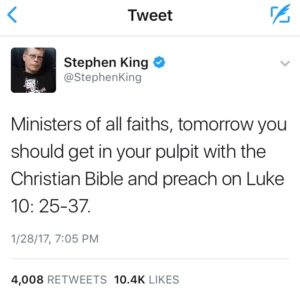
The recent debate regarding immigration and refugee resettlement was stirred by the president’s executive order barring (temporarily?) immigration from certain countries (an act widely seen as one designed to close our borders to Muslim immigrants). When such issues surface, pastors are often told by good people what to preach. I resist such direction. Whether I do so out of wisdom or laziness I’ll let others determine. This time novelist Stephen King offered to choose my text for me.

I didn’t comply and so probably need to give up trying to get his autograph. (However, if Mr. King or anyone else is still interested he can listen to my sermon on that text from June of 2015. It may be still relevant to this situation.)

Others have been directing our attention to the book of Leviticus and its language of care for the stranger. As gratifying as that might be, I’m guessing that some of those doing so are not quite so fond of what it seems to say about homosexual sex or the viability of human life in the womb.

There are those telling me what to preach and those who want to make sure that what I preach does not impact the church’s tax exempt status. The president this week announced his intention to free churches and pastors to endorse political candidates.

On the one hand, I’m all for this. The government should have no more say over what I say from the pulpit than Stephen King, and if churches curb their message to gain tax relief, they have already voluntarily compromised that freedom.

I don’t endorse candidates from the pulpit, but the government’s preferences on that matter have nothing to do with that decision. It is utterly foolish to hitch the church’s wagon to a political horse. When the horse goes down, it takes the wagon with it. (It’s intriguing in this regard to watch Trump supporter, Eric Metaxas, twist and turn as he uncritically defends Donald Trump’s first two weeks in office.  But he must. It’s what one must do, individually, or as a church, when we have declared someone besides Jesus to be ‘our’ man.)

“Evangelical” Christianity used to be honorable. But what it once was has now been dishonored by wittingly or unwittingly allowing itself to be defined politically. In the process its vital message of the kingship of Christ and the supremacy of his gospel has been obscured if not lost. There is more wisdom in Stephen King counseling me to preach on a biblical definition of neighbors than there is in a church celebrating the ‘right’ to endorse a candidate. One can only bring good, the other only disaster.

So when some want to hear a sermon on the “Good Samaritan” or when others find biblical support for compassion in the remote outposts of Leviticus, they reveal good instincts. That instinct says that the biblical authors who form the framework of Christian faith and practice are those to whom we are to listen first in framing a response the the issues of the day. We are, as Stott reminds us, to “develop a Christian mind” and then “to think with it.” This we should do, but only after having first removed our nationalistic “America first” lens.

As Christians, Christ and his kingdom must always be first.

Powered by WordPress & Theme by Anders Norén