The Hunger Games trilogy dips in and out of ‘arenas’ in which deadly games are played. These are not arenas as we would picture them, but large modeled environments in which arbitrarily selected youth fight to the death in contests controlled and manipulated by remote ‘gamemakers’. The games are continuously filmed and broadcast as each contestant, one by one, is killed, until only one victor is left.
The chief gamemaker in the games is a producer who manipulates the environments and situations faced by the contestants in order to provide maximum entertainment for the audience. The games are brutal, and the gamemakers are heartless.
The movie version of The Hunger Games had at the end of April grossed nearly $375,000,000 in the USA alone. Less viewed (in the same period grossing 1/10 of that of The Hunger Games) is a film called The Cabin in the Woods. (Before seeing this one, the closest I had ever come to watching a film listed as ‘horror’ was Zombieland, and that hardly counts.)
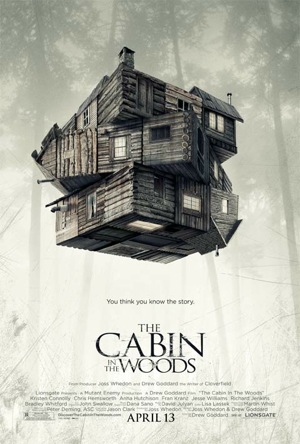 This movie concerns five college students who head to an isolated cabin for a weekend getaway. They have no idea how isolated it really is. As evening sets on their perfect getaway, strange events begin to suggest that all is not as was advertised. One learns that they, too, have entered unawares into an arena of sorts where remote ‘puppeteers’ are manipulating their environment in a way designed to lead to the deaths of four of the five, each in a particular order.
Their deaths are intended to fulfill an ancient ritual designed to placate a mysterious deity whose unhappiness could lead to the destruction of the entire world. What was once accomplished by tossing humans into volcanos is given a modern and high tech twist.
The controllers in this movie, like those in The Hunger Games, play god to those in the arena, allowing the illusion of free will while at the same time manipulating events to their own seemingly trivial or arbitrary ends. When the goal of the four deaths is reached, a party complete with dance music and drinks all around erupts in the control room while on the screens the one remaining character engages in a life or death battle with a zombie. It is a surreal image. None of the ‘gods’ in the control room care about the life struggling for survival behind them. They have achieved their goal, the gods are having their fun, and the life of the person under their thumb does not matter.
Whereas The Hunger Games seems only interested in revealing the cruelty of which people are capable, clearly in the absence of the divine, The Cabin in the Woods seems self-consciously bent on suggesting a view of the gods, or God, in which they or He are unconcerned for human pain and suffering.
Is there hope in either vision? The only hope is centered in the strength of the human spirit (mixed with a bit of marijuana in the latter). But The Cabin in the Woods may be suggesting that in the face of an all powerful deity, the human spirit, though noble, is powerless.
The Cabin in the Woods in the end was more brutal, more gory, more over-the-top and even more funny, than The Hunger Games. But it was more thoughtful as well. It left me longing for a God whose power is matched by his love. And perhaps that is what these films always long for. That there is brutality and suffering in the world does not and cannot imply that the God who rules is insensitive and uncaring. Instead of partying while we die, he is the only gamemaker to enter the arena himself to die not as the victor, but as the one who would bring the games to an end.
In the meantime, we are going to go see The Avengers so we can see evil get its butt seriously whooped.


 series.

 , a book with some startling and challenging and helpful observations – repeated about 18 times each. Perhaps he, too, needs the love and attention of a firm and gifted editor who is unwilling to be cowed by his reputation and tell him to his face when he is being repetitive without mercy.
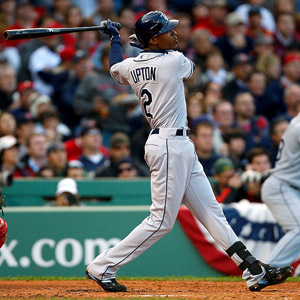 Tampa Bay Rays outfielder B. J. Upton Sunday had a day in which failure outgunned success. He struck out four times. After a walk, he was then picked off first (albeit making it to second anyway). And he missed a spectacular, but catchable catch in the ninth inning.