
Concerning Life as It Is Supposed to Be

Month: July 2011

John Stott, 1921-2011

Today, God added one more saint to his cloud of witnesses. And somehow, though I never met him, I feel a sense of loss. When asked to list those Christians living and dead who have had the most significant impact upon my ministry, the name of John R. W. Stott has always seemed to come up. If his name is unfamiliar to you, you can read an obituary here.

My first exposure to Stott came in college through his book Basic Christianity. I was already a Christian but found his careful expression of the Christian faith something that deepened and solidified my own commitment. And I remember clearly his respectful invitation to non-Christians to read and give consideration to what he was saying. He invited them to hear, he did not hound them to believe.

In 1979, Barb and I had the privilege of attending the Inter-Varsity Urbana Missions Convention where John Stott lectured daily on the book of Romans. A rich theological and biblical foundation was being laid for me day after day. And though I cannot today tell you anything he said I can say that I ‘caught’ through that an attitude of respect for the Bible and a love for the importance of a Biblical theology. Stott modeled that.

Shortly thereafter I plunged into Stott’s Christian Mission in the Modern World which gave my wife and I a sense of God’s heart for the whole world. We became persuaded that a career in missions was what God had in store for us. That persuasion led us to seminary where God turned my heart toward pastoral ministry. But that sense that the mission of God encompassed all peoples was not something that has ever left me.

As a preacher I have long learned to depend upon a series of commentaries Stott championed and called The Bible Speaks Today. His contribution to that series included a volume on Acts which came to me at a time when my vision for what the church was meant to be was maturing and expanding. I was not left the same.

And several times I have read his book on preaching, Between Two Worlds, and have been encouraged and challenged to persevere in what can be an exhausting and draining task. And those who have listened to me will appreciate the answer Stott gives to the question of how long a sermon should be: “It does not matter as long as it seems like twenty minutes.” Wise answer, that.

In 2004, NY Times columnist David Brooks penned a remarkable tribute to Stott. In an age when the news media would rush to find the most extreme examples of Christian thinking to comment on whatever issues were in the news, Brooks wondered why none ever thought to seek the insights and wisdom of a man who was the best representative of Christianity.

I came to Stott’s magnum opus, The Cross of Christ late. Having just preached on John 12:31 I feel a need to return to his mature reflections upon the central event of our Christian faith.

All this could be said about the influence of any scholar and model pastor upon a younger generation, I suppose. But there is something more. I cried shortly after reading about Stott’s death. It’s not that I have lost a friend. I never met him; how can I call him that? It’s not that I feel the church on earth is weakened by his absence; his influence has been minimal in recent years. Rather, I think I cried because of these words written by his associate and biographer Timothy Dudley-Smith and quoted by Justin Taylor:

He thinks of himself, as all Christians should but few of us achieve, as simply a beloved child of a heavenly Father; an unworthy servant of his friend and master, Jesus Christ; a sinner saved by grace to the glory and praise of God.

He modeled that for which I long: to know myself primarily “as a beloved child of a heavenly father.”

To whatever degree I am in the least bit able to live my life to the glory and praise of God, John Stott has played a role in that. I thank God for the privilege of falling under his influence.

+ + + + +

UPDATE: A good tribute is this from Don Sweeting, president of Reformed Theological Seminary in Orlando.

Seeing Red

I once had a conversation with a seller of Christian books and Bibles who had tried to explain to a publisher why he thought the publisher should publish less ‘red letter’ editions of the Bible. The publisher was so puzzled by this sentiment that it seemed to him my friend had come from Mars.

I’m not certain of the history of the practice of highlighting the ‘words of Christ in red’ in our Bibles, but I have for some time been troubled by the practice. If Jesus is fully God (which he is), and if the whole Bible is the Word of God (which it is), then if we really wanted to put Christ’s words in red we should just highlight the whole thing. To do otherwise suggests that the words which Jesus spoke on earth were just somehow more important and weightier than those which he spoke through David or Moses. That is dangerous.

It’s an impossible task anyway. Unfortunately for modern publishers, the Greek of the New Testament did not come with quotation marks. We will never in this life know for certain whether Jesus or John was responsible for saying, ‘For God so loved the world that he gave his one and only son….’ but that does not stop publishers from printing the whole in red.

The practice, though, is most odd when the words of Christ back up against the words of his heavenly Father as illustrated here.

Red Letter

The words of the incarnate Son, I suppose we are to understand, are of greater value than those of the non-incarnate Father. Very odd.

I’m not suggesting we toss our red letter bibles. I would, though, be delighted to see the demand for them diminish. That would be a message even publishers could understand.

Preaching Hell

Written well before any modern controversy, British commentator Bruce Milnepenned some wise words on the place of hell in Christian preaching. Worthy of reflection here are his comments on John 12:35, 36, a passage following a very rich presentation on the meaning of the cross.

So Jesus said to them, “The light is among you for a little while longer. Walk while you have the light, lest darkness overtake you. The one who walks in the darkness does not know where he is going. While you have the light, believe in the light, that you may become sons of light.” When Jesus had said these things, he departed and hid himself from them. (John 12:35, 36)

To this Milne says:

There is an urgency in this last appeal of Jesus from which the modern church does well to learn. The days when sermons on hell and its conditions were the staple diet of the evangelical pulpit have long since departed. Their going is not wholly to be regretted. Fear of hell-fire is certainly not the primary motive for seeking Christ’s salvation. Besides, such preaching often concentrated on the damnation of the lost in a manner that left the saved smugly secure and unchallenged concerning the profound moral and ethical implications of living a ‘saved’ life. We would not turn back the clock in this respect even if we could.

Yet the warning note which Jesus strikes here is always relevant. The implications of turning away from the light of God are terrible in the extreme, and Jesus is concerned that people be clearly aware of them. We are certainly to draw men and women towards God’s salvation by all God-honouring inducements. We are certainly authorized to bear witness with full hearts to the completeness of the salvation which Christ has won for sinners, and the joys beyond compare which await those who cast themselves upon his mercy.

In addition, however, we dare not fail to warn them that the Redeemer is also a judge, that sin unrepented is sin condemned, and that it is, and will be, when the king returns, ‘a dreadful thing to fall into the hands of the living God ‘ (Hebrews 10:31). While people have opportunity, we are to speak, and plead, as did our Saviour….

from Bruce Milne, The Message of John (Bible Speaks Today)

F.A.R.M. II

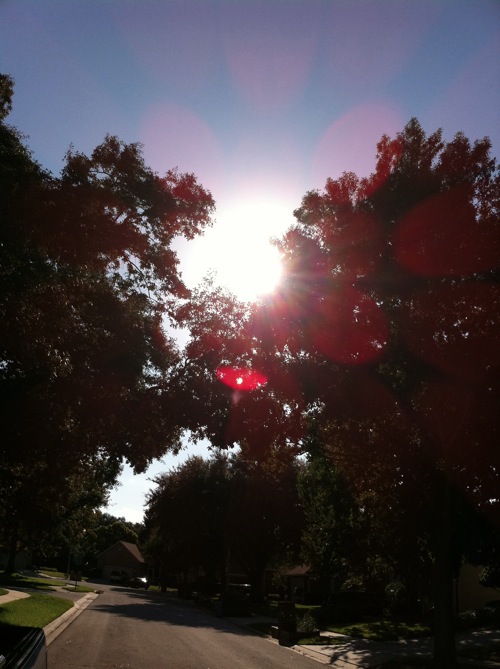
I have found another Florida Afternoon Run Motivator. Perhaps not pushing for speed, but certainly invites one outside.

FARM 3

However, today was a bit unusual. 85º and 51% humidity is not the norm for Central Florida late afternoons, but it was wonderful today. Of course, it does come with a de-motivator, pictured below.

FARM 4

F.A.R.M.

I’d really like to return to blogging. I really would. I’ve gotten as far as including on my weekly action list: “Schedule time slot for blogging.” But, alas, I’ve not gotten to that one yet. It will come.

So, here just a quick note on one dull area of my life. My running.

After the 5K run in April, I developed some knee soreness. I laid off the knee for a couple of months and have slowly returned to a regular routine. This was the first full week back at it.

(I’m feeling good enough that I’m fantasizing a 10K run. Someone please talk me out of it.)

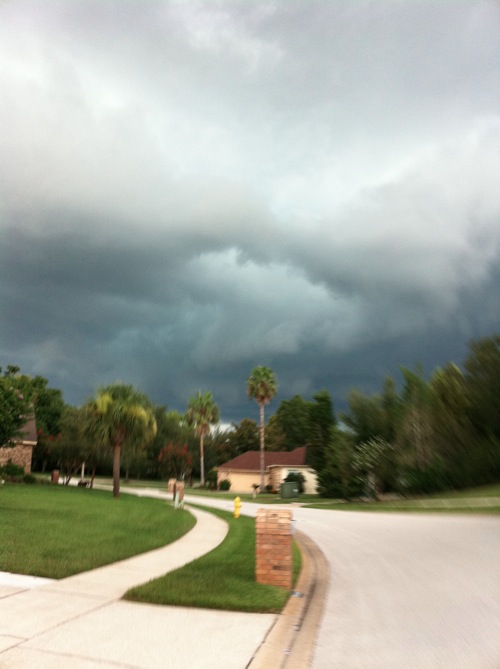
The accompanying picture (blurry because snapped while running) is what I have chosen to call a F.A.R.M. That is, a Florida Afternoon Run Motivator.

F.A.R.M.

It very nearly became a Florida Afternoon Run Terminator (the acronym is yours to imagine). I finished just before the lightning and rain.

Powered by WordPress & Theme by Anders Norén