Concerning Life as It Is Supposed to Be

Month: December 2008 Page 1 of 3

Rovings 12-31-2008

I have some great research assistants who push interesting articles too me through the week. Often, I don’t have time to read what I’m sent. But this week has produced some very interesting – and entertaining – fare.

Does everyone go to heaven, regardless of religion? Apparently, most people in America think so, as do most Christians.

Speaking of going to heaven, here is one guy who believes that he is not headed there. He is atheist by profession. And yet, he makes the best case for the necessity and impact of conversion that many of us have ever heard. As he reflects on his time living in Malawi he says this:

“In the city we had working for us Africans who had converted and were strong believers. The Christians were always different. Far from having cowed or confined its converts, their faith appeared to have liberated and relaxed them. There was a liveliness, a curiosity, an engagement with the world – a directness in their dealings with others – that seemed to be missing in traditional African life. They stood tall.”

And finally, if you’ve ever had the kind of ‘fun’ I’ve had in dealing with a phone company, you will appreciate this. One of my best friends was once one of those guys you would get on the phone if you called Verizon. He was the exception to the rule.

(If you are required to register with the NYTimes to read the articles, do so. Registration is free.)

I trust you all will have a Happy New Year! We will be celebrating at Busch Gardens to live music and then a synchronized fireworks display which, a couple years ago, ended with “Joy to the World” accompanied with fireworks. No knowing if the designer of the display meant anything by it, but it gave me chills!


Christmas Pictures

The pictures from our Christmas morning are back from the developers. Here are some sample shots of those who gathered in our living room for that delightful morning.

Of Calvin, Calvinists and Violins

Deserved or not, to some the word ‘Calvinist’ conveys the imagery of stubborn, graceless, coldly logical Christians who expect everyone but themselves and a select few others to be in hell. That’s a shame, because by that characterization, many, including John Calvin, would make rather poor Calvinists!

John Calvin was a man of deep scholarship and deeper piety. He understood joy and he understood suffering. He had a deep passion for the glory of God and a deep compassion for the plight of men. He was one who knew what it meant to be a Christian, what it meant to live as a Christian, and had that rare giftedness which enabled him to convey with clarity what he knew.

Calvin’s Institutes of the Christian Religion has been enshrined in two lists:

1) as one the Great Books of western civilization and

2) as one of the books which, therefore, almost no one reads.

That is a great loss. I read the institutes a number of years ago, and found the experience deeply, deeply rewarding. Calvin’s insights into the Christian life still resonate with me, and I have returned to him often and recommended passages to others.

A friend has put me on to an organization which is encouraging others to join with them in reading through Calvin in 2009. You can get the details here. Even if you do not commit to read through this in a year, if you request one, the folks at this site will send you a reading schedule which has broken down Calvin’s massive book into bitesized portions. That would be worth having, even if you read the book at a slower pace.

Now, what about violins?

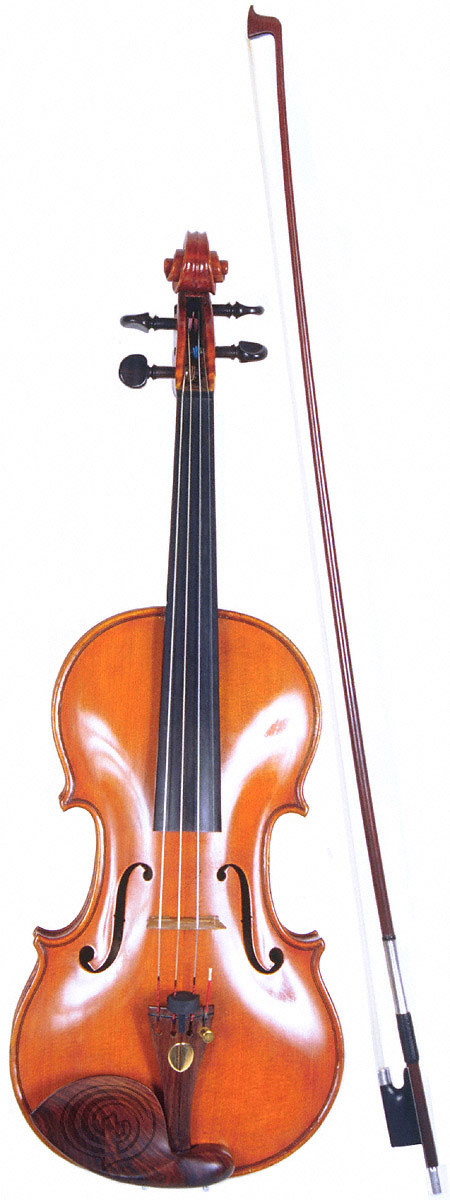
When a child begins to learn a musical instrument, many parents make what is to me a grave mistake. They provide their child with an inferior (i.e. ‘cheap’) instrument. While this makes good economic sense, the child, unskilled to begin with, will meet early frustration because he just won’t be able to make the instrument sound good. I think that a good instrument, more costly at the outset, will pay rich rewards as it will be that much easier to learn, easier to play, and more likely to keep the child’s interest.

If you decide to read Calvin, you have the same options before you. You can lay hands on an inexpensive translation (Beveridge) and think that you have stumbled upon a bargain. But the translation is old, tedious, and dry, and you will bog down quickly. Your reading will not sing.

I would suggest that instead you take on this noble task with a worthy instrument. Spend the money and buy the Ford Lewis Battles translation. It is modern, well annotated, and well bound. It stands a much greater chance of keeping your interest.

Does it matter if she is a Christian?

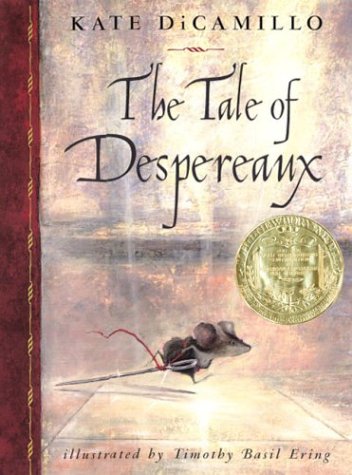
I know very, very little about Kate DiCamillo other than what I have read in her book The Tale of Despereaux referenced here, and a few things that I’ve picked up along the way (that she used to work at Half-Price Books is of particular interest to my daughter-in-law who works at Half-Price Books). I know as well that she lives someplace cold and is single. That’s about it.

That’s her picture here. She has curly hair. But I don’t know her spiritual commitments.

Now, the passage I quoted earlier could be read to be a clear reference to the Christian’s understanding of Christ’s substitutionary atonement. Did she mean it? or am I right in seeing it there?

Irrelevant questions, those, ultimately.

I’d love to hear that this wonderful writer is a Christian. But at the level of her storytelling, it really does not matter. God has woven his character and his story into the fabric of the universe in a way that it is hard to avoid. And he sometimes graces unbelievers with such rich gifts of insight and expression that they cannot help but see it.

As she in this case simply notes that a mere ‘goodbye’ cannot hold a candle to a ‘let me die for you’, she need not be a Christian to observe this. She speaks truthfully and in her truthfulness, God gives us a gift.

My point should be obvious. If we read only those things written by those claiming to be Christians, we will miss some of the most wonderful insights that God himself has for his people.

This principle applies to music and other forms of art as well.

You agree?

The Tale of Despereaux

I have never heard before of Kate DiCamillo. If you have, why have you kept her a secret from me? I saw the movie Because of Winn-Dixie which was based upon the DiCamillo book of the same name, but the movie was so unimpressive that I did not feel impelled to run out and read the book. So, I have not known who she is.

Thankfully, Universal Studios has decided to turn her book The Tale of Despereaux into an animated feature. Colin, my eight year old son, and I saw a preview for it, and thought it would be a movie worth seeing. But first, it was suggested I read the book first.


Fortunately, Colin received the book for Christmas (what a surprise…) and we have started to read it. Let me say this – the book may make an unhappy turn at some point that will destroy everything, but to this point (about 1/3 through) the book is magical. She has us wondering whether there are still things such as happy endings (Colin thinks there are) and what the meaning of the word ‘perfidy’ is.

And to add intrigue to magic, we have the following passage. Despereaux, a small and unique mouse, is being sentenced to death for his breach of the mouse code. His French mother, Antoinette, who appears more show than substance, puts on what seems to be a display of sorrow as her son is led away. Here is how DeCamillo presents the scene:

At the last moment, Antoinette came out of her faint and shouted one word to her child.

That word, reader, was adieu.

Do you know the definition of adieu? Don’t bother with your dictionary. I will tell you.

Adieu is the French word for farewell.

“Farewell” is not the word that you would like to hear from your mother as you are being led to the dungeon by two oversize mice in black hoods.

Words that you would like to hear are “Take me instead. I will go to the dungeon in my son’s place.” There is a great deal of comfort in those words.

But, reader, there is no comfort in the word “Farewell,” even if you say it in French. “Farewell” is a word that, in any language, is full of sorrow. It is a word that promises absolutely nothing.

Well, reader, if you are a Christian, you know that the word we hear from our Father when facing our own eternal dungeon is not “farewell.” The words we here are “I will go in your place.” There is comfort there.

To see this spoken in a children’s story is a sublime joy.

On Church Music


Read this and ponder it carefully.

C. S. Lewis wrote this from within the mid-century worship wars (awful term) of the mid-Twentieth Century Anglican church of which he was a devoted member. (And you thought worship battles were a new phenomenon.)

I have highlighted the key phrase. There is enough here to give us all pause.

“The first and most solid conclusion which (for me) emerges is that both musical parties, the High Brows and the Low, assume far too easily the spiritual value of the music they want. Neither the greatest excellence of a trained performance from the choir, nor the heartiest and most enthusiastic bellowing from the pews, must be taken to signify that any specifically religious activity is going on. It may be so, or it may not….

“There are two musical situations on which I think we can be confident that a blessing rests. One is where a priest or an organist, himself a man of trained and delicate taste, humbly and charitably sacrifices his own (aesthetically right) desires and gives the people humbler and coarser fare than he would wish, in a belief (even, as it may be, the erroneous belief) that he can thus bring them to God. The other is where the stupid and unmusical layman humbly and patiently, and above all silently, listens to music which he cannot, or cannot fully, appreciate, in the belief that it somehow glorifies God, and that if it does not edify him this must be his own defect. Neither such a High Brow nor such a Low Brow can be far out of the way. To both, church music will have been a means of grace; not the music they have liked, but the music they have disliked. They have both offered, sacrificed, their taste in the fullest sense. But where the opposite situation arises, where the musician is filled with the pride of skill or the virus of emulation and looks with contempt on the unappreciative congregation, or where the unmusical, complacently entrenched in their own ignorance and conservatism, look with the restless and resentful hostility of an inferiority complex on all who would try to improve their taste – there, we may be sure, all that both offer is unblessed and the spirit that moves them is not the Holy Ghost….

“All our offerings, whether of music or martyrdom, are like the intrinsically worthless present of a child, which a father values indeed, but values only for the intention.”

– C. S. Lewis, “On Church Music”

I have for so long believed in the ideal that Christians can love each other across musical tastes. Perhaps I hope for too much.

Heavy Cello – the New Music Genre

I mentioned recently the ‘irrepressible gift of music’. It’s more irrepressible than I might have imagined.

Apparently, four guys met at an elite Finnish music conservatory. They shared a love for classical music and for heavy metal. They were cellists. That is apparently a volatile mix, for what you end up with is shown below.

This is not for the faint of heart. But you have to see it to believe it.

Look, (Yo-Yo) Ma, no electric guitar!

I am wondering about their parents – sending their boys off to the conservatory, picturing them someday playing concerti with major orchestras. There’s a story there somewhere.

Thanks to Matthew for putting me on to these guys.

Alongside Us

“For the Son of God, the incarnation meant a whole new set of relationships: with his father and mother; with his brothers and sisters; with his disciples; with the scribes, the Pharisees and the Sadducees; with Roman soldiers and with lepers and prostitutes. It was within these relationship that he lived his incarnate life, experiencing pain, poverty, and temptation; witnessing squalor and brutality; hearing obscenities and profanities and the hopeless cry of the oppressed. He lived not in sublime detachment or in ascetic isolation, but ‘with us’, as ‘the fellowman of all men’, crowded, busy, harassed, stressed and molested. No large estate gave him space, no financial capital guaranteed his daily bread, no personal staff protected him from interruptions and no power or influence protected him from injustice. He saved us from alongside us.”

– Donald MacLeod, The Person of Christ, page 180


I know this is not easily a merry Christmas for all of you. I know that some of you face Christmas this year with loss and hurt and confusion and frustration and sadness and loneliness and fear.

Jesus knew these things, too.

So, may you find this Christmas blessed because of the One who came to save us from alongside us.

Rovings 12-24-2008

A Jewish blogger, who likes Christmas and expects our culture to make a big deal out of it, noted last week something I did not know – that some of our favorite Christmas songs were written by Jews. Curious

I commented Sunday that South Florida suffers under something of a reverse Narnia curse. In Narnia, if you do not know, the White Witch kept Narnia under a spell where it was always winter and never Christmas. (And if you did not already know that, I hope that Santa brings you The Chronicles of Narnia by C. S. Lewis.) In Florida it is occasionally Christmas and NEVER winter. This bothers me now and then, but on the other hand….

Apple may have lost some of my admiration due to some hardware problems (I’ve replaced now my battery, hard drive, keyboard, and power adapter – what’s left?), but they still hit home runs with their ads (and service has been helpful).

A better audio/video version of this may still be visible at the Apple site.

Chik-fil-Cheer

As most of you know, I write the bulk of my posts at a local Chik-fil-A. My son and grandson (a mere four years apart) play in the play area and I write. It’s weird, but it works.

We come on ‘family night’, and usually there is some kind of kid’s activity going on, usually harmless, sometimes irritatingly noisy and obtrusive. But tonight, it was different.

Tonight, there were two guys on guitar and keyboard playing all kinds of Christmas music. At times, it sounded like we were in a saloon (the keyboardist has that style down, especially on Rudolph!) and at other times in a church. Everything from ‘Feliz Navidad’ to ‘O Holy Night’ to ‘Angels We Have Heard on High’ have been played with great skill.

Makes me want to burst into song. Or at least into a big smile.

Bless these guys. And bless God for the irrepressible gift of music.

—–

UPDATE: after typing that, I spoke with them and found at they play regularly at the Bradenton Christian Reformed Church (thanks Steve and Joel!)

Page 1 of 3

Powered by WordPress & Theme by Anders Norén